
PEI sales tax credit: renamed the PEI Essentials Benefit, with a $175 minimum
Short answer
The PEI sales tax credit pays up to $310 a year for an individual, plus $55 for a spouse, common-law partner or eligible dependant, for a maximum of $365. Beginning November 2026 it is renamed the Prince Edward Island Essentials Benefit (PEIEB) and gets a new minimum payment of $175 for every qualifying resident. It is paid quarterly with the federal Canada Groceries and Essentials Benefit.
- 01Current maximum
- $310 individual; $365 couple or single parent
- 02New name
- PEI Essentials Benefit, beginning November 2026
- 03New minimum
- $175 a year for all qualifying residents
- 04Paid with
- The quarterly Canada Groceries and Essentials Benefit
- 05PEI Child Benefit
- $34.16 a month per child under $45,000 income; $24.16 from $45,000 to $80,000
What is changing with the PEI sales tax credit?
The PEI sales tax credit is being renamed the Prince Edward Island Essentials Benefit (PEIEB) beginning November 2026, according to the Canada Revenue Agency (CRA). The province describes the new benefit as broader support for essential household costs, not only an offset for sales tax.
The practical change is a new minimum. Every Island resident who qualifies will receive at least $175, regardless of income. Under the old sales tax credit, higher-income residents could receive a small amount or nothing.
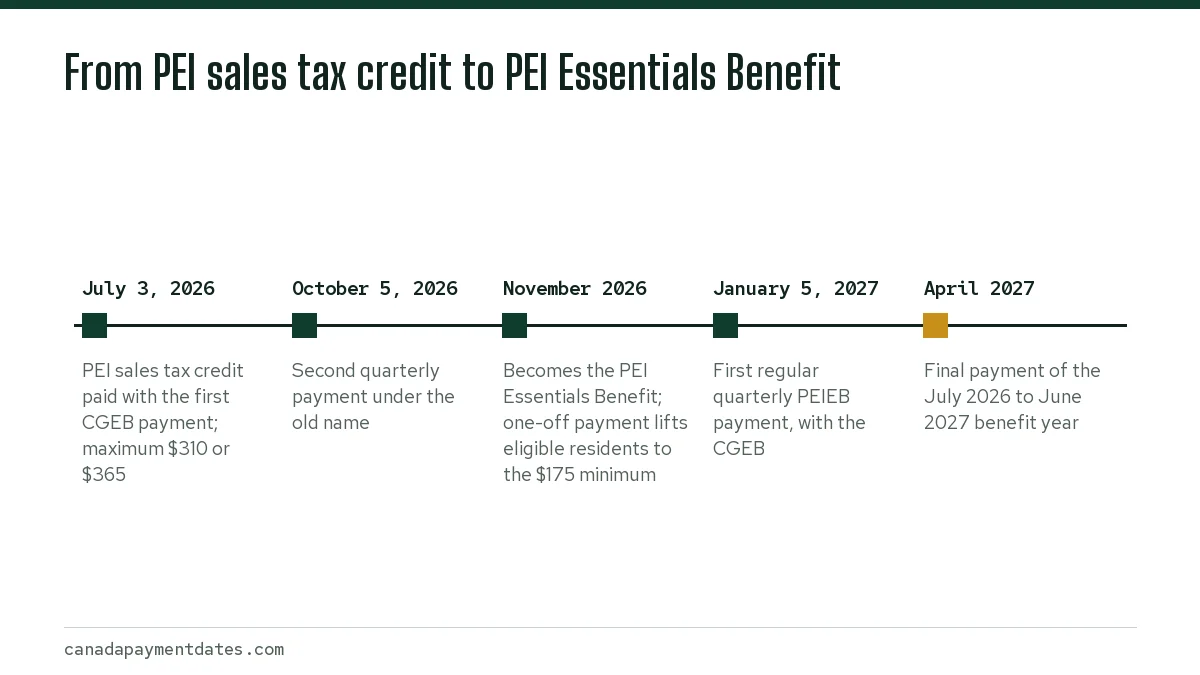
The CRA filled in the details on its Prince Edward Island programs page on October 15, 2026. It says the PEIEB replaces the sales tax credit starting November 2026, that the July and October 2026 payments were issued under the old sales tax credit, and that the $175 minimum applies from July 1, 2026. The maximums for July 2026 to June 2027 stay at $310 for a single person and $365 for a couple or single parent.
How much is the PEI sales tax credit now?
For the July 2026 to June 2027 benefit year, the CRA's guide to the Canada Groceries and Essentials Benefit lists the PEI sales tax credit as $310 a year for an individual, plus $55 if you have a spouse, common-law partner or eligible dependant. That gives a maximum of $365 for a couple or a single parent.
| Household | Maximum per year | Per quarterly payment |
|---|---|---|
| Single adult | $310 | $77.50 |
| Couple (spouse or common-law partner) | $365 | $91.25 |
| Single parent with an eligible dependant | $365 | $91.25 |
Unlike New Brunswick's HST credit, the PEI credit does not add an amount for each child. A couple with four children has the same $365 maximum as a couple with none. Instead of a reduction rate, the CRA now lists income bands: the full amount applies up to $95,000 of adjusted family net income (AFNI), it shrinks to $175 between $95,000 and $108,500 for a single person or $114,000 for a couple or single parent, and anyone above those levels gets the $175 minimum. Check your CGEB notice for the exact amount calculated for you.
What the $175 minimum means in practice
Take a hypothetical Summerside couple whose income is high enough that the old credit had shrunk to $60 a year. Once the PEIEB minimum applies, their benefit rises to at least $175. The minimum works as a floor that lifts smaller amounts up to $175; the CRA describes the change as increased support.
When is the PEI Essentials Benefit paid?
The PEI credit is paid four times a year together with the federal Canada Groceries and Essentials Benefit (CGEB), the payment that replaced the GST/HST credit in July 2026. The 2026 quarterly payments were made on July 3 and October 5 under the old sales tax credit name. From January 2027 the PEIEB follows the regular CGEB schedule, which the CRA's CGEB guide sets for January 5 and April 5, 2027.
The changeover adds a one-off payment in November 2026. Eligible residents whose yearly amount would have been under $175 receive the $175 minimum that month. A single person with AFNI above $108,500, or a couple or single parent above $114,000, is paid in July, October and November 2026 instead of January and April; above $126,000 (single) or $131,500 (couple or single parent), the November payment is the only one. The federal calendar is on CGEB payment dates.
How much is the PEI Child Benefit?
The PEI Child Benefit (PEICB) is a separate, tax-free monthly payment for children under 18, paid with the Canada Child Benefit rather than the CGEB. For July 2026 to June 2027 it pays $34.16 a month per child when adjusted family net income (AFNI) is under $45,000, and $24.16 a month per child when AFNI is between $45,000 and $80,000.
| Adjusted family net income | Per child per month | Two children per year |
|---|---|---|
| Under $45,000 | $34.16 | $819.84 |
| $45,000 to $80,000 | $24.16 | $579.84 |
| Above $80,000 | Reduces to zero | Check your notice |
The PEICB arrives on the CCB date, so after the October 20 payment, the remaining 2026 payments are November 20 and December 11. It reaches much further up the income scale than Nova Scotia's child benefit, which stops at $34,000.
Worked example: a PEI family's provincial payments
A Charlottetown couple with two children and 2025 AFNI of $60,000 would receive the following provincial amounts in the July 2026 to June 2027 year:
- PEI Child Benefit: 2 x $24.16 = $48.32 a month with the CCB, or $579.84 for the year.
- PEI sales tax credit: up to $365 before any income reduction, paid in quarterly CGEB instalments.
- From the PEI Essentials Benefit change onward: never less than $175 for the year.
The same pattern of one child benefit plus one quarterly credit is used in New Brunswick; see New Brunswick Child Tax Benefit. Saskatchewan pays only a quarterly credit, covered on Saskatchewan Low-Income Tax Credit, and Manitoba runs its child benefit itself; see Manitoba Child Benefit.
What to do if your PEI payment looks wrong
- Compare the deposit with your notice: the provincial credit is listed separately from the federal CGEB amount.
- If a CGEB payment has not arrived, wait 10 working days after the payment date before contacting the CRA.
- If you receive less than $175 in a year once the PEIEB is in effect, ask the CRA to confirm how your amount was calculated.
- If you moved to or from PEI, confirm the CRA has your current province, since provincial credits follow residency.
All Atlantic and western provincial payments are listed on provincial and territorial benefits.
Common questions
What is the PEI Essentials Benefit?
It is the new name for the PEI sales tax credit, beginning November 2026. It keeps being paid by the CRA with the federal Canada Groceries and Essentials Benefit and adds a minimum payment of $175 for every qualifying resident.
How much is the PEI sales tax credit?
Up to $310 a year for an individual, plus $55 for a spouse, common-law partner or eligible dependant, for a maximum of $365.
Do I have to apply for the PEI Essentials Benefit?
No. The CRA considers you automatically when you file your tax return as a PEI resident.
Does the PEI sales tax credit increase for each child?
No. It has an amount for the individual and one additional $55 amount for a spouse or eligible dependant. Children are supported through the separate PEI Child Benefit.
Who gets the PEI Child Benefit?
PEI families with children under 18 who receive the Canada Child Benefit. It pays $34.16 a month per child below $45,000 of family income and $24.16 between $45,000 and $80,000.
Sources
- CRA: Province of Prince Edward Island programs canada.ca
- CRA RC4210: Canada Groceries and Essentials Benefit canada.ca
- CRA: CGEB payment dates canada.ca
We check figures against these official pages. Rules change; confirm anything that affects a deadline or payment with the agency before you act.
Tell us what happened
Describe your situation and our editors will use it to improve this guide. If you leave your email, we may reply with a pointer to the right page or official contact. We never share your details.
Related guides
 Provincial Benefits Paid With the CCB and CGEB, by Province
Most provincial and territorial benefits in Canada are paid by the Canada Revenue Agency inside a federal payment: child benefits…
Saskatchewan Low-Income Tax Credit: Amounts and Dates
The Saskatchewan Low-Income Tax Credit (SLITC) pays $460 per adult and $181 per child (up to two children), to a family maximum o…
New Brunswick Child Tax Benefit and HST Credit Amounts
The New Brunswick Child Tax Benefit (NBCTB) pays $20.83 a month for each child under 18, inside the Canada Child Benefit deposit,…
Manitoba Child Benefit: Up to $35 a Month per Child
The Manitoba Child Benefit (MCB) pays up to $35 a month, or $420 a year, for each child under 18 in lower-income Manitoba familie…
CGEB Payment Dates: Groceries and Essentials Benefit Days
Canada Groceries and Essentials Benefit payment dates for the first benefit year are July 3, 2026, October 5, 2026, January 5, 20…