
Topic
Canada Child Benefit guide: dates, amounts and who qualifies
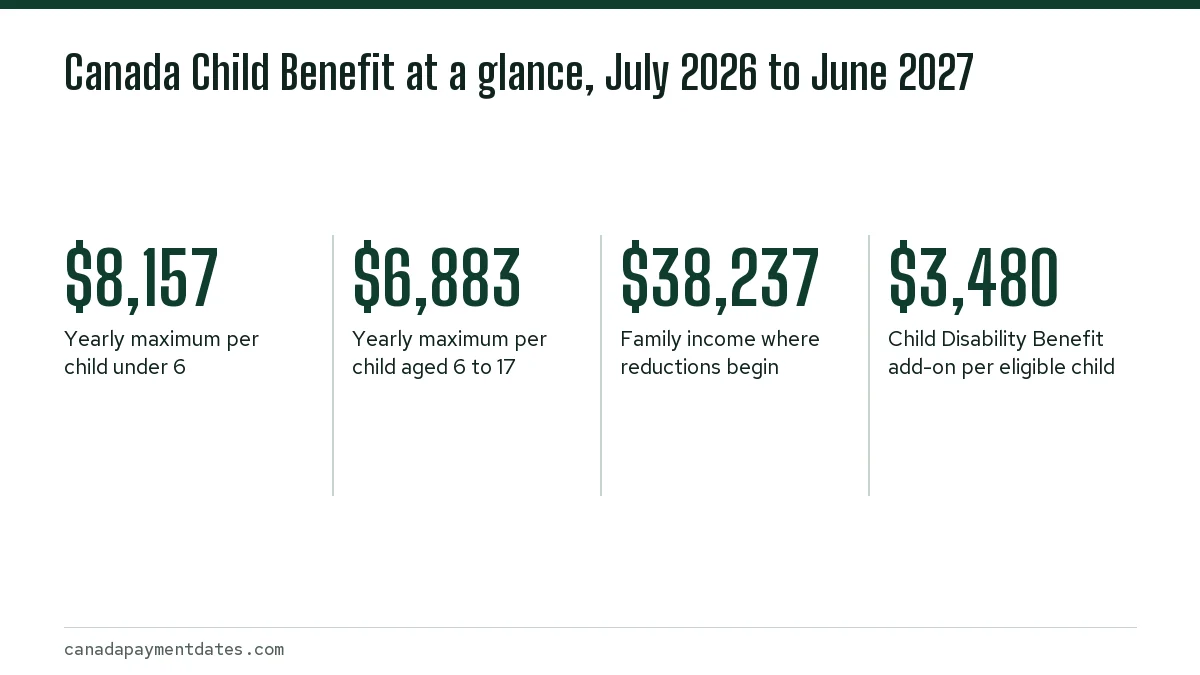
The Canada Child Benefit (CCB) is a tax-free monthly payment from the Canada Revenue Agency to families raising children under 18. From July 2026 to June 2027 it pays up to $8,157 a year for each child under 6 and $6,883 for each child aged 6 to 17, reduced as family income rises. Most 2026 payments land on the 20th, with December paid early on the 11th.
12 guides in this topic Updated October 20, 2026
- At What Age Does CCB Stop? Last Payment at 18, Drop at 6At what age does CCB stop? The Canada Child Benefit, still often called the child tax benefit, stops when a child turns 18. The CRA pays the month of…
- CCB Calculator: Estimate Your Canada Child Benefit PaymentThis Canada child benefit calculator estimates your CCB for July 2026 to June 2027. Enter your 2025 adjusted family net income, the number of childre…
- CCB Eligibility for Work Permit Holders and Other NewcomersCCB eligibility for work permit holders begins once you have lived in Canada throughout the previous 18 months and hold a valid permit in the 19th mo…
- CCB Eligibility: Who Can Get the Canada Child BenefitCCB eligibility depends on five conditions, all of which must be met: you live with a child under 18, you are primarily responsible for the child's c…
- CCB Increase: July 2026 Amounts and the July 2027 UpdateThe latest CCB increase took effect with the July 20, 2026 payment: the yearly maximum rose by $160 to $8,157 per child under 6 and by $135 to $6,883…
- CCB Payment Dates 2026, and When the 2027 Dates Are PostedCCB payment dates in 2026 fall on the 20th of each month unless the 20th is a weekend, in which case the CRA pays on the Friday before. The October 2…
- CCB Shared Custody: How the 50/50 Split Works for ParentsCCB shared custody means a child lives with each parent 40% to 60% of the time. Both parents apply, and each receives 50% of the Canada Child Benefit…
- Can I Receive CCB While Outside Canada? Trips and MovesCan I receive CCB while outside Canada? Yes, as long as you remain a resident of Canada for tax purposes. Families on holiday, a work assignment or a…
- Can You Get CCB Retroactively? Back Pay Up to 10 YearsCan you get CCB retroactively? Yes, for months up to 10 years back. If you applied late, filed a tax return late, or had a child approved for the dis…
- Child Disability Benefit: Up to $290 a Month Paid With CCBThe Child Disability Benefit (CDB) is a tax-free supplement of up to $3,480 a year, or $290 a month, for each child under 18 who is approved for the…
- Does CCB Count as Income? Is CCB Taxable? No to BothIs CCB taxable? No, and the CCB does not count as income on your tax return. The CRA describes the Canada Child Benefit as a non-taxable amount, so y…
- How Much Is CCB per Child? July 2026 to June 2027 AmountsHow much is CCB per child? From July 2026 to June 2027, the Canada Child Benefit pays up to $8,157 a year ($679.75 a month) for each child under 6 an…
How the Canada Child Benefit works
The Canada Child Benefit is a monthly, tax-free payment that the CRA sends to the parent or caregiver who is primarily responsible for a child under 18. It is not a loan and it does not have to be spent on anything in particular. The CRA calculates it from the family's tax returns, so there is no separate income form to send each year.
Each benefit year runs from July to the following June. The amount you get from July 2026 to June 2027 is based on your 2025 adjusted family net income, which is line 23600 of your return plus line 23600 of your spouse's or common-law partner's return, with a few adjustments for UCCB and RDSP income. When the new benefit year starts in July, your monthly amount is recalculated.
Three things set the payment: how many children you have, how old each child is, and your family income. A family with income under $38,237 gets the full amount. Above that, the benefit is reduced gradually, which is why a family earning $150,000 with several young children can still receive a monthly payment.
CCB payments in 2026: every date
The CRA pays the CCB once a month, normally on the 20th. When the 20th falls on a weekend, the payment moves to the last business day before it. December is the exception: the CRA pays it earlier in the month before the holidays.
| Month | Payment date | Day |
|---|---|---|
| January | January 20 | Tuesday |
| February | February 20 | Friday |
| March | March 20 | Friday |
| April | April 20 | Monday |
| May | May 20 | Wednesday |
| June | June 19 | Friday |
| July | July 20 | Monday |
| August | August 20 | Thursday |
| September | September 18 | Friday |
| October | October 20 | Tuesday |
| November | November 20 | Friday |
| December | December 11 | Friday |
The official 2027 CCB dates have not been published yet. For the monthly pattern, the early December payment and a labelled projection for 2027, see our CCB payment dates page. If a deposit does not show up, the CRA asks you to wait 5 working days before contacting it; our page on a CCB payment not received lists what to check first.
Canada Child Benefit amount for July 2026 to June 2027
The maximum rose in July 2026 because the CCB is indexed to inflation each July. Compared with the previous benefit year, the cap went up by $160 per child under 6 and $135 per child aged 6 to 17, according to the Government of Canada's July 2026 announcement.
| Child's age | Per year | Per month |
|---|---|---|
| Under 6 | $8,157 | $679.75 |
| 6 to 17 | $6,883 | $573.58 |
| Child Disability Benefit add-on (eligible child) | up to $3,480 | up to $290 |
The maximum is paid when adjusted family net income is $38,237 or less. Between $38,237 and $82,847, the reduction is 7% of income over the first threshold for one child, 13.5% for two, 19% for three and 23% for four or more. Above $82,847 a smaller percentage applies on top of a fixed amount. Our CCB amount per child page works through four family examples, and the CCB calculator lets you run your own numbers.
Who can get the CCB?
To qualify you must meet every one of these conditions at the same time. Missing any one of them means no payment for that month, even if the others are met.
- You live with a child under 18.
- You are primarily responsible for the child's care and upbringing, such as supervising daily activities, arranging child care and making sure medical needs are met.
- You are a resident of Canada for tax purposes.
- You or your spouse or common-law partner is a Canadian citizen, permanent resident, protected person, someone registered or entitled to be registered under the Indian Act, or a temporary resident who has lived in Canada for the previous 18 months and holds a valid permit in the 19th month.
- The child is not a foster child for whom a Children's Special Allowance is already paid.
When both parents live in the same home, the CRA presumes the female parent is primarily responsible, so she is normally the one who applies. The CCB eligibility guide covers the exceptions, and families who are new to Canada can read the separate page on CCB for work permit holders for the 18-month rule.
How to apply for CCB payments
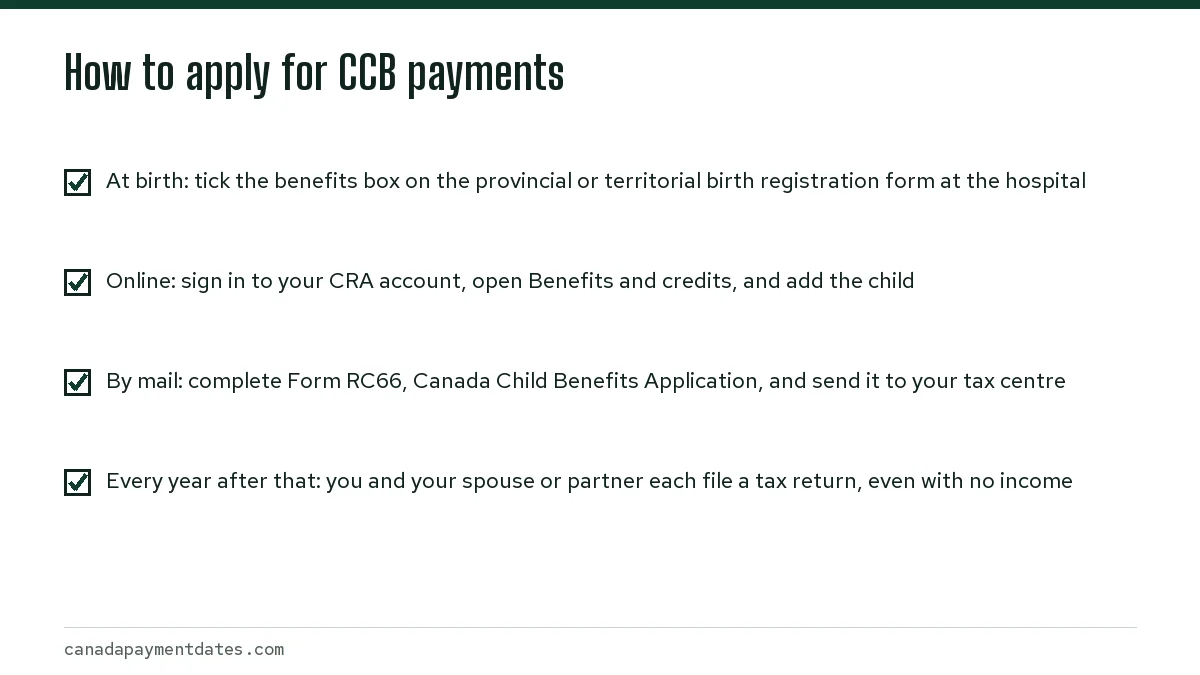
Apply as soon as a child is born, starts living with you, or you become eligible. Waiting does not raise the amount, and requests for more than 11 months back need extra documents.
- At birth: tick the benefits box on the provincial or territorial birth registration form at the hospital or birthing centre (not available in Nunavut). This sends your application to the CRA automatically.
- Online: sign in to your CRA account, open Benefits and credits, and add the child. This is the faster route for adopted children, children moving in with you, and custody changes.
- By mail: complete Form RC66, Canada Child Benefits Application, and send it to your tax centre. Newcomers and some temporary residents also attach Schedule RC66SCH, Status in Canada and Income Information.
- Every year after that: you and your spouse or partner each file a tax return, even with no income, so the CRA can recalculate the benefit in July.
Provincial child benefits paid with the CCB
Several provinces and territories run their own child benefit and have the CRA add it to the federal payment. You do not apply separately; the CRA uses the same CCB application and the same income figure.
| Province | Program | Maximum | Income where it starts to drop |
|---|---|---|---|
| Ontario | Ontario Child Benefit | $146.66 a month per child | $26,865 |
| Nova Scotia | Nova Scotia Child Benefit | $127.08 a month per child | Partial between $26,000 and $34,000 |
| Newfoundland and Labrador | NL Child Benefit | $157.33 first child, more for later children | $20,397 |
| New Brunswick | NB Child Tax Benefit | $20.83 a month per child | $20,000 |
| Prince Edward Island | PEI Child Benefit | $34.16 a month per child | $45,000 (lower rate to $80,000) |
Alberta is different: the Alberta Child and Family Benefit is paid four times a year (February, May, August and November) rather than on the CCB date. See the Ontario Child Benefit page for Ontario detail.
Changes that affect your CCB payments
Most payment surprises come from a change the CRA did not know about, or one it learned about late. Report these through your CRA account as soon as they happen.
Marital status
Moving in with a partner, marrying, separating or being widowed changes which incomes are combined. A new partner's income can lower the payment, and a separation can raise it. Tell the CRA by the end of the month after the change.
Custody and living arrangements
If a child lives with each parent between 40% and 60% of the time, both parents apply and each gets half of what they would receive with full custody. Less than 40% of the time with you means you are not eligible for that child.
Moving, leaving Canada or a child turning 18
Update your address and province, because provincial add-ons follow the province you live in. Payments for a child end around the child's 18th birthday; our page on when CCB stops gives the timing. Leaving Canada can end eligibility if you stop being a resident for tax purposes.
Not filing a return
If either spouse misses the annual return, the July recalculation cannot happen and payments usually stop until the return is assessed.
Common questions
How much is the Canada Child Benefit per month?
For July 2026 to June 2027 the monthly maximum is $679.75 for a child under 6 and $573.58 for a child aged 6 to 17. You get the full amount only if your adjusted family net income is $38,237 or less; above that it is reduced.
When is the next CCB payment?
The next CCB payment is November 20, 2026, followed by December 11; the October payment was issued on October 20. The 2027 dates are not yet announced; the CRA normally posts the next year's calendar late in the year.
Is the Canada Child Benefit taxable?
No. The CCB is tax-free and you do not report it as income on your return.
Do I need to reapply for CCB every year?
No. You apply once per child. What you must do every year is file a tax return, and your spouse or common-law partner must file too, so the CRA can recalculate the amount each July.
Can a father get the Canada Child Benefit?
Yes. A father can apply if he is the parent primarily responsible, for example as a single parent or in a shared custody arrangement. If both parents live together, the father applies only with a signed letter from the female parent stating that he is primarily responsible.
What is the difference between the CCB and the Child Disability Benefit?
The Child Disability Benefit is an extra amount, up to $3,480 a year for 2026-27, added to the CCB for a child who qualifies for the disability tax credit. It is paid on the same day as the CCB.