
CCB eligibility: the rules for getting the Canada Child Benefit
Short answer
CCB eligibility depends on five conditions, all of which must be met: you live with a child under 18, you are primarily responsible for the child's care, you are a resident of Canada for tax purposes, you or your partner meets the citizenship or immigration test, and the child is not covered by a Children's Special Allowance. There is no fixed income cap; income only sets the amount.
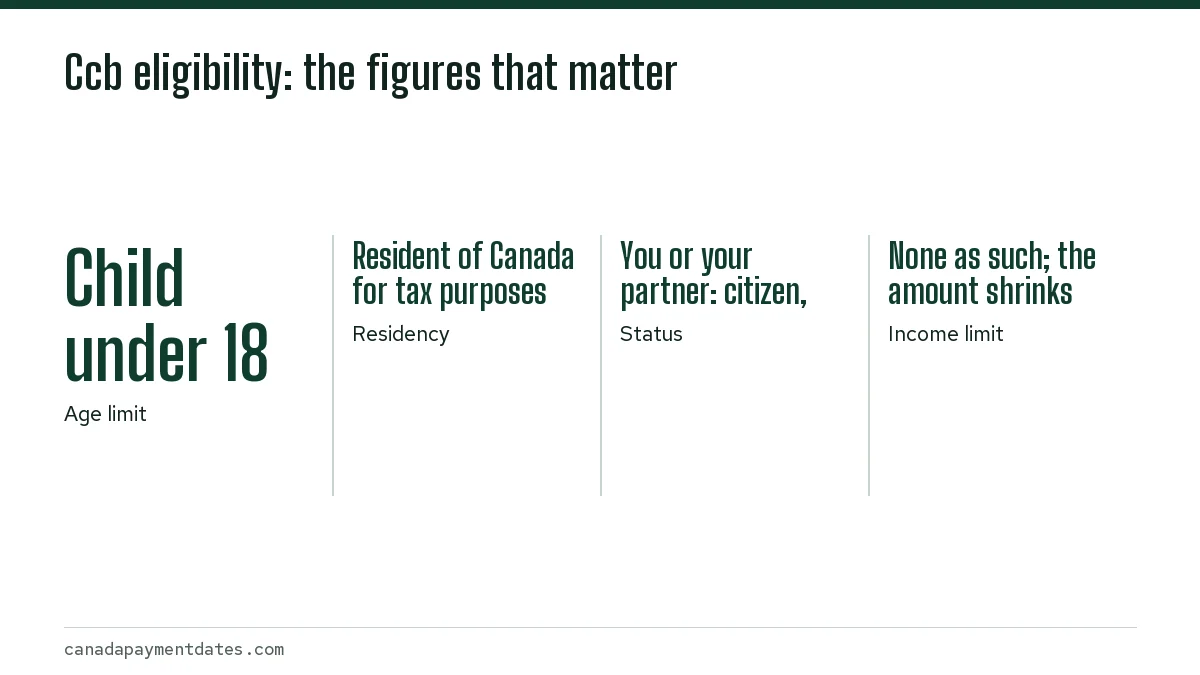
- 01Age limit
- Child under 18
- 02Residency
- Resident of Canada for tax purposes
- 03Status
- You or your partner: citizen, PR, protected person, Indian Act, or qualifying temporary resident
- 04Income limit
- None as such; the amount shrinks as income rises
- 05Payments start
- The month after the month you become eligible
- 06Who applies in a two-parent home
- The female parent, unless she signs a letter naming the other parent
CCB eligibility requirements: the five tests
The CRA checks CCB eligibility month by month. If you meet all five conditions in a month, you can be paid for that month; if one stops being true, payments stop from that point. Here is what each test means in practice.
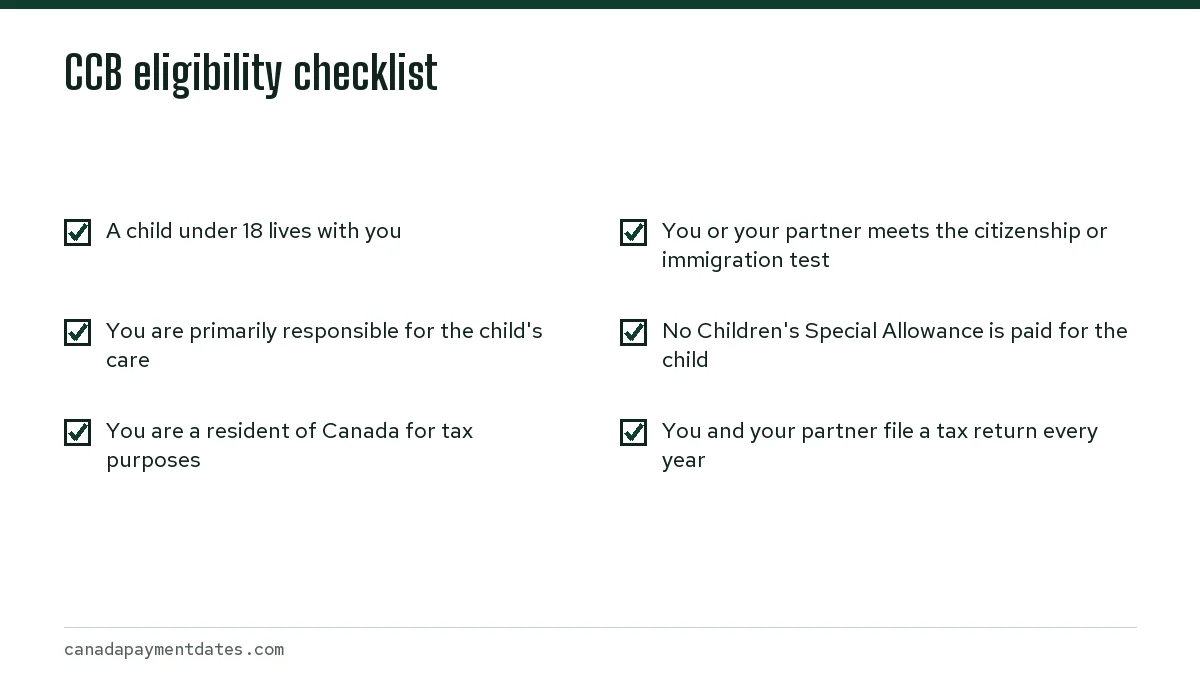
1. You live with a child under 18
The child must live with you, not just be your child. A parent who pays support but whose child lives elsewhere full time is not eligible for that child. The child can be your biological or adopted child, a grandchild, a relative's child, or another child in your care.
2. You are primarily responsible for the child
The CRA looks at who actually does the parenting: supervising daily activities and needs, making sure medical needs are met, and arranging child care when needed. Legal guardianship alone is not the test.
3. You are a resident of Canada for tax purposes
You must normally live in Canada and have significant residential ties, such as a home here or a spouse and dependants living here. Someone who has moved abroad and cut those ties loses eligibility even if they still hold Canadian citizenship.
4. You or your spouse meets the status test
Only one of the two partners needs to meet this test. The qualifying categories are listed in the next section.
5. No Children's Special Allowance for the child
Children in care of an agency for whom a Children's Special Allowance is paid cannot also be claimed for the CCB. This mainly affects foster placements. A child placed with a grandparent, another relative or a close friend under a kinship or close relationship program can still be claimed, as long as no Children's Special Allowance is payable for that child.
Canada child benefit eligibility and immigration status
You, or your spouse or common-law partner, must fall into one of these groups. It does not matter which of you meets it, and the child's own status is not part of the test.
| Status | What the CRA requires |
|---|---|
| Canadian citizen | No extra condition |
| Permanent resident | No extra condition |
| Protected person | A positive decision from the Immigration and Refugee Board; a claim still in progress does not count |
| Registered or entitled under the Indian Act | No extra condition |
| Temporary resident | Lived in Canada throughout the previous 18 months and holds a valid permit in the 19th month; a permit marked 'does not confer status' does not count |
The temporary resident rule has its own details, including what happens when a permit expires and which permits do not count. Our page on CCB for work permit holders covers them step by step.
Who should apply: the female parent presumption
When a child lives with both parents in the same home, the CRA presumes the female parent is primarily responsible for all the children. She is the one who should apply, and the payment goes to her. The CRA issues one CCB payment per household, and the amount is the same whichever parent receives it.
The other parent can apply instead if the female parent signs a letter stating that the other parent is primarily responsible, and the letter is attached to the application. For same-sex couples, one parent applies for all the children in the home.
Separated or shared custody
- Child lives with you more than 60% of the time: you apply.
- Child lives with each parent 40% to 60% of the time: both parents apply and each receives half the amount they would get with full custody.
- Child lives with you less than 40% of the time: you are not eligible for that child.
- Temporary stays: apply only for the period the child actually lives with you.
For how the 50% split and custody changes are handled, see the page on CCB and shared custody.
When does CCB entitlement start, and how do you apply?
Because eligibility is checked month by month, timing matters. The CRA pays the CCB from the month after the month you become eligible, for example the month after your baby is born or a child starts living with you, and entitlement stops the month after the child is no longer in your care. Apply as soon as you qualify, using one of three routes:
- At birth registration: the mother of a newborn can consent on the provincial or territorial birth registration form to share her information with the CRA (the Automated Benefits Application, available everywhere except Nunavut).
- In your CRA account: under Benefits and credits, apply for child benefits and upload any documents through Submit documents.
- By mail with Form RC66: send the signed form to your tax centre. Newcomers and returning residents also attach Form RC66SCH, Status in Canada and Statement of Income.
If the period you apply for started more than 11 months ago, the CRA asks for proof of your status, your residency and that you are primarily responsible for the child, covering the whole period. The same application registers the child for the Canada Groceries and Essentials Benefit and the provincial or territorial programs the CRA runs. The CCB was last paid on October 20, 2026; the next payments are November 20 and December 11.
CCB eligibility income: is there a limit?
There is no income ceiling in the eligibility rules. A family earning $250,000 is just as eligible as one earning $25,000; the difference is how much it receives. Income sets the amount through the reduction formula, and the amount only reaches zero at high incomes that vary with the number and ages of children.
| Adjusted family net income | Effect on the CCB |
|---|---|
| $38,237 or less | Full amount: $8,157 per child under 6, $6,883 per child 6 to 17 |
| $38,237 to $82,847 | Reduced by 7% to 23% of income over $38,237, depending on number of children |
| Over $82,847 | Further reduced at 3.2% to 9.5% of income over $82,847 |
Because of this, it is worth applying even if you expect a small amount. If the yearly total is under $240, you get it as one July payment. Registering also lets the CRA pay any provincial or territorial child benefit you qualify for in the same deposit. The CCB increase page explains how the thresholds move each July.
Staying eligible after you are approved
Meeting the rules once is not enough. These are the most common ways families lose payments they are still entitled to.
- File a tax return every year, and make sure your spouse or partner does too, even if neither of you had income.
- Report a change in marital status through your CRA account, since it changes whose income is counted.
- Tell the CRA when a child moves out, moves in, or the custody split changes.
- Update your address when you move, especially to another province.
- If you are a temporary resident, send your renewed permit to the CRA before the current one expires.
For amounts and dates once you qualify, the Canada Child Benefit guide brings everything together.
Common questions
Who is eligible for the Canada Child Benefit?
A person who lives with a child under 18, is primarily responsible for that child, is a Canadian tax resident, and who (or whose partner) is a citizen, permanent resident, protected person, registered under the Indian Act, or a temporary resident who has lived in Canada 18 months with a valid permit in the 19th month.
Is there an income limit for CCB eligibility?
No. Any income level can qualify. Higher income reduces the payment, and for a family with one child aged 6 to 17 it reaches zero at roughly $200,000 of adjusted family net income.
Who should apply for CCB, the mother or the father?
In a home where both parents live together, the female parent applies because the CRA presumes she is primarily responsible. The father can apply if she signs a letter saying he is the one primarily responsible.
Can grandparents get the CCB?
Yes, if the child lives with the grandparent and the grandparent is primarily responsible for the child's care. The parents cannot also claim the CCB for that child for the same period.
Does the child need to be a Canadian citizen for CCB?
No. The status test applies to you or your spouse or partner, not to the child. The child must live with you and be under 18.
Are refugee claimants eligible for CCB?
Not while the claim is pending. The CRA counts only protected persons with a positive decision; a claimant's family may still qualify if the spouse or common-law partner meets the status test. Until then, the application can still register the children for the Canada Groceries and Essentials Benefit.
When does CCB entitlement start?
The CRA pays the CCB from the month after the month you become eligible, such as the month after a birth or after a child moves in with you. If you apply late, you can ask for earlier months, but for a period that started more than 11 months ago you must send supporting documents covering the whole period.
Sources
- Canada child benefit: before you apply canada.ca
- Canada child benefit: how we calculate your CCB canada.ca
- T4114, Canada Child Benefit and related provincial and territorial programs canada.ca
- Canada child benefit: keep getting your payments canada.ca
We check figures against these official pages. Rules change; confirm anything that affects a deadline or payment with the agency before you act.
Tell us what happened
Describe your situation and our editors will use it to improve this guide. If you leave your email, we may reply with a pointer to the right page or official contact. We never share your details.
Related guides
 Canada Child Benefit: Payment Dates, Amounts and Eligibility
The Canada Child Benefit (CCB) is a tax-free monthly payment from the Canada Revenue Agency to families raising children under 18…
CCB Eligibility for Work Permit Holders and Other Newcomers
CCB eligibility for work permit holders begins once you have lived in Canada throughout the previous 18 months and hold a valid p…
CCB Increase: July 2026 Amounts and the July 2027 Update
The latest CCB increase took effect with the July 20, 2026 payment: the yearly maximum rose by $160 to $8,157 per child under 6 a…
CCB Shared Custody: How the 50/50 Split Works for Parents
CCB shared custody means a child lives with each parent 40% to 60% of the time. Both parents apply, and each receives 50% of the…
At What Age Does CCB Stop? Last Payment at 18, Drop at 6
At what age does CCB stop? The Canada Child Benefit, still often called the child tax benefit, stops when a child turns 18. The C…