
Can I receive CCB while outside Canada
Short answer
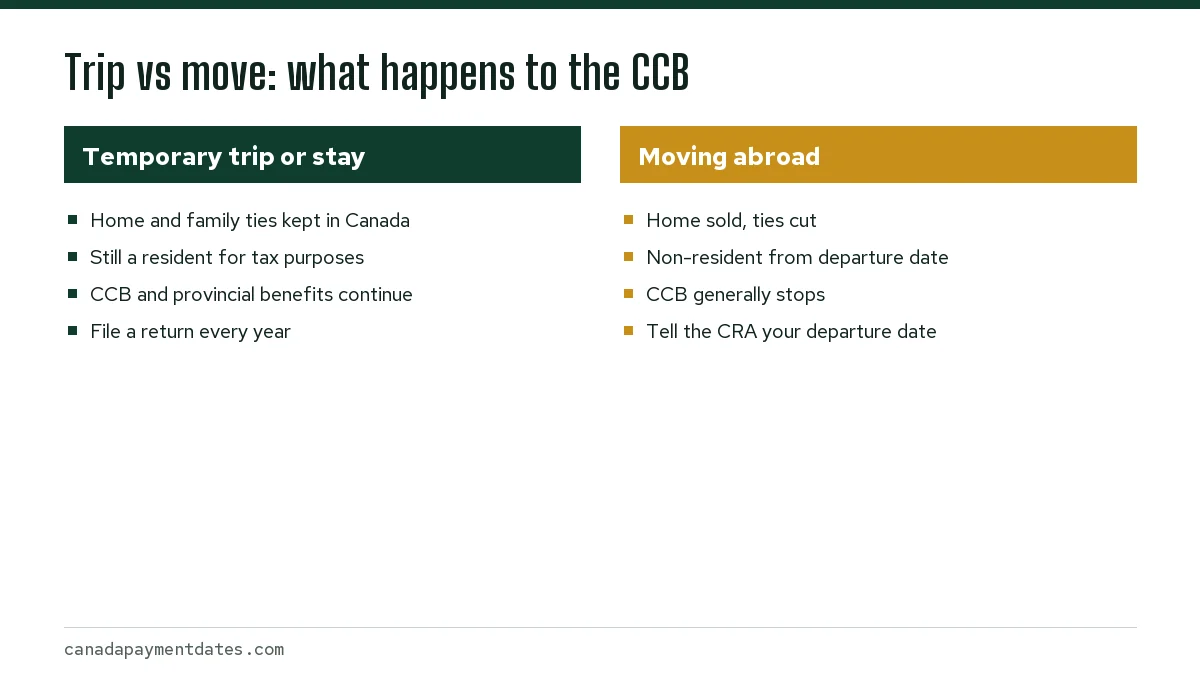
Can I receive CCB while outside Canada? Yes, as long as you remain a resident of Canada for tax purposes. Families on holiday, a work assignment or a school year abroad who keep their home and ties here are factual residents and keep getting the CCB. Once you leave to live elsewhere and become a non-resident, you are generally no longer eligible and must tell the CRA your departure date.
- 01The test
- Residency for tax purposes, not physical presence
- 02Temporary absence with ties kept
- CCB continues
- 03Moving away (non-resident)
- Generally not eligible
- 04When to tell the CRA
- Your departure date, as soon as possible
- 05Residency ruling form
- NR73 (leaving Canada)
- 06Next CCB deposits (also while abroad)
- November 20 and December 11, 2026
Can I receive CCB while outside Canada: residency is the test
The CCB has no rule that counts days out of the country. The condition is that you are a resident of Canada for tax purposes, and that is decided by your ties to Canada, not by where you happen to be this month.
The CRA looks first at significant residential ties: a home in Canada, a spouse or common-law partner here, and dependants here. Secondary ties include personal property such as a car, bank accounts and credit cards, provincial health coverage and a driver's licence. Someone who keeps a home and family in Canada while travelling is still a resident.
| Your status | Typical situation | CCB |
|---|---|---|
| Factual resident | Temporarily abroad but keeps significant ties | Continues, with related provincial benefits |
| Deemed resident | Examples include Canadian government employees posted abroad | Continues, but related provincial or territorial benefits do not |
| Non-resident (emigrant) | Has left Canada to live elsewhere and cut ties | Generally not eligible |
Can I get CCB outside Canada on a long trip?
Yes, if the trip is temporary and your ties stay in place. The CRA lists vacationing abroad, working temporarily outside Canada, teaching or studying in another country, and spending part of the year in the United States for health reasons or a holiday as examples of people who can remain factual residents.
How long the trip lasts does not decide it on its own. In the CRA's own example, an employee sent to work in Hong Kong for 18 months, whose spouse and children stay at the family home in Saskatchewan, is a factual resident because of those ties. A stay of 6 months to a year is judged the same way: what counts is whether your home and family ties stay in Canada.
Three examples
- Winter in Mexico: a family keeps its rented home in Winnipeg, its bank accounts and its health cards, and spends January to March abroad. It stays resident and the CCB keeps arriving on the usual CCB payment dates.
- One-year contract in Germany: a parent takes the children for a school year but keeps the house, which is not rented out, and returns next summer. This can still be a factual residence situation, and payments continue.
- Relocation to Australia: the family sells its home, closes most accounts and moves permanently. They become non-residents from the departure date, and the CCB stops.
The line between the second and third example is not always clear. If you are unsure, file Form NR73, Determination of Residency Status (leaving Canada), and the CRA will give its opinion on your status before or after you go.
What if I move abroad
As a non-resident you are generally not eligible for the CCB or for related provincial and territorial programs. Payments made after your departure date are not yours to keep, even if they keep arriving in your Canadian account.
- Tell the CRA the date you left, as soon as possible, through My Account, in writing, or by calling the CRA benefits line at 1-800-387-1193.
- Update your address. The CRA may stop payments when it cannot reach you, and mail keeps going to the old address otherwise.
- Enter your departure date in the residence information section on page 1 of your return for the year you leave.
- Tell Canadian banks and other payers that you are no longer a resident.
- Keep any CCB paid after you left aside; the CRA will treat it as an overpayment. See benefit overpayment for how repayment works.
When must I tell the CRA
For a holiday or temporary stay abroad, you do not need to report the trip itself. You do need to keep your mailing address current and file a tax return every year, for you and your partner, so the CRA can calculate the next benefit year.
Staying a resident keeps your other CRA benefits too. The CRA says factual residents can be eligible for the Canada Groceries and Essentials Benefit (CGEB), which replaced the GST/HST credit in July 2026, while non-residents generally cannot receive the CGEB or the CCB. If you are a resident travelling this fall, the next CCB deposits are November 20 and December 11, 2026, and the next CGEB payment is January 5, 2027.
Report right away if any of these happen: you or your partner stop being residents, your address changes, the child stops living with you, or custody changes. A late report does not avoid repayment; it only makes the amount owed larger.
| Event | Report to the CRA? | Effect on CCB |
|---|---|---|
| Two-week holiday | No | None |
| Several months abroad, home kept | Only a mailing address change if you have one | Continues |
| You emigrate | Yes, departure date as soon as possible | Stops from the move |
| Partner emigrates, you stay | Yes, and file Form CTB9 | Continues, recalculated |
| You return to live in Canada | Yes, apply again | Can restart once eligible |
Coming back to Canada
Returning residents must apply again; the CCB does not restart by itself. Apply through My Account or on Form RC66, and include Form RC66SCH, Status in Canada and Income Information, so the CRA has your income from the time you lived abroad.
If the application covers a period that began more than 11 months earlier, you will need proof of residence and responsibility for those months; CCB retroactive payments lists the documents. Your first payments use the current CCB amount per child rates, and the Canada Child Benefit guide covers the rest of the eligibility rules.
Common questions
How long can I be out of Canada and still get CCB?
There is no fixed number of days. You keep the CCB as long as you remain a resident of Canada for tax purposes, which depends on keeping ties such as your home and family here.
Will CCB be paid into my Canadian bank account while I travel?
Yes. If you stay a resident, deposits continue on the normal schedule wherever you are.
Do I have to pay back CCB received after I moved abroad?
Generally yes. Payments for months after you became a non-resident are an overpayment, and the CRA will ask for them back.
Can I keep CCB if my husband works overseas and I stay in Canada with the kids?
Yes. You remain eligible. If he becomes a non-resident, fill out Form CTB9 so his income can be included in your family income.
Do Canadian diplomats abroad get CCB?
Canadian government employees posted abroad are generally deemed residents. They continue to receive the CCB, but not related provincial or territorial benefits.
Can I apply for CCB for a baby born while we are outside Canada?
Yes, if you are still a resident of Canada for tax purposes. The CRA says a factual resident who has a child while outside Canada can apply by sending Form RC66, Canada Child Benefits Application, which also covers the provincial and territorial programs.
Sources
- Factual residents: temporarily outside of Canada canada.ca
- Leaving Canada (emigrants) canada.ca
- Canada child benefit: before you apply canada.ca
- T4114 Canada Child Benefit and related programs canada.ca
We check figures against these official pages. Rules change; confirm anything that affects a deadline or payment with the agency before you act.
Tell us what happened
Describe your situation and our editors will use it to improve this guide. If you leave your email, we may reply with a pointer to the right page or official contact. We never share your details.
Related guides
 Canada Child Benefit: Payment Dates, Amounts and Eligibility
The Canada Child Benefit (CCB) is a tax-free monthly payment from the Canada Revenue Agency to families raising children under 18…
CCB Payment Dates 2026, and When the 2027 Dates Are Posted
CCB payment dates in 2026 fall on the 20th of each month unless the 20th is a weekend, in which case the CRA pays on the Friday b…
Can You Get CCB Retroactively? Back Pay Up to 10 Years
Can you get CCB retroactively? Yes, for months up to 10 years back. If you applied late, filed a tax return late, or had a child…
How Much Is CCB per Child? July 2026 to June 2027 Amounts
How much is CCB per child? From July 2026 to June 2027, the Canada Child Benefit pays up to $8,157 a year ($679.75 a month) for e…
CCB Shared Custody: How the 50/50 Split Works for Parents
CCB shared custody means a child lives with each parent 40% to 60% of the time. Both parents apply, and each receives 50% of the…