
CCB shared custody: how the split works for each parent
Short answer
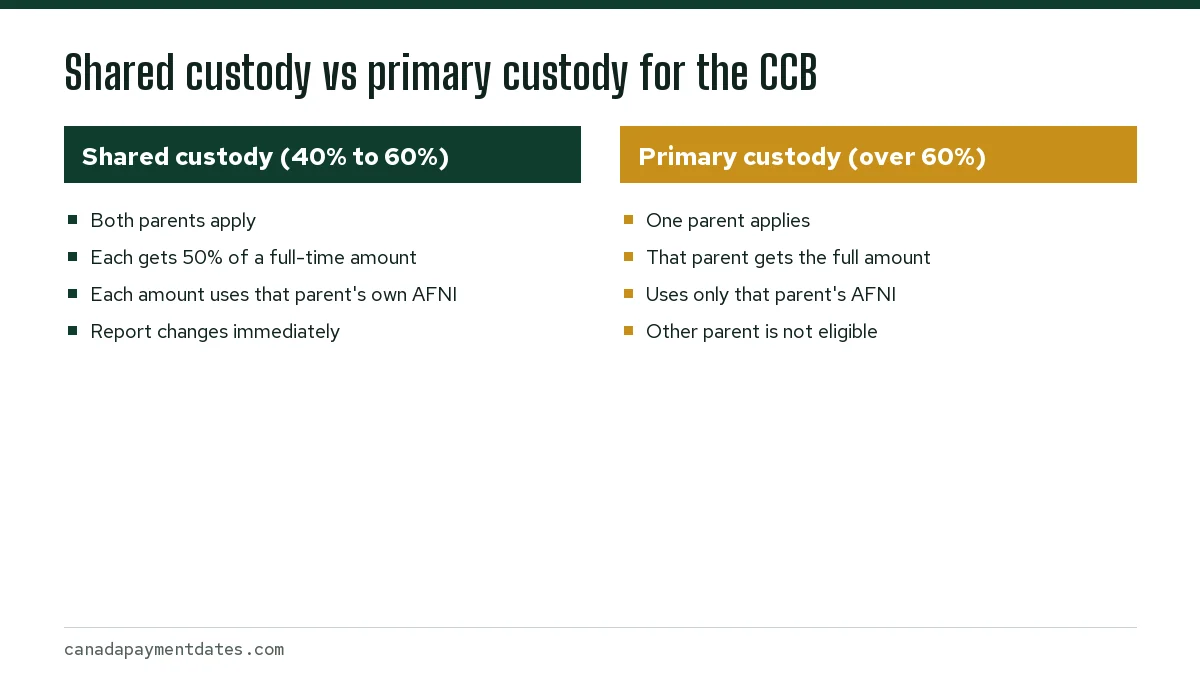
CCB shared custody means a child lives with each parent 40% to 60% of the time. Both parents apply, and each receives 50% of the Canada Child Benefit they would get if the child lived with them full time, calculated on their own household's income. Payments arrive in each parent's account on the same monthly date.
- 01Shared custody range
- Child lives with you 40% to 60% of the time
- 02Each parent receives
- 50% of their own full-time CCB amount
- 03Income used
- Each parent's own adjusted family net income
- 04When to report a change
- Immediately, by My Account or Form RC66
- 05Forms
- RC66 and, if needed, RC66SCH
What counts as CCB shared custody?
For the Canada Child Benefit (CCB), the CRA treats you as sharing custody when the child lives with you between 40% and 60% of the time and lives with another person for the rest. The test is where the child actually lives, measured in time, not what a separation agreement calls the arrangement.
That means a court order that says "joint custody" does not automatically create CCB shared custody. Joint decision-making with the child living with one parent 75% of the time is, for CCB purposes, a primary custody situation. The parent with the child more than 60% of the time applies alone, and the other parent is not eligible.
| Time the child lives with you | Your CCB position |
|---|---|
| More than 60% | You apply as the only recipient and get the full amount |
| 40% to 60% | Shared custody: both parents apply and each gets 50% of their own amount |
| Less than 40% | You are not eligible for that child |
Each parent must still meet the general conditions on their own: live with the child, be a resident of Canada for tax purposes, and hold one of the qualifying statuses. The Canada Child Benefit guide lists them in full, and newcomers can check CCB for work permit holders.
CCB joint custody vs split custody: the terms people mix up
Three phrases get used loosely, and only one of them changes how the CRA pays you. Using the CRA's own wording when you call or write avoids delays.
- Shared custody (CRA term): one child alternates between two homes, 40% to 60% with each. Both parents receive half.
- Joint custody (family law term): both parents share legal decision-making. It says nothing about living time, so the CRA still looks at where the child lives.
- Split custody (family law term): siblings are divided, for example one child lives mainly with each parent. For the CCB, each parent claims the child who lives mainly with them as the full-time recipient. Shared custody does not apply unless a child is also splitting time 40% to 60%.
Mixed families are common. A parent can receive the full amount for one child who lives with them most of the time and a half amount for another child in a shared arrangement, all in the same monthly deposit.
How the 50% calculation works, with worked numbers
The CRA does not take one family amount and cut it in half. It calculates what each parent would get if the child lived with them 100% of the time, using that parent's own adjusted family net income (AFNI), then pays 50% of that figure. A new partner's income counts in that parent's AFNI.
The example below uses the July 2026 to June 2027 rates: $8,157 a year for a child under 6, reduced by 7% of income between $38,237 and $82,847 for a one-child family, and by $3,123 plus 3.2% of income above $82,847.
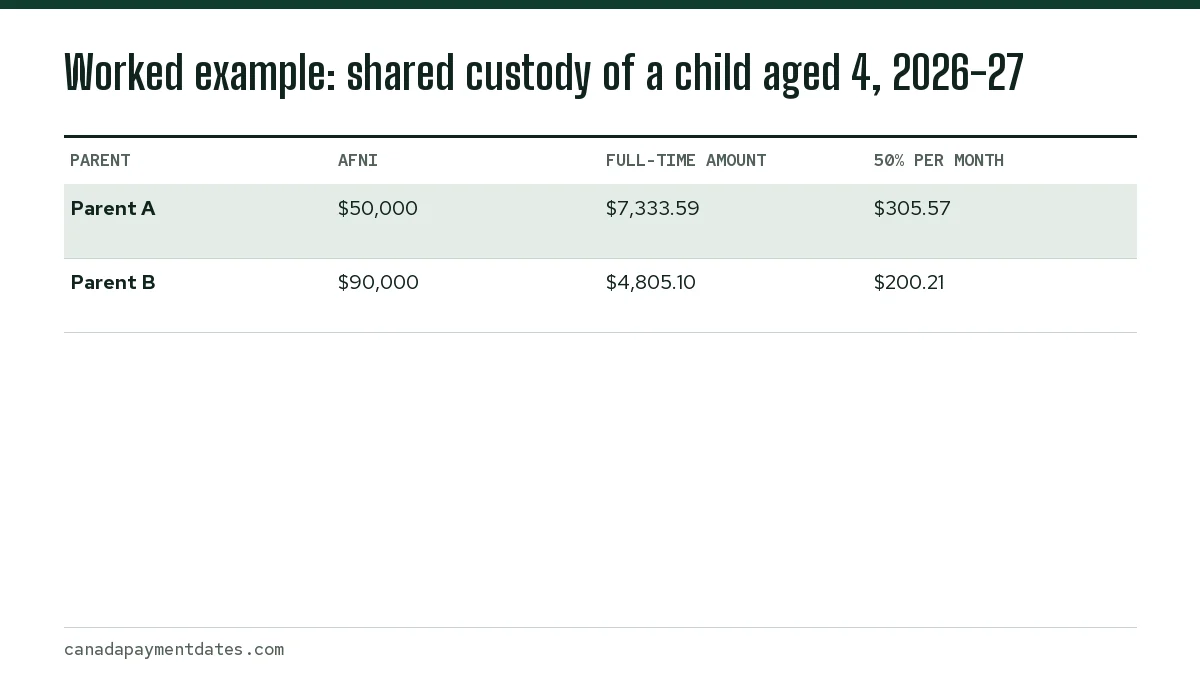
Example: one child aged 4, two households
- Parent A's AFNI is $50,000. Full-time amount: $8,157 minus 7% of $11,763 ($823.41) = $7,333.59. Half is $3,666.80 a year, about $305.57 a month.
- Parent B's AFNI, including a new spouse, is $90,000. Full-time amount: $8,157 minus ($3,123 + 3.2% of $7,153, or $228.90) = $4,805.10. Half is $2,402.55 a year, about $200.21 a month.
- Together the two homes receive about $505.78 a month for this child, which is less than either would get alone at the maximum. That gap is normal when incomes differ.
The reduction also depends on how many children count in each parent's family. If Parent B has two other children living there full time, Parent B's reduction uses the rate for three children before the 50% is applied. The CCB calculator can run the full-time figure; halve it to estimate a shared custody payment.
What if custody is not 50/50 or changes later
A 55/45 or 60/40 schedule is still shared custody, and each parent still receives half. There is no sliding scale that pays 60% to the parent with slightly more time. Once one parent goes above 60%, the arrangement flips to primary custody for that parent. The CRA's guide does allow for uneven months: because of illness or summer vacation schedules, the split may be 38% to 62% in a particular month. A child who is with you only every second weekend is below 40%, so you are not eligible for that child.
Common changes and what happens
- Teen moves in with one parent full time: that parent reports the change and becomes the sole recipient from the following month. The other parent's half stops.
- Summer-only or temporary change: the CRA allows a claim for a set period, such as the months a child lives with you over the summer. When the child goes back, the other parent has to reapply to restart their payments.
- Parent moves out of Canada: that parent loses eligibility as a non-resident; see CCB while outside Canada.
- Child turns 6 or 18: the rate change or end date applies to both parents' halves at the same time.
A Child Disability Benefit for an eligible child is included in the CCB payment, so in shared custody each parent's half reflects it too. The CCB itself is tax-free for both parents; is CCB taxable explains what that means at filing time.
Common questions
Do both parents have to apply for CCB in shared custody?
Yes. The CRA says both parents should apply, and each receives half. If only one parent applies and is paid the full amount, that parent may have to repay 50% retroactively once the other parent applies.
How is CCB split in shared custody when incomes are different?
Each parent's half is based on their own adjusted family net income, so the lower-income household usually receives more. The two payments are rarely equal.
Does a new partner's income affect my shared custody CCB?
Yes. A spouse or common-law partner living with you is part of your adjusted family net income, which lowers or raises your full-time amount before it is halved.
Can the other parent claim the CCB if the child lives with me 65% of the time?
No. Above 60% you are the only eligible parent for that child. The other parent should not apply, and if they already receive payments they should report the change.
Is a week-on, week-off schedule shared custody for CCB?
Yes. Alternating weeks puts the child with each parent about 50% of the time, which is inside the 40% to 60% range.
How do I update my information if my family situation changes for the CCB?
For custody, use your CRA account: "Apply for child benefits" or Form RC66 to start shared custody, "Modify shared custody" if you were getting the full amount, or "End care of child" if the child no longer lives with you. Report a new spouse, common-law partner or separation through My Account, by calling 1-800-387-1193 or with Form RC65, Marital Status Change, by the end of the month after the change; for a separation, wait until you have been apart for more than 90 consecutive days. See CRA marital status change.
Sources
- T4114 Canada Child Benefit and related programs canada.ca
- Canada child benefit: before you apply canada.ca
- Canada child benefit: how we calculate your CCB canada.ca
We check figures against these official pages. Rules change; confirm anything that affects a deadline or payment with the agency before you act.
Tell us what happened
Describe your situation and our editors will use it to improve this guide. If you leave your email, we may reply with a pointer to the right page or official contact. We never share your details.
Related guides
 Canada Child Benefit: Payment Dates, Amounts and Eligibility
The Canada Child Benefit (CCB) is a tax-free monthly payment from the Canada Revenue Agency to families raising children under 18…
CCB Calculator: Estimate Your Canada Child Benefit Payment
This Canada child benefit calculator estimates your CCB for July 2026 to June 2027. Enter your 2025 adjusted family net income, t…
Child Disability Benefit: Up to $290 a Month Paid With CCB
The Child Disability Benefit (CDB) is a tax-free supplement of up to $3,480 a year, or $290 a month, for each child under 18 who…
CCB Eligibility for Work Permit Holders and Other Newcomers
CCB eligibility for work permit holders begins once you have lived in Canada throughout the previous 18 months and hold a valid p…
Does CCB Count as Income? Is CCB Taxable? No to Both
Is CCB taxable? No, and the CCB does not count as income on your tax return. The CRA describes the Canada Child Benefit as a non-…