
How much is the Canada Workers Benefit? Maximums, income limits and examples
Short answer
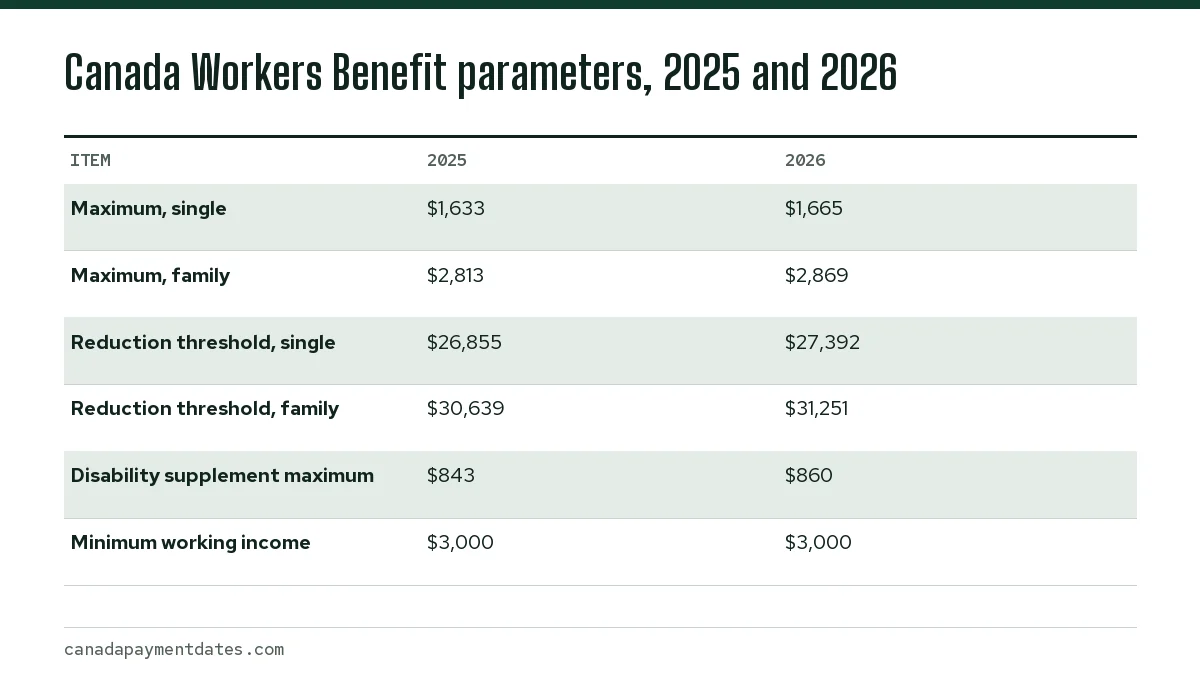
How much is the Canada Workers Benefit? For the 2026 tax year the maximum is $1,665 for a single person and $2,869 for a family, plus up to $860 for the disability supplement. For 2025 returns the maximums are $1,633 and $2,813. The amount grows with working income above $3,000 and shrinks once net income passes $27,392 (single) or $31,251 (family) in 2026.
- 01Maximum, single, 2026
- $1,665 (2025: $1,633)
- 02Maximum, family, 2026
- $2,869 (2025: $2,813)
- 03Phase-in rate
- 27% of working income over $3,000
- 04Phase-out rate
- 15% of adjusted net income over the threshold
- 05Benefit ends, single, 2025
- Net income above $37,742
How much is the Canada Workers Benefit for 2025 and 2026?
The most a single worker can get from the Canada Workers Benefit (CWB) is $1,633 on a 2025 return and $1,665 on a 2026 return. Families, which include couples and single parents with an eligible dependant, can get up to $2,813 for 2025 and $2,869 for 2026 (CRA, how much you can get; CRA indexation table).
The 2026 figures are 2.0% higher because the CRA indexes the CWB to inflation each January. The 2027 figures are not published yet; the CRA's indexed amounts for 2027 are expected in November 2026.
What is the Canada Workers Benefit income threshold?
The CWB has two income tests. You need working income over $3,000 before any benefit starts, and your adjusted net income decides when it starts to shrink. Adjusted net income for a couple is combined net income, after the lower-earning spouse excludes up to $16,386 (2025) or $16,714 (2026) of their working income, called the secondary earner exemption.
| Household | Reduction starts 2025 | Ends 2025 | Reduction starts 2026 | Ends 2026 (calculated) |
|---|---|---|---|---|
| Single, no eligible dependant | $26,855 | $37,742 | $27,392 | about $38,492 |
| Family | $30,639 | $49,393 | $31,251 | about $50,378 |
The 2025 end points are the CRA's own figures. The 2026 end points are our calculation: the 2026 reduction threshold plus the maximum divided by the 15% reduction rate. The CRA will publish its own 2026 cut-offs with the 2026 Schedule 6.
How is the CWB amount calculated?
The basic CWB is 27% of working income above $3,000, capped at the maximum, minus 15% of adjusted net income above the reduction threshold. The 27% and 15% rates were set in the 2021 federal budget enhancement and apply from the 2021 tax year on (Budget 2021, Annex 6). Working income means employment and self-employment income.
- Take your working income (for couples, both spouses combined) and subtract $3,000.
- Multiply by 27%. If the result is above the maximum ($1,665 single or $2,869 family for 2026), use the maximum.
- Work out adjusted net income and subtract the threshold ($27,392 single or $31,251 family for 2026).
- If that is above zero, multiply it by 15% and subtract it from step 2.
- Any result below zero means no basic CWB for the year.
A single worker reaches the 2026 maximum at about $9,167 of working income, and a family at about $13,626. Below those points, every extra dollar earned adds 27 cents of CWB.
Canada Workers Benefit examples at different incomes
These worked examples use 2026 figures and assume working income equals net income. They are illustrations, not a substitute for Schedule 6 or certified software, which apply every line of the calculation.
| Household | Income | Calculation | Basic CWB |
|---|---|---|---|
| Single, part-time | $7,000 | 27% x ($7,000 - $3,000) | $1,080.00 |
| Single | $22,000 | Phase-in above cap; below threshold | $1,665.00 |
| Single | $33,000 | $1,665 - 15% x ($33,000 - $27,392) | $823.80 |
| Single parent, one child | $42,000 | $2,869 - 15% x ($42,000 - $31,251) | $1,256.65 |
| Couple earning $26,000 and $14,000 | $40,000 combined | $14,000 excluded as secondary earner; $26,000 is below $31,251 | $2,869.00 |
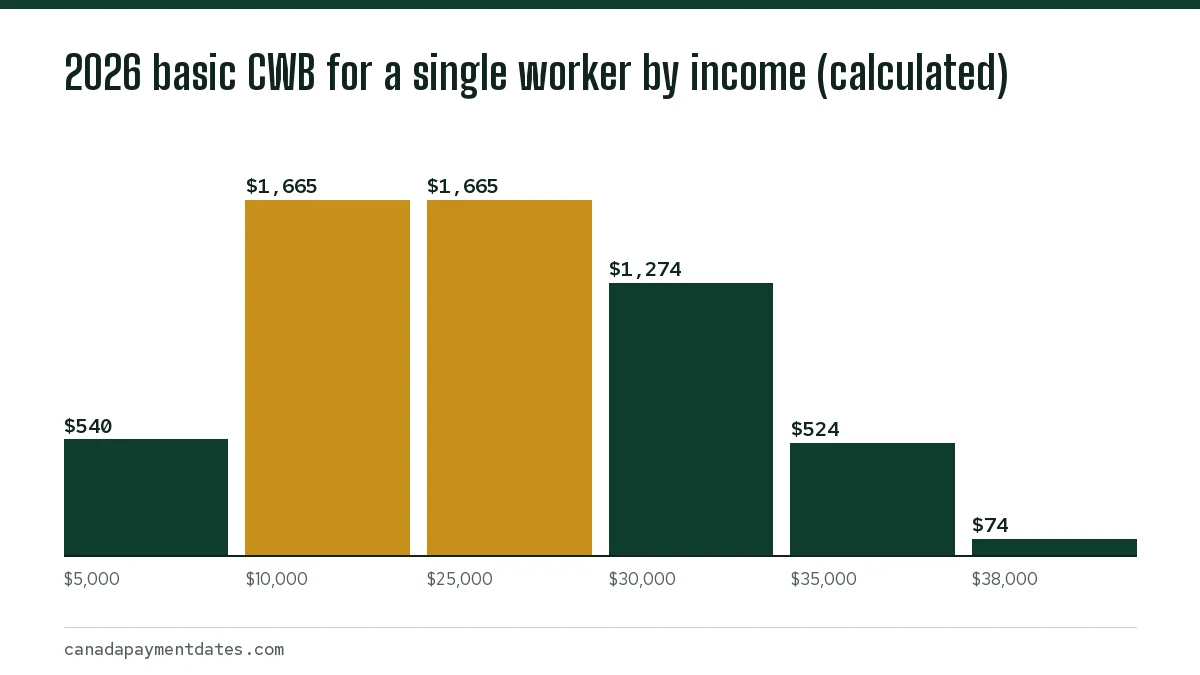
The couple example shows why the secondary earner exemption matters. Without it their $40,000 combined income would cut the benefit by $1,312.35; with it they keep the full family amount. Up to half of any of these amounts is paid in advance, as explained in how the Advanced Canada Workers Benefit works.
Is the CWB different in Quebec, Alberta or Nunavut?
Yes. Quebec, Alberta and Nunavut have reshaped the CWB with the federal government, so their residents use separate forms: 5005-S6 (Quebec), 5009-S6 (Alberta) and 5014-S6 (Nunavut). The maximum amounts and income cut-offs differ from the rest of Canada (CRA, who is eligible).
| Household | Other provinces and territories | Quebec | Alberta | Nunavut |
|---|---|---|---|---|
| Single, no children | $37,742 | $33,230.35 | $37,826 | $67,367 |
| Single with children | $49,393 | $24,561.56 | $50,232 | $67,365 |
| Family, no children | $49,393 | $51,504.09 | $50,232 | $67,365 |
| Family with children | $49,393 | $41,048.90 | $50,232 | $67,365 |
Ontario, British Columbia and the other provinces not listed use the general Schedule 6 (5000-S6) and the federal figures above. If you moved during the year, the CRA uses your province of residence on December 31. Eligibility rules that apply everywhere are on Canada Workers Benefit eligibility.
How much does the disability supplement add?
Workers with an approved Disability Tax Credit get up to $843 more for 2025 and $860 for 2026. The supplement starts to fall at a higher income than the basic amount ($37,740 single in 2025), so it can continue after the basic CWB has run out. Details are on the CWB disability supplement page.
For a summary of all CWB rules, payment dates and guides, return to the Canada Workers Benefit overview.
Common questions
What is the maximum Canada Workers Benefit for a single person?
$1,633 for the 2025 tax year and $1,665 for 2026, outside Quebec, Alberta and Nunavut. A single worker with a Disability Tax Credit can also get the disability supplement on top.
At what income does the Canada Workers Benefit stop?
For 2025, a single person's basic CWB ends at net income above $37,742 and a family's above $49,393, outside Quebec, Alberta and Nunavut. By our calculation the 2026 end points are about $38,492 and $50,378.
Is there an official Canada Workers Benefit calculator?
The CRA's CWB pages direct you to Schedule 6 or certified tax software to work out the amount; the five steps on this page give you a close estimate.
Why is my CWB less than the maximum?
Either your working income is below the point where the benefit reaches its cap (about $9,167 single for 2026) or your adjusted net income is above the reduction threshold. Both reduce the amount.
Does a single parent get the family CWB amount?
Yes. A single parent with an eligible dependant under 19 on December 31 uses the family maximum, up to $2,813 for 2025 and $2,869 for 2026, and the family income thresholds.
How much is the ACWB payment?
Up to half of your expected CWB, split into three deposits. For a single person at the 2026 maximum of $1,665 the three advances can total $832.50, and for a family at $2,869 up to $1,434.50. The 2026 advances were paid on July 10 and October 9, 2026; the last one comes in January 2027.
How much does the CWB go down above the income threshold?
15 cents for every dollar of adjusted net income above the threshold, which is $27,392 for a single person and $31,251 for a family in 2026. For example, $1,000 of income over the threshold lowers the basic CWB by $150.
What is the CWB income limit in Alberta?
For the 2025 tax year, Alberta's basic CWB ends at net income above $37,826 for a single person and $50,232 for a family. Alberta residents use their own Schedule 6, form 5009-S6.
Is the Canada Workers Benefit the same as the Working Income Tax Benefit?
Yes. The CWB replaced the Working Income Tax Benefit (WITB) starting with the 2019 tax year, with higher amounts. If you see the old name, the calculation on this page is the current version of it.
Sources
- CRA, CWB how much you can get canada.ca
- CRA, Indexation adjustment for personal income tax and benefit amounts canada.ca
- CRA, CWB who is eligible canada.ca
- Budget 2021, Annex 6 tax measures budget.canada.ca
We check figures against these official pages. Rules change; confirm anything that affects a deadline or payment with the agency before you act.
Tell us what happened
Describe your situation and our editors will use it to improve this guide. If you leave your email, we may reply with a pointer to the right page or official contact. We never share your details.
Related guides
 Canada Workers Benefit: Advance Payments, Dates and Amounts
The Canada Workers Benefit (CWB) is a refundable federal tax credit for low-income workers, worth up to $1,633 for a single perso…
Canada Workers Benefit Eligibility: Who Can Claim the CWB
Canada Workers Benefit eligibility requires three things: you earned working income, you were a resident of Canada for the whole…
Advanced Canada Workers Benefit: How the 50% Advance Works
The Advanced Canada Workers Benefit (ACWB) pays up to 50% of the Canada Workers Benefit you are expected to get, in three automat…
Canada Workers Benefit Disability Supplement: How It Is Paid
The Canada Workers Benefit disability supplement adds up to $843 for 2025 and $860 for 2026 to the CWB of a worker who has an app…
CWB Payment Dates 2026 and the Next Advance in January 2027
CWB payment dates in 2026 were Monday, January 12, Friday, July 10, and Friday, October 9, the last advance of the year. These th…