
Canada Workers Benefit eligibility: the rules, the exclusions and edge cases
Short answer
Canada Workers Benefit eligibility requires three things: you earned working income, you were a resident of Canada for the whole year, and you were 19 or older on December 31 or lived with a spouse, common-law partner or child. Full-time students for more than 13 weeks without a dependant, and anyone jailed 90 days or more, cannot claim.
- 01Minimum age
- 19 on December 31, unless you live with a spouse or child
- 02Residency
- Resident of Canada throughout the year
- 03Student limit
- Full-time more than 13 weeks excludes you, unless you have an eligible dependant
- 04Income cut-off, single, 2025
- Net income above $37,742 ends the basic amount
- 05Working income needed
- More than $3,000 before any basic CWB builds up
Who qualifies for the Canada Workers Benefit?
You meet the basic Canada Workers Benefit eligibility rules if you earned working income in the year, were resident in Canada throughout the year, and were at least 19 on December 31 or lived with your spouse, common-law partner or child (CRA, who is eligible). Your net income must also be under the limit for your province and household.
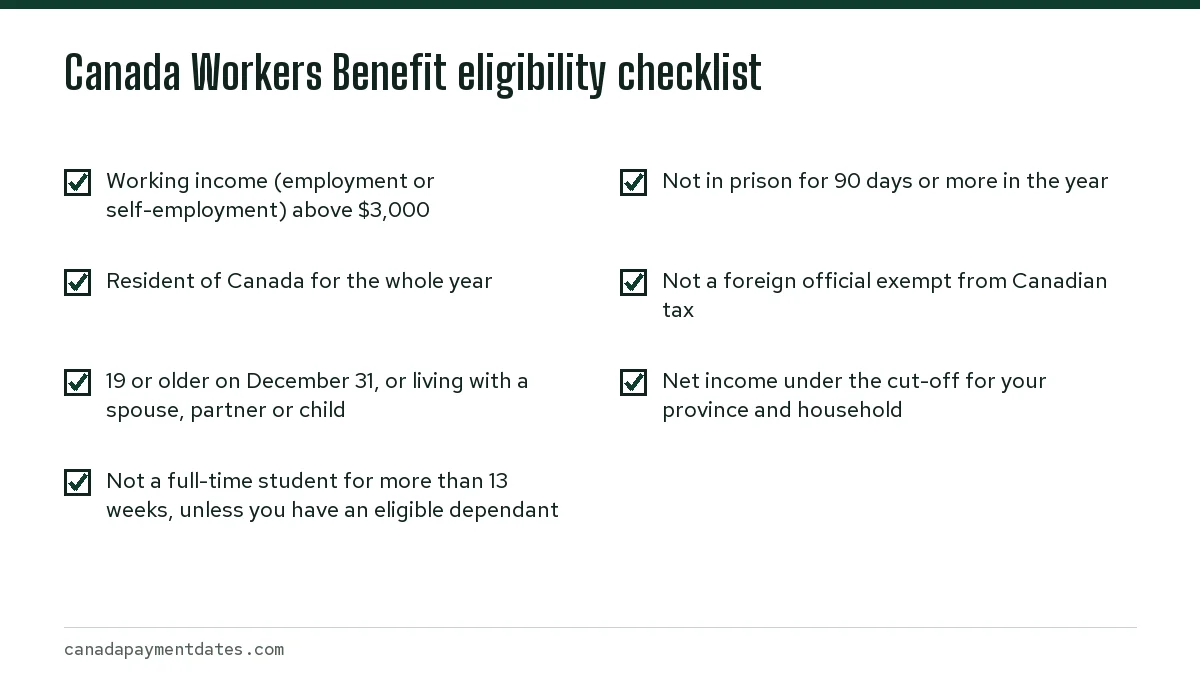
Working income means employment and self-employment income (Budget 2021, Annex 6). Other income you report, such as benefits or pension payments, is not working income, but it still counts toward the net income that can reduce the CWB.
What is the age rule for the CWB?
The CWB age rule is tested on December 31: you must be 19 or older on that date. The exception is anyone who lives with a spouse or common-law partner, or with their own child, on that date; they qualify at any age.
- An 18-year-old living with their parents and working part-time cannot claim for that year, even with steady earnings.
- An 18-year-old parent living with their child on December 31 can claim.
- Someone who turns 19 on December 30 qualifies for the whole year, because only the December 31 age counts.
What residency do you need for the CWB?
You must have been a resident of Canada for tax purposes throughout the entire year. A newcomer who arrived in March 2026 cannot claim the CWB on a 2026 return, and becomes eligible from the first full calendar year of residence. The same rule applies in reverse: someone who emigrates partway through a year loses the CWB for that year.
Officers or servants of another country, such as foreign diplomats, who do not pay tax in Canada are also excluded.
Can students get the Canada Workers Benefit?
Students can get the CWB only if they were enrolled full time at a designated educational institution for 13 weeks or less in the year. More than 13 weeks of full-time study disqualifies you, unless you had an eligible dependant on December 31.
| Situation | Full-time weeks in the year | Eligible? |
|---|---|---|
| University student, full time January to April and September to December | About 30 | No |
| Graduated in April, then worked full time | About 16 | No |
| Part-time evening courses all year | 0 full-time weeks | Yes, if other rules met |
| Started a full-time program in October | 13 or fewer | Yes, if other rules met |
| Full-time student with a child under 19 living with them | Any | Yes, if other rules met |
Your T2202 tuition slip shows months of full-time study, not weeks, so ask your school for exact start and end dates if your count is close to 13. Check before you file, because the CRA can reassess and recover the benefit if it later finds you were over the limit.
Who is excluded from the CWB?
- Anyone confined to a prison or similar institution for a period of at least 90 days during the year.
- Full-time students over the 13-week limit with no eligible dependant.
- People who were not resident in Canada for the whole year.
- Foreign officials exempt from Canadian tax.
- Anyone whose adjusted net income is above the cut-off for their household and province.
For 2025 returns outside Quebec, Alberta and Nunavut, the basic amount ends when net income passes $37,742 for a single person or $49,393 for a family. Those three jurisdictions have their own limits, set out on how much is the Canada Workers Benefit.
How do spouses and eligible dependants affect eligibility?
An eligible spouse is a spouse or common-law partner who lived with you on December 31, was resident in Canada all year, and is not excluded by the student, prison or foreign-official rules. A couple gets one family amount and only one spouse claims the basic CWB.
If your spouse or common-law partner died after June 30, 2025, they still count as your eligible spouse for 2025 if you were living together on the date of death and you were not living with another spouse or partner on December 31, 2025.
An eligible dependant is your child or your spouse's child who was under 19, lived with you on December 31, and is not eligible for the CWB themselves. The CRA includes children placed with you under a kinship or close relationship care program, unless the payments you receive for that child are children's special allowances. Having an eligible dependant moves a single parent onto the family amount and also lifts the student exclusion.
If you separate or start living with someone, tell the CRA, because it changes both your CWB and your advances. See reporting a marital status change.
Canada Workers Benefit eligibility in Ontario
Ontario has no separate version of the CWB, so Ontario workers follow the federal rules above and use the general Schedule 6 (5000-S6). The 2025 cut-offs of $37,742 (single) and $49,393 (family) apply, and 2026 amounts are indexed by 2.0% (CRA indexation table).
Ontario workers often receive the Ontario Trillium Benefit from the same CRA account, and in 2026 two of the three CWB advances landed on the same day as an OTB deposit. See CWB payment dates for the schedule and the Ontario Trillium Benefit page for that program.
How do you apply for the Canada Workers Benefit?
There is no separate application. You claim the CWB on your tax return: complete Schedule 6 for your province or territory (5000-S6 in most of Canada, 5005-S6 in Quebec, 5009-S6 in Alberta, 5014-S6 in Nunavut) and enter the result on line 45300; certified tax software does this for you. When the CWB replaced the Working Income Tax Benefit in 2019, Finance Canada said the CRA can calculate the CWB for anyone who has not claimed it on their return, but completing Schedule 6 yourself makes sure the family, spouse and disability details are right.
Who is eligible for the advance payments?
The Advanced Canada Workers Benefit has no extra eligibility test. If your return shows a CWB amount on line 45300 and the CRA receives it before November 1 of the benefit period, the advances start automatically. For the July 2026 to June 2027 period, that means your 2025 return must reach the CRA before November 1, 2026. How the advances work is explained on Advanced Canada Workers Benefit.
What if you qualify but did not claim?
File the missing return or ask the CRA to adjust an earlier one. The CWB is claimed on Schedule 6 and line 45300, and the CRA determines eligibility when it assesses the return (CRA, how to claim). If you have an approved Disability Tax Credit, check the CWB disability supplement as well, since its income limit is higher. The Canada Workers Benefit overview links every related guide.
Common questions
Can I get the Canada Workers Benefit if I am 18?
Only if you lived with a spouse, common-law partner or your own child on December 31. Otherwise you must be 19 or older on December 31 of the tax year.
Can international students get the CWB?
Most cannot, because full-time study of more than 13 weeks in the year excludes you, and you must also be a resident of Canada for the entire year. A student meeting both tests would qualify like anyone else.
Does self-employment income count for the CWB?
Yes. Working income includes both employment income and self-employment income, so gig and freelance earnings count.
Can newcomers to Canada get the Canada Workers Benefit?
Not in the year they arrive, because you must be resident in Canada throughout the year. From the first full calendar year of residence, the normal rules apply.
Do I qualify for the CWB if I am on EI?
Employment Insurance benefits are not working income, but you can still qualify on any wages you earned in the same year, as long as your total net income stays under the cut-off.
How do I apply for the Canada Workers Benefit?
You do not fill in an application. Claim it on Schedule 6 and line 45300 when you file your return; certified tax software completes Schedule 6 for you.
Is WITB eligibility the same as CWB eligibility?
The Working Income Tax Benefit (WITB) was replaced by the Canada Workers Benefit starting in 2019, so for 2019 and later years the CWB rules on this page are the ones that apply.
Who is eligible for the Advanced Canada Workers Benefit?
Anyone whose return shows a CWB amount on line 45300, as long as the CRA receives that return before November 1 of the benefit period. No separate application is needed.
Sources
- CRA, CWB who is eligible canada.ca
- CRA, CWB how to claim canada.ca
- CRA, Indexation adjustment for personal income tax and benefit amounts canada.ca
- Budget 2021, Annex 6 tax measures budget.canada.ca
We check figures against these official pages. Rules change; confirm anything that affects a deadline or payment with the agency before you act.
Tell us what happened
Describe your situation and our editors will use it to improve this guide. If you leave your email, we may reply with a pointer to the right page or official contact. We never share your details.
Related guides
 Canada Workers Benefit: Advance Payments, Dates and Amounts
The Canada Workers Benefit (CWB) is a refundable federal tax credit for low-income workers, worth up to $1,633 for a single perso…
Canada Workers Benefit Disability Supplement: How It Is Paid
The Canada Workers Benefit disability supplement adds up to $843 for 2025 and $860 for 2026 to the CWB of a worker who has an app…
How Much Is the Canada Workers Benefit? Amounts and Limits
How much is the Canada Workers Benefit? For the 2026 tax year the maximum is $1,665 for a single person and $2,869 for a family,…
CWB Payment Dates 2026 and the Next Advance in January 2027
CWB payment dates in 2026 were Monday, January 12, Friday, July 10, and Friday, October 9, the last advance of the year. These th…
CRA Marital Status Change: How It Affects Your Benefits
A CRA marital status change must be reported by the end of the month after the month your status changed, and benefits such as th…