
The $150 Canada Disability Benefit supplemental payment: who gets it and when
Short answer
The Canada Disability Benefit supplemental payment is a one-time $150 paid for each approved Disability Tax Credit certificate that makes someone eligible for the CDB. It helps cover the cost of getting the DTC form completed. The first payments went out September 17, 2026; people newly approved from July 2026 are due to be paid in winter 2027, and nobody needs to apply.
- 01Amount
- $150, one time, per approved DTC certificate
- 02First round paid
- September 17, 2026
- 03Next round
- Winter 2027, exact date not yet announced
- 04Application needed?
- No, it is automatic
- 05Legal basis
- CDB regulation amendments in force September 1, 2026
What is the $150 Canada Disability Benefit supplemental payment?
The Canada Disability Benefit supplemental payment is a one-time $150 lump sum from Service Canada. Employment and Social Development Canada (ESDC) announced it in September 2026 to help offset the costs people face in getting the Disability Tax Credit approved, since the DTC is the entry requirement for the CDB.
Those costs usually come from Form T2201, Disability Tax Credit Certificate. Part B must be completed by a medical practitioner, and some practitioners charge a fee to fill it in. The $150 is a flat amount; it does not depend on what you actually paid, and you do not need a receipt.
Who qualifies for the CDB $150 payment?
ESDC's release splits eligibility into two groups. Both are paid automatically based on Service Canada's records.
| Group | Who is in it | When paid |
|---|---|---|
| First round | Anyone who received CDB payments between July 2025 and June 2026, including people who received only one payment or are no longer eligible | September 17, 2026 |
| Second round | People who became eligible for a CDB payment at any time since July 2026, and people re-certified for the DTC with a new certificate that qualifies them for the CDB | Winter 2027 (date not yet announced) |
The first-round rule matters for people who have since turned 65 or whose income rose. You did not need to be on the CDB in September 2026 to be paid; one payment during July 2025 to June 2026 was enough.
Can you get more than one $150 payment?
ESDC describes the amount as $150 per approved DTC certificate that makes a person eligible, and it lists renewed certificates in the second round. That suggests a person whose DTC certificate expires and is renewed could qualify again for the new certificate. Service Canada has not published further detail, so treat a second payment as possible rather than certain.
The September 17, 2026 payment
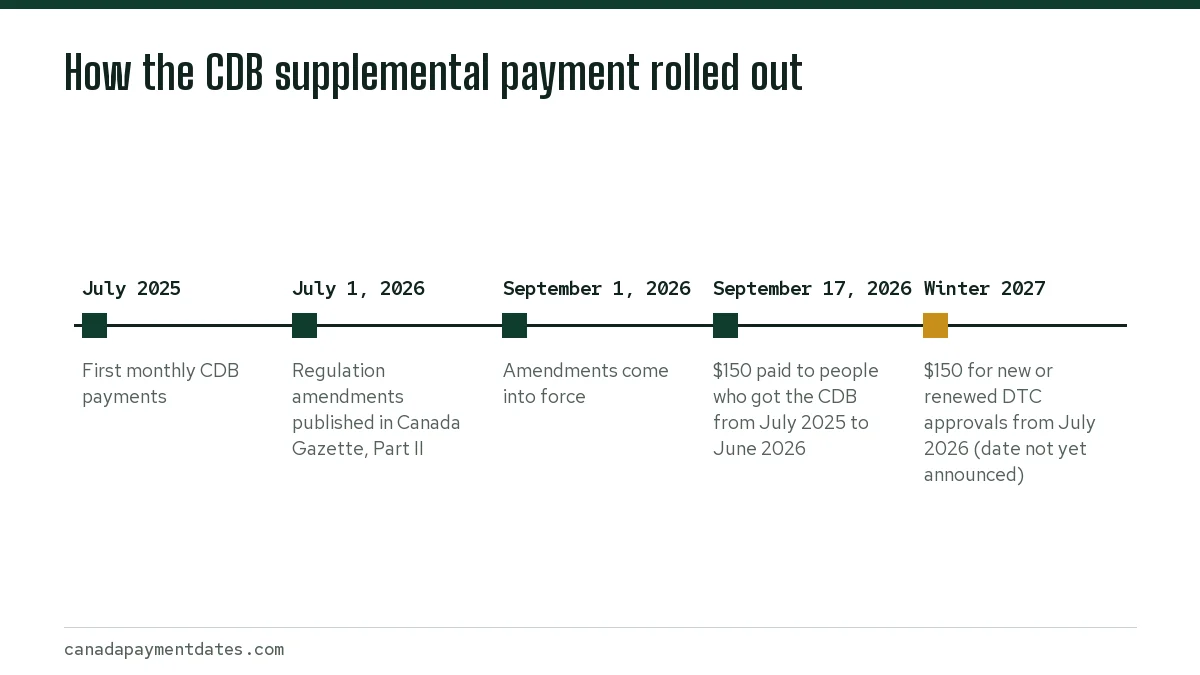
The first supplemental payments were issued on September 17, 2026, the same Thursday as the regular September CDB payment. The legal basis came from amendments to the Canada Disability Benefit Regulations published in the Canada Gazette, Part II on July 1, 2026, which came into force on September 1, 2026.
If you expected the $150 and did not see it, check these points before contacting Service Canada:
- Confirm you received at least one CDB payment between July 2025 and June 2026. If your first payment was July 2026 or later, you belong to the winter 2027 group.
- Look at your account for a separate $150 deposit around September 17, and check whether it was combined with your regular payment.
- If you are paid by cheque, allow extra days for mail. Canada.ca notes that payments can take a few days to arrive.
- Make sure your address and banking details with Service Canada are current, especially if you stopped receiving the CDB.
When is the next CDB supplemental payment in 2027?
The next round is scheduled for winter 2027, for people who became eligible for a CDB payment at any time since July 2026 and for people re-certified for the DTC with a new certificate. As of October 22, 2026, the exact date is still not announced; Canada.ca's amount page says only that supplemental payments start in fall 2026.
Since the first round was paid on a regular CDB date, a winter 2027 round may also line up with a monthly payment. That alignment is our assumption, not an announcement; the table below shows the scheduled and projected regular payments from our CDB payment dates calendar.
| Date | Payment | Status |
|---|---|---|
| November 19, 2026 | Regular monthly CDB | Scheduled |
| December 17, 2026 | Regular monthly CDB | Scheduled |
| January 21, 2027 | Regular monthly CDB | Our projection |
| February 18, 2027 | Regular monthly CDB | Our projection |
| March 18, 2027 | Regular monthly CDB | Our projection |
| Winter 2027, date not announced | $150 supplemental, second round | Announced by ESDC, no date yet |
If your DTC was approved recently, apply for the CDB itself right away. The $150 is tied to a certificate that qualifies you for the benefit, and the monthly payments, including any CDB back pay, are worth far more than the supplement.
Do you need to apply for the $150 payment?
No. ESDC says the supplemental payment is issued automatically to eligible people. There is no form, and you do not need to send proof of what your practitioner charged.
Be wary of anyone offering to claim the $150 for you for a fee or asking for your SIN or bank details by text or email. Service Canada does not need a separate request, so a message asking you to apply for this payment is a warning sign.
Is the $150 CDB payment taxable?
Canada.ca states that CDB payments are non-taxable and do not need to be reported on your return. The supplemental amount is paid under the Canada Disability Benefit Regulations, so it follows the benefit. ESDC's release does not address tax treatment separately, and no tax slip is issued for CDB payments.
How provincial assistance programs treat a one-time $150 can differ from how they treat monthly income, so report it if your province requires it. The is the CDB taxable page explains the tax and provincial rules. Residents of Newfoundland and Labrador with the DTC may also receive the provincial NL disability benefit, which has no equivalent supplement. See the Canada Disability Benefit hub for the rest of the program.
Common questions
What is the $150 disability payment in September 2026?
It is the one-time Canada Disability Benefit supplemental payment, issued September 17, 2026, to help cover the cost of getting the Disability Tax Credit form completed.
I stopped getting the CDB. Do I still get the $150?
Yes, if you received at least one CDB payment between July 2025 and June 2026. ESDC's release says people who are no longer eligible are included.
Why didn't I get the CDB supplemental payment?
The most common reason is timing: if your first CDB payment came in July 2026 or later, you are in the winter 2027 group, not the September 2026 group.
Does the $150 reduce my monthly CDB?
No. It is a separate one-time amount paid on top of your monthly benefit.
Is the CDB supplemental payment for DTC form fees only?
It was created to offset those costs, but it is a flat $150 with no receipt required, so you can use it however you need.
When is the next Canada Disability Benefit payment?
Regular monthly CDB payments arrive on November 19 and December 17, 2026. The $150 second round, for people who became eligible since July 2026 or were re-certified for the DTC, is scheduled for winter 2027, with no exact date announced yet.
Sources
- Supplemental Canada Disability Benefit payments to begin in September (ESDC news release) canada.ca
- Canada Disability Benefit: How much you could receive canada.ca
- Canada Disability Benefit: Payments canada.ca
- Summary of the Canada Disability Benefit Regulations canada.ca
We check figures against these official pages. Rules change; confirm anything that affects a deadline or payment with the agency before you act.
Tell us what happened
Describe your situation and our editors will use it to improve this guide. If you leave your email, we may reply with a pointer to the right page or official contact. We never share your details.