
Canada Disability Benefit amount: how the $204.20 is worked out
Short answer
The Canada Disability Benefit amount is up to $204.20 a month ($2,450.40 a year) from July 2026 to June 2027, up from $200. Singles with adjusted family net income of $23,000 or less, and couples at $32,500 or less, get the full amount; above that it drops by 20 cents per dollar, after excluding up to $10,210 of working income.
- 01Maximum per month, July 2026 to June 2027
- $204.20
- 02Maximum per year
- $2,450.40
- 03Full-benefit income limit
- $23,000 single, $32,500 couple
- 04Reduction rate
- 20% of excess income (10% each if both partners qualify)
- 05Working income exemption
- $10,210 single, $14,294 couple
- 06Income year used
- 2025 tax return
What is the Canada Disability Benefit amount per month?
For payments from July 2026 to June 2027, the maximum Canada Disability Benefit amount is $204.20 per month, according to Canada.ca's How much you could receive page. Over a full benefit year that is $2,450.40.
Your own amount can be lower. Service Canada starts from the maximum and subtracts an income-based reduction calculated from your adjusted family net income (AFNI), which is your family net income from line 23600 of your return and your spouse's return, less Universal Child Care Benefit and Registered Disability Savings Plan income, plus any of those amounts you repaid.
Did the Canada Disability Benefit increase in 2026?
Yes. The maximum rose from $200 a month to $204.20 a month in July 2026, an increase of $4.20 a month, or 2.1%. Canada.ca says CDB amounts are adjusted for inflation each year, with the new rate starting each July rather than in January like CPP.
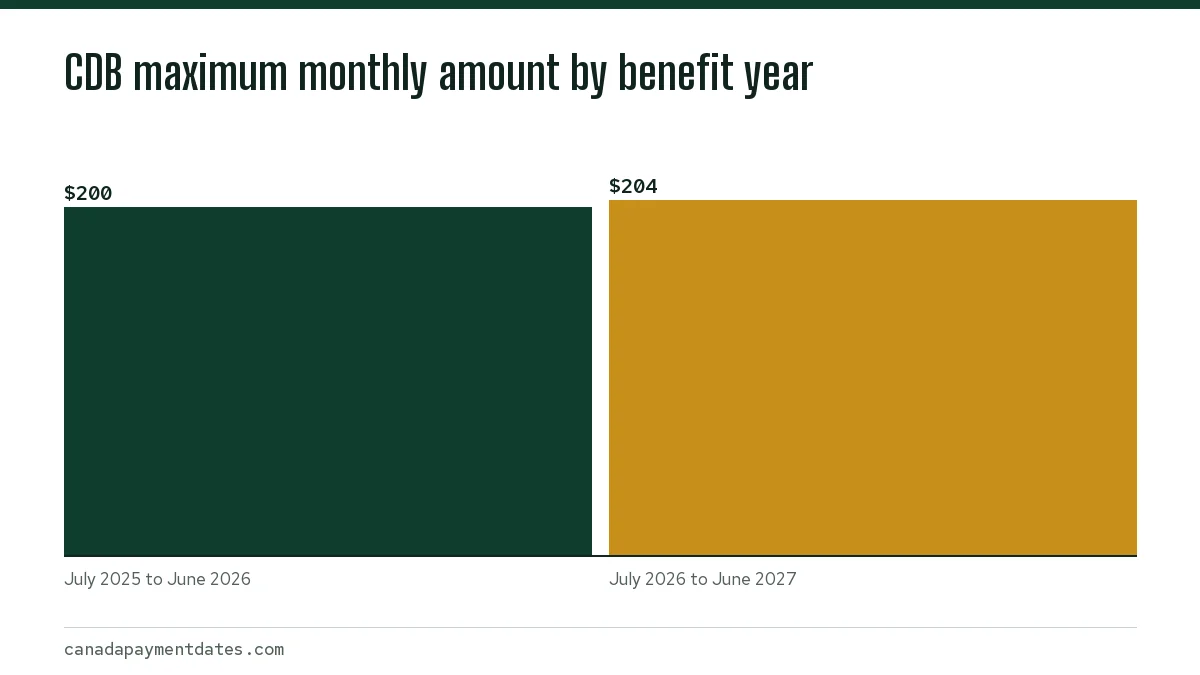
The working income exemptions were raised at the same time: from $10,000 to $10,210 for singles and from $14,000 to $14,294 for couples. The July 2027 rate is not yet announced, so any figure you see for it elsewhere is an estimate.
Canada Disability Benefit income thresholds and reduction rates
The Canada Disability Benefit income threshold is $23,000 for a single person and $32,500 for a couple. Below the threshold you get the full amount. Above it, the yearly benefit is reduced by a set share of every dollar over the line.
| Household | Full benefit if AFNI is | Reduction | Benefit ends around |
|---|---|---|---|
| Single | $23,000 or less | 20 cents per dollar | $35,252 |
| Couple, one partner eligible | $32,500 or less | 20 cents per dollar | $44,752 |
| Couple, both partners eligible | $32,500 or less | 10 cents per dollar, each | $57,004 |
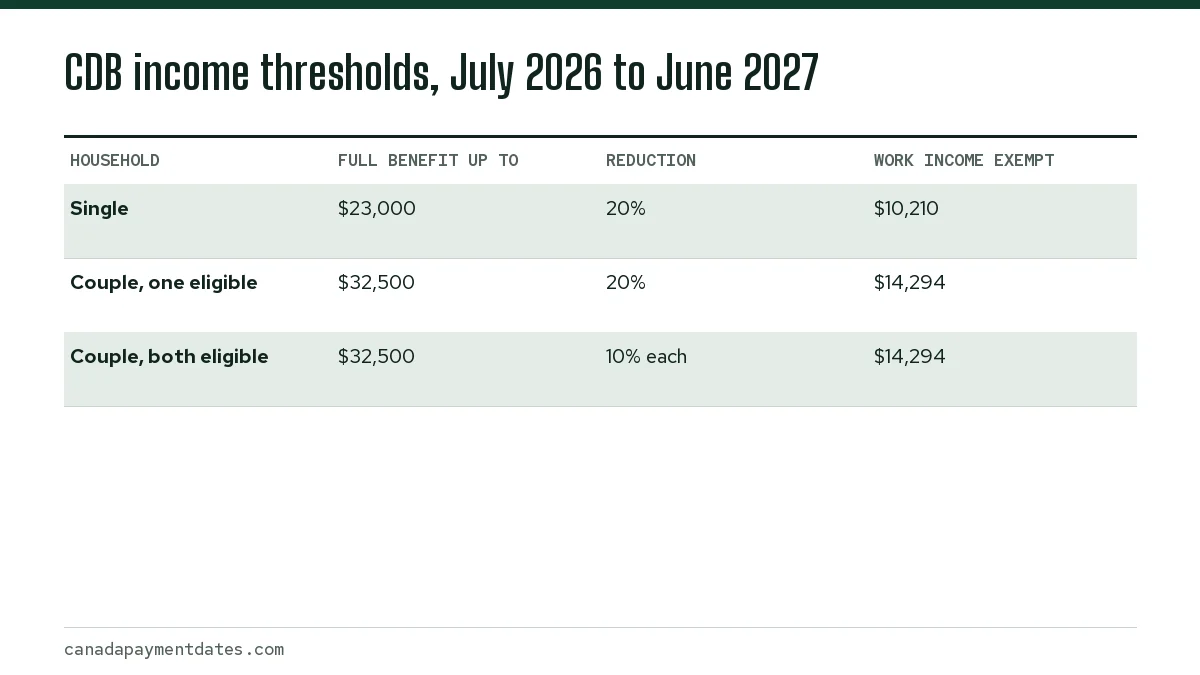
The last column is our calculation, not a published figure: the $2,450.40 annual maximum divided by the reduction rate, added to the threshold. It assumes no working income. Job or self-employment income pushes these end points higher because part of it is exempt.
How the working income exemption changes your amount
The working income exemption removes part of your earnings from the income test. Canada.ca says income from employment, self-employment and taxable scholarships counts as working income, and up to $10,210 of it (single) or $14,294 of combined working income (couple) is excluded when your benefit is calculated for July 2026 to June 2027.
The exemption is applied before the income is compared with the threshold. So a single person with $10,000 of wages and $15,000 of other income is tested on $15,000, not $25,000, and receives the full amount. Earning more than the exemption does not automatically cut the benefit; it only matters once the counted income passes the threshold.
Pension income, CPP disability benefits, EI and social assistance are not working income, so they count in full. People who combine CPP disability with the CDB often see a reduction for that reason; the CPP disability amount page shows those figures.
Canada Disability Benefit amount examples
These examples use the July 2026 to June 2027 rules and round monthly figures to the cent. They are illustrations; your approval letter shows your actual amount.
| Situation | Income counted | Yearly reduction | Monthly CDB |
|---|---|---|---|
| Single, $18,500 AFNI, no job income | $18,500 | $0 | $204.20 |
| Single, $31,000 AFNI including $12,000 wages | $31,000 minus $10,210 = $20,790 | $0 | $204.20 |
| Single, $35,000 AFNI, all employment income | $35,000 minus $10,210 = $24,790 | 20% of $1,790 = $358 | $174.37 |
| Single, $28,000 AFNI, all pension and CPP | $28,000 | 20% of $5,000 = $1,000 | $120.87 |
| Couple, one eligible, $38,000 AFNI, no wages | $38,000 | 20% of $5,500 = $1,100 | $112.53 |
| Couple, both eligible, $38,000 AFNI, no wages | $38,000 | 10% of $5,500 = $550 each | $158.37 each |
Canada.ca's own example checks out against this method: a single person with $35,000 of employment income received $166.67 a month in 2025-26, under that year's $200 maximum and $10,000 exemption. With the July 2026 figures, the same income gives $174.37 a month, as the table shows.
How to calculate your own amount
- Add your net income (line 23600) and your spouse's, then remove any UCCB or RDSP income. This is your AFNI.
- Subtract working income up to $10,210 (single) or $14,294 (couple combined).
- Subtract the threshold: $23,000 single or $32,500 couple. If the result is zero or less, you get $204.20 a month.
- Multiply what is left by 0.20, or by 0.10 if both partners qualify for the CDB.
- Subtract that from $2,450.40 and divide by 12 for the monthly amount.
If the yearly result is $240 or less, Service Canada pays it as one lump sum rather than monthly. For a single person with no job income that happens above roughly $34,052 of AFNI.
What can change your CDB amount during the year
Your amount is normally set once a year, in the confirmation letter Service Canada mails every June for the July to June period. A few events can change it in between.
- A new spouse or common-law partner, or a separation, which changes the family income and threshold used.
- Your partner also getting approved for the CDB, which switches the reduction to 10% each.
- A reassessed tax return that changes line 23600.
- Turning 65, after which the CDB ends.
- A missed tax return; payments can stop until it is filed.
Tell Service Canada about relationship changes and also update the CRA. For when the money arrives, see CDB payment dates; for who can receive it at all, see CDB eligibility. If you applied late, back months are paid at the rate for each period, as the CDB back pay page explains. The full program overview is on the Canada Disability Benefit hub.
Common questions
How much is the Canada Disability Benefit per year?
Up to $2,450.40 for July 2026 to June 2027, which is 12 payments of $204.20. The previous year's maximum was $2,400.
What income is too high for the Canada Disability Benefit?
With no job income, the benefit reaches zero at about $35,252 of adjusted family net income for a single person, about $44,752 for a couple with one eligible partner and about $57,004 when both partners qualify. These are our calculations from the published rates.
Does my spouse's income affect the CDB?
Yes. The test uses adjusted family net income, which includes your spouse or common-law partner's net income, but couples get a higher $32,500 threshold and a $14,294 combined working income exemption.
Does CPP disability reduce the Canada Disability Benefit?
It can. CPP disability counts in your net income and is not working income, so if it pushes your AFNI over $23,000 as a single person, your CDB is reduced by 20% of the excess.
Will the CDB go up in July 2027?
It is adjusted for inflation each year, and the payment period runs from July 1 to June 30, so the next change is due with the July 2027 payment. The July 2027 rate is not yet announced. Until then, $204.20 is the current maximum, and your July 2027 amount will be based on your 2026 tax return.
Is the Canada Disability Benefit amount the same in Quebec?
Yes. The CDB is a federal benefit paid by Service Canada, so the $204.20 maximum, the income thresholds and the working income exemptions are the same in every province and territory, including Quebec. Provincial disability assistance is a separate program with its own rules.
When is the next Canada Disability Benefit payment?
Payments are sent on the third Thursday of each month; the next two are November 19 and December 17, 2026. Your amount stays the same until the July 2027 recalculation unless your situation changes.
Sources
- Canada Disability Benefit: How much you could receive canada.ca
- Canada Disability Benefit: Payments canada.ca
- Canada Disability Benefit (CDB) canada.ca
We check figures against these official pages. Rules change; confirm anything that affects a deadline or payment with the agency before you act.
Tell us what happened
Describe your situation and our editors will use it to improve this guide. If you leave your email, we may reply with a pointer to the right page or official contact. We never share your details.