
Is the Canada Disability Benefit taxable? Tax, reporting and provincial assistance
Short answer
Is Canada Disability Benefit money taxable? No. Canada.ca says CDB payments are non-taxable, you do not report them on your income tax return, and Service Canada issues no tax slip. The Income Tax Act was amended so the benefit is not counted as income. Provincial social assistance programs set their own rules, so the CDB can still affect those.
- 01Taxable?
- No
- 02Reported on your return?
- No, and no slip is issued
- 03Counts in net income (line 23600)?
- No
- 04Back pay and $150 supplement
- Also CDB payments, not reported
- 05Tax return still required?
- Yes, by April 30 each year
Is the Canada Disability Benefit taxable income?
No. The Canada Disability Benefit is not taxable income. Canada.ca's CDB payments page states that the payments do not need to be reported as income on your income tax return and that no tax slips are issued for them (checked September 2026).
The legal reason is a change to the Income Tax Act. The 2024 Fall Economic Statement announced the government would exempt the CDB from income, and ESDC's program page now refers to the Income Tax Act amendments that exempt CDB payments from being treated as income. So a person who receives $2,450.40 of CDB in a year owes exactly the same tax as they would without it.
Do I report CDB payments on my tax return?
No. There is no line for the CDB on the T1 return and nothing to enter in tax software. If your software asks about government benefits, it is looking for taxable ones such as a T4A(P) from CPP or a T5007 for social assistance, not the CDB.
The same applies to the lump sums. CDB back payments covering past months, and the one-time $150 supplemental payment, are paid under the Canada Disability Benefit program, and Canada.ca's statement that CDB payments are not reported and carry no slip covers them. You do not need to adjust earlier returns for a back-pay deposit; see CDB back pay and the CDB supplemental payment.
Canada Disability Benefit tax treatment compared with other disability payments
People often receive several disability-related payments, and the tax rules are not the same for each. This table shows where each one goes on a return.
| Payment | Taxable? | Tax slip | Where it goes |
|---|---|---|---|
| Canada Disability Benefit | No | None | Not reported |
| NL Disability Benefit | No | None | Not reported |
| Child Disability Benefit (with CCB) | No | None | Not reported |
| CPP disability benefit | Yes | T4A(P) | Line 11400 (CPP benefits) |
| Provincial social assistance | Reported, then deducted | T5007 | Line 14500, deducted at line 25000 |
The Disability Tax Credit is a different thing again: it is not a payment but a non-refundable credit you claim as the disability amount on line 31600 to lower tax owed. Having the DTC is what makes you eligible for the CDB, but claiming it does not make the CDB taxable. The Canada Disability Benefit hub explains how the two connect.
Does the CDB count as income for other federal benefits?
No. Because the CDB is exempt from income under the Income Tax Act, it never enters net income on line 23600. Federal programs that test income using your return therefore do not see it.
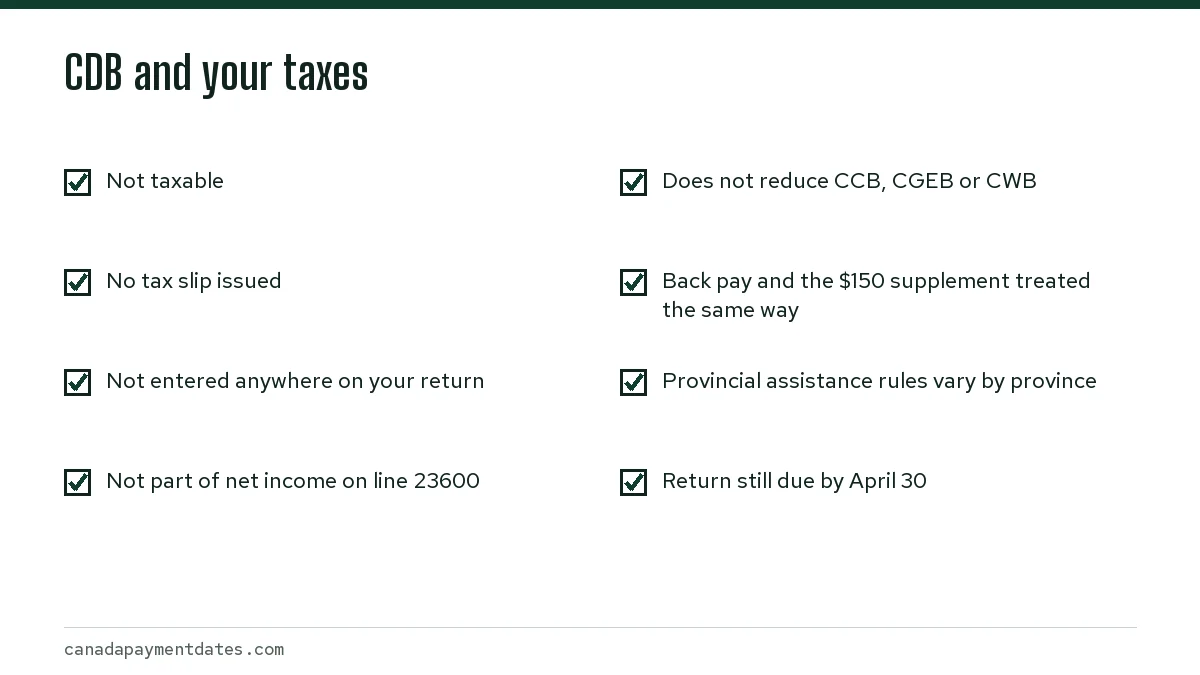
In practice, receiving the CDB will not lower your next Canada Child Benefit, Canada Groceries and Essentials Benefit or Canada Workers Benefit, and it will not push you over the $90,000 limit for the Canadian Dental Care Plan. It also does not reduce the CDB itself the following year, since the CDB income test uses the same adjusted family net income.
Two small caveats. Interest you earn by saving CDB money in a bank account is ordinary investment income and is taxable. And the CDB is not earned income, so it does not create RRSP contribution room or count as working income for the CWB.
Does the CDB affect provincial disability assistance?
It depends on your province or territory. Provincial and territorial assistance programs have their own income rules, and the federal tax exemption does not bind them.
A federal Question Period note dated May 23, 2025 recorded that Alberta had chosen to claw back the CDB from its social assistance programs, in particular Assured Income for the Severely Handicapped (AISH), while several other provinces and territories had told federal officials they intended not to claw it back. Provincial policies can change, so confirm the current rule with your own program.
What to do if you receive provincial assistance
- Ask your caseworker or program office, in writing, whether CDB payments are exempt or deducted, and whether lump sums such as back pay are treated differently.
- Report the CDB if your program's rules require you to declare all income, even if it is exempt. Not reporting can create an overpayment later.
- Keep your Service Canada decision letter and the June confirmation letter as proof of the amount.
- If a reduction looks wrong, use your province's review or appeal process; Service Canada cannot change provincial decisions.
Newfoundland and Labrador also pays its own tax-free NL disability benefit on top of the CDB, administered by the CRA.
Tax season checklist for CDB recipients
Filing matters more than tax for CDB recipients, because the return sets next year's amount. Your 2026 return, filed in spring 2027, will set the benefit from July 2027.
- File by April 30, 2027, and make sure your spouse or partner does too.
- Leave the CDB off the return entirely.
- Claim the disability amount on line 31600 if your DTC covers 2026.
- Report any T4A(P), T5007 or T4 slips you did receive.
- Check that the CRA and Service Canada both have your current address and bank account.
Do not count on automatic filing yet. Bill C-31, the Budget 2025 Implementation Act, No. 2, proposes letting the CRA file a return for some low-income people who have not been filing, but it had not received Royal Assent as of mid-October 2026. On October 5, 2026, the Taxpayers' Ombudsperson asked the House of Commons finance committee to review those provisions, warning they could interrupt benefit payments. Pre-filled returns that you review and approve yourself are expected to launch in March 2027.
Monthly deposit timing is on CDB payment dates.
Common questions
Do I get a T4A or T5007 for the Canada Disability Benefit?
No. Service Canada does not issue any tax slip for CDB payments, because they are not reported on your return.
Does the CDB count toward the OAS clawback or GIS?
The CDB ends at 65, when OAS usually starts, and in any case it is excluded from net income, so it does not count toward income-tested federal benefits.
Is CDB back pay taxable in the year I receive it?
No. Back payments are CDB payments, which are not taxable and are not reported in any year.
Does Alberta claw back the Canada Disability Benefit from AISH?
A May 2025 federal briefing note said Alberta had chosen to claw back the CDB from AISH. Check with Alberta's AISH program for the current rule.
Why do I have to file taxes if the CDB is not taxable?
Service Canada uses your and your spouse's returns to confirm eligibility and calculate the amount. A missing return can stop payments.
Will the CRA file my taxes automatically so my CDB keeps coming?
Not under current law. Automatic filing for some low-income people is only a proposal in Bill C-31, which had not received Royal Assent as of mid-October 2026. File your own return, and make sure your spouse or partner files too.
Sources
- Canada Disability Benefit: Payments canada.ca
- About the Canada Disability Benefit program (ESDC) canada.ca
- Question Period Note: Canada Disability Benefit (May 2025) search.open.canada.ca
- Canada Disability Benefit (CDB) canada.ca
We check figures against these official pages. Rules change; confirm anything that affects a deadline or payment with the agency before you act.
Tell us what happened
Describe your situation and our editors will use it to improve this guide. If you leave your email, we may reply with a pointer to the right page or official contact. We never share your details.