
Ontario energy and property tax credit: who qualifies and how it is paid
Short answer
The Ontario energy and property tax credit (OEPTC) pays up to $1,307 a year to people under 64, or $1,488 to seniors, for July 2026 to June 2027. Renters and homeowners both qualify, and the credit is paid inside the monthly Ontario Trillium Benefit on the 10th. You claim it on Form ON-BEN with your 2025 return.
- 01Maximum, under 64
- $1,307 ($290 energy + $1,017 property tax)
- 02Maximum, seniors
- $1,488 ($290 energy + $1,198 property tax)
- 03Renters count
- 20% of rent paid as occupancy cost
- 04Income reduction
- 2% of income over $29,047 (single) or $36,309 (others)
- 05Paid through
- Ontario Trillium Benefit, monthly on the 10th
What is the Ontario energy and property tax credit?
The Ontario energy and property tax credit is a refundable provincial credit that gives back part of the sales tax on home energy and part of the property tax that Ontario residents pay, either directly as owners or indirectly through rent. It is calculated by the Canada Revenue Agency (CRA) and paid as one of three parts of the Ontario Trillium Benefit (OTB).
The credit has two components. The energy component is capped at $290. The property tax component is capped at $1,017 for people under 64 and $1,198 for seniors. Together they give the OEPTC maximums of $1,307 and $1,488 for the 2026 benefit year (CRA, OEPTC questions and answers).
Who meets the Ontario energy and property tax credit eligibility rules?
You can get the 2026 OEPTC if you lived in Ontario on December 31, 2025, meet an age or family test, and paid one of four kinds of housing costs for 2025.
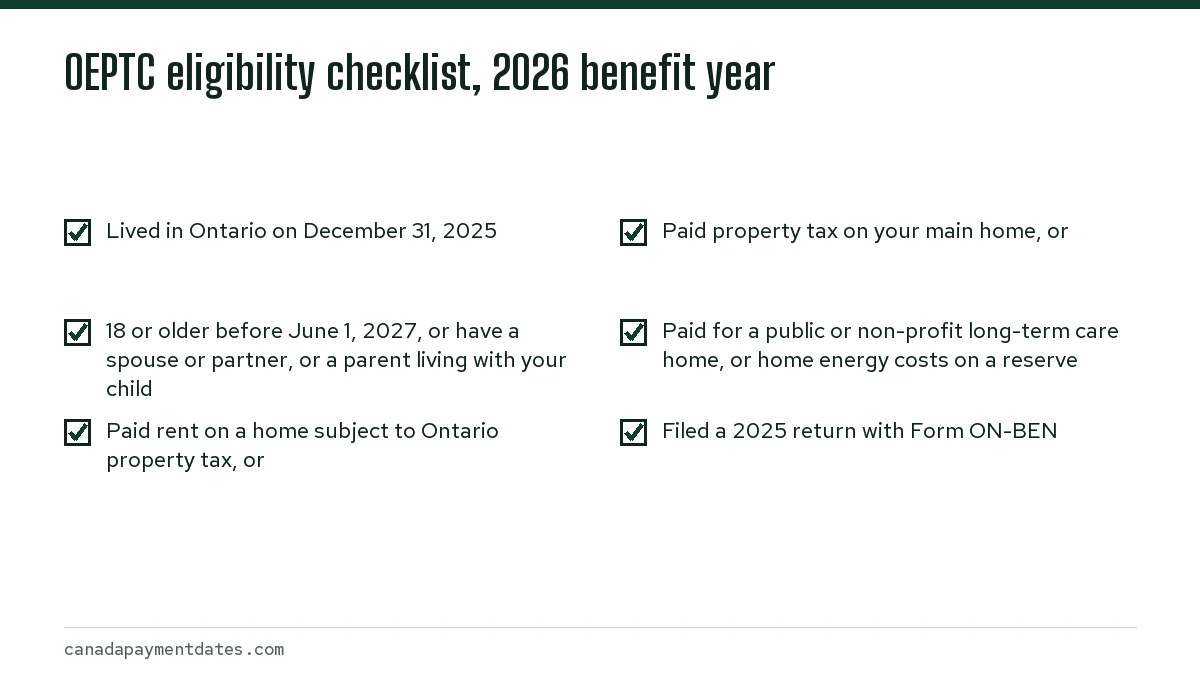
The CRA treats you as a senior for this credit if you were 64 or older on December 31, 2025. Seniors get the higher property tax cap and, when single, the higher income threshold of $36,309.
Do renters qualify for the OEPTC?
Yes. Renters qualify as long as their building is subject to Ontario municipal and school property tax. The CRA counts 20% of the rent you paid in 2025 as your occupancy cost, on the reasoning that part of every rent cheque covers the landlord's property tax.
Some rent does not count. Rent for a home that pays no municipal or school tax, such as a tax-exempt social housing unit or a home on a reserve, is excluded, and so are condo fees. Students in a designated university, college or private school residence get a flat $25 instead of claiming rent.
Worked example: couple renting in Ottawa
- A couple, both 40, paid $2,200 a month in rent in 2025: $26,400 for the year.
- Occupancy cost: 20% of $26,400 = $5,280.
- Energy component: the lesser of $5,280 and $290 = $290.
- Property tax component: 10% of $5,280 = $528 (below the $944 cap), plus $73 = $601.
- Credit before the income test: $290 + $601 = $891.
- Their adjusted family net income was $52,000. Income over $36,309 is $15,691; 2% is $313.82.
- OEPTC for the year: $891 minus $313.82 = $577.18, about $48.10 a month inside the OTB.
How much can homeowners and seniors get?
Homeowners use the property tax they actually paid for their main home in 2025 as the occupancy cost, with no 20% adjustment. For seniors, the property tax component is 10% of that cost (capped at $581) plus a base of $617, so seniors with modest property taxes still reach a large credit.
Worked example: senior homeowner in Kingston
A widow aged 72 paid $3,800 in property tax in 2025 and had net income of $31,000. Her energy component is $290. Her property tax component is 10% of $3,800 ($380) plus $617, or $997. Because her income is under the $36,309 senior threshold, nothing is deducted: her OEPTC is $1,287 for the year, about $107.25 a month.
| Situation | Energy component | Property tax component | Maximum OEPTC |
|---|---|---|---|
| Under 64, renter or owner | Up to $290 | 10% of occupancy cost (max $944) + $73 | $1,307 |
| 64 or older, renter or owner | Up to $290 | 10% of occupancy cost (max $581) + $617 | $1,488 |
| Public or non-profit long-term care home | 20% of accommodation cost, up to $290 | None | $290 |
| Home energy costs on a reserve | Energy costs paid, up to $290 | None | $290 |
| Designated student residence | None | $25 | $25 |
Seniors who own their home may also receive the Ontario Senior Homeowners' Property Tax Grant of up to $500, claimed on the same form; the CRA's calculation sheet adjusts the OEPTC when both apply. Low-income seniors can also receive GAINS, a separate monthly top-up.
How is the OEPTC paid?
The OEPTC is not paid on its own. The CRA adds it to your Ontario sales tax credit and, if you live in the north, the Northern Ontario energy credit, then pays the total as the Ontario Trillium Benefit.
- Total OTB over $500: one-twelfth each month on the 10th, July 2026 to June 2027, or one payment on June 10, 2027 if you chose it.
- Total OTB of $500 or less: paid in full in July.
- The remaining 2026 OTB dates are November 10 and December 10; the full list is on the OTB payment dates page.
How do you claim the Ontario energy and property tax credit?
You claim it by completing Form ON-BEN with your 2025 income tax and benefit return. Unlike the Ontario sales tax credit, it is not automatic: no ON-BEN, no OEPTC.
- Gather your 2025 rent receipts or property tax bills, or long-term care statements.
- On Form ON-BEN, enter the amounts for your main home and the landlord or municipality.
- If you have a spouse or common-law partner, decide who applies. Either can claim for both, but if only one of you was 64 or older on December 31, 2025, that person must.
- File the return and keep the receipts. The CRA does not require them upfront but may ask to see them.
Families should also check that their Ontario Child Benefit is flowing, since the same household income drives both. The Ontario benefit payment dates page has every Ontario deposit in one place.
Common questions
Can I claim the Ontario energy and property tax credit if I rent a room?
Yes, if the home is subject to Ontario property tax and you paid rent for it as your main residence. Claim 20% of the rent you actually paid.
Do utility bills count for the OEPTC?
Not for most people. The credit uses rent or property tax as the occupancy cost; actual home energy bills count only for people living on a reserve.
Why is my OEPTC lower than the maximum?
Either your rent or property tax was not high enough to reach the caps, or your 2025 adjusted family net income was above $29,047 (single) or $36,309 (others), which reduces the credit by 2% of the excess.
Do both spouses get the OEPTC?
No. One spouse or common-law partner claims it for the household, and the same person must also claim the Northern Ontario energy credit if it applies.
Does long-term care count for the Ontario energy and property tax credit?
Yes, for a public or non-profit long-term care home. 20% of the accommodation cost counts toward the energy component, up to $290.
Sources
- Ontario energy and property tax credit questions and answers (CRA) canada.ca
- 2026 OEPTC calculation sheets (CRA) canada.ca
- Province of Ontario programs (CRA) canada.ca
- Ontario Trillium Benefit (Government of Ontario) ontario.ca
We check figures against these official pages. Rules change; confirm anything that affects a deadline or payment with the agency before you act.
Tell us what happened
Describe your situation and our editors will use it to improve this guide. If you leave your email, we may reply with a pointer to the right page or official contact. We never share your details.