
Canada Carbon Rebate: why it stopped and what late filers can still collect
Short answer
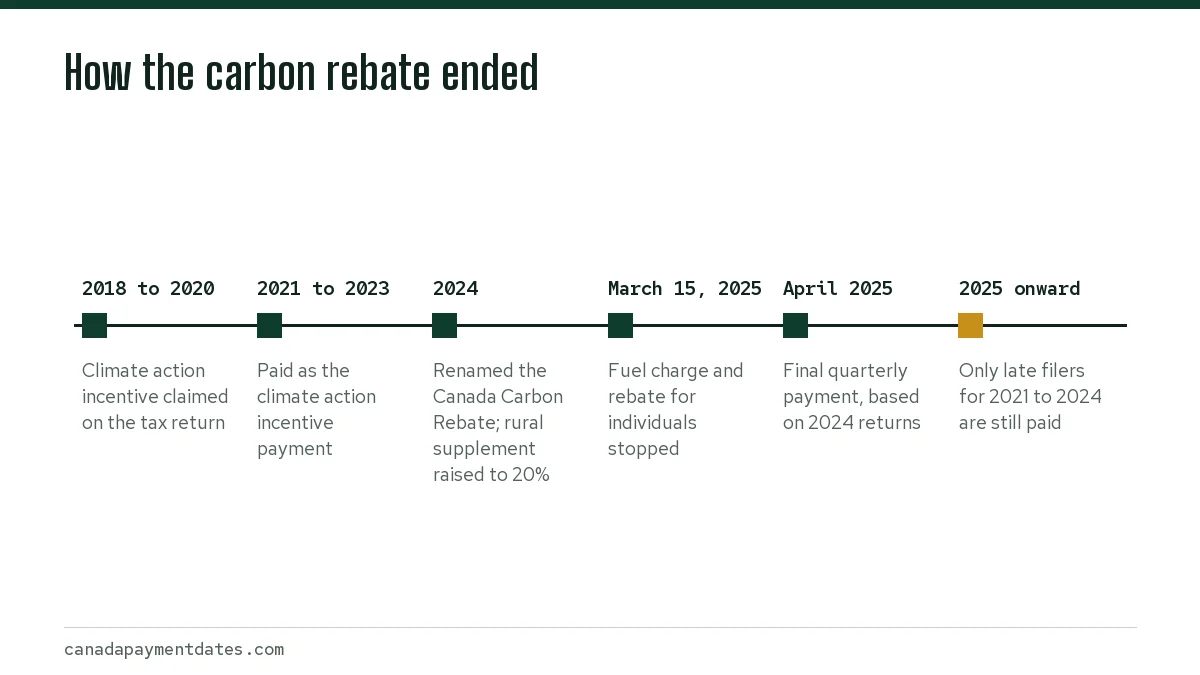
The Canada Carbon Rebate is no longer paid: the federal government ended it for individuals on March 15, 2025, and the April 2025 deposit was the final quarterly payment. There is no Canada Carbon Rebate in 2026 or 2027. People who were eligible but never filed a return for 2021, 2022, 2023 or 2024 can still receive those amounts by filing, and a bill before Parliament would make October 30, 2026 the last day to do it.
- 01Program ended
- March 15, 2025
- 02Final quarterly payment
- April 2025
- 03Years late filers can still collect
- 2021, 2022, 2023 and 2024; file by October 30, 2026 (proposed)
- 04Largest April 2025 individual amount
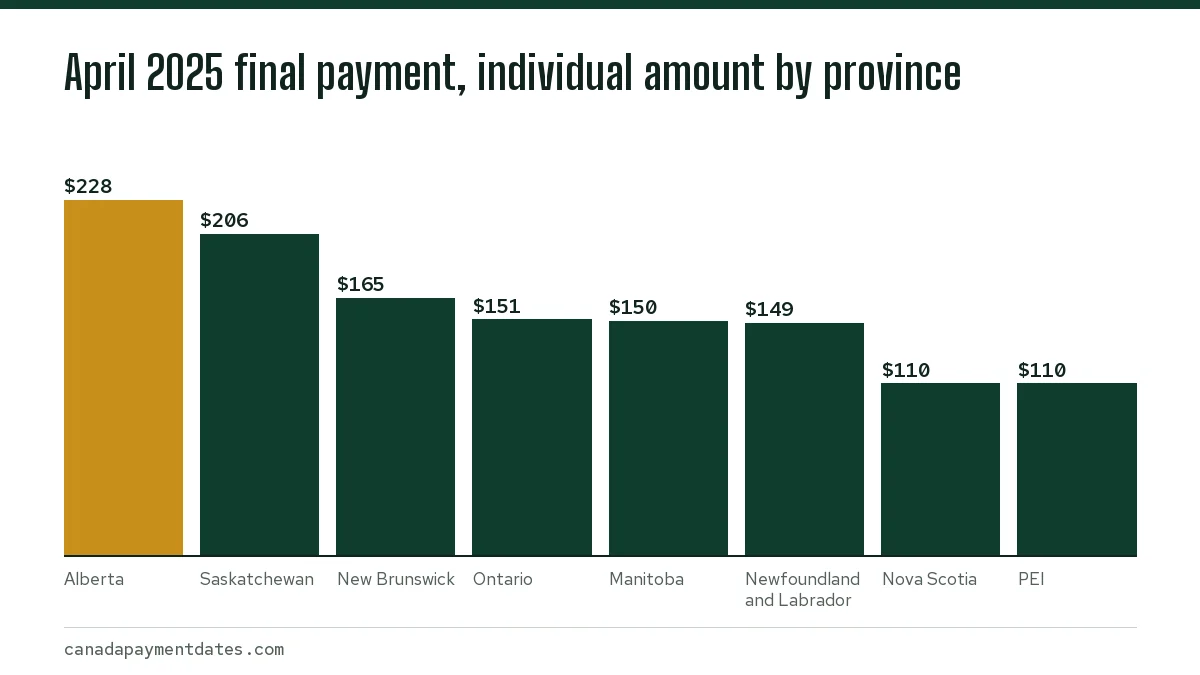
- $228 in Alberta, plus a $45.60 rural supplement
- 05Former name
- Climate action incentive payment (CAIP)
Is the Canada Carbon Rebate still paid in 2026?
No. The Canada Carbon Rebate (CCR) was a tax-free quarterly payment that offset the federal fuel charge in provinces using the federal carbon pricing system. On March 15, 2025, the Government of Canada stopped both the fuel charge and the rebate for individuals, and the CRA says there are no quarterly payments after April 2025 (CRA, Canada Carbon Rebate).
So a search for the Canada Carbon Rebate 2026 schedule turns up nothing because none exists. If money labelled as a carbon payment reaches your account in 2026, it is almost certainly a late-filer payment for an older year, not a new quarterly instalment.
When was the last Canada Carbon Rebate payment?
The last scheduled payment was in April 2025, and it was a single payment based on the 2024 tax return. Earlier years paid four times a year; the 2023 base year, for example, paid quarterly from April 2024 to January 2025.
Anyone who e-filed a 2024 return after April 2, 2025 missed the regular April run. The CRA says those people receive the final payment once the 2024 return is assessed, so it may have arrived weeks or months later with a notice of assessment.
What did the final April 2025 payment pay?
The amount depended on your province and family, not your income. The CCR was never reduced as income rose. These were the 2024 base year amounts for the April 2025 payment, from the CRA's amounts page:
| Province | Individual | Spouse or partner | Each child under 19 | Rural supplement |
|---|---|---|---|---|
| Alberta | $228 | $114 | $57 | 20% extra |
| Saskatchewan | $206 | $103 | $51.50 | 20% extra |
| New Brunswick | $165 | $82.50 | $41.25 | 20% extra |
| Ontario | $151 | $75.50 | $37.75 | 20% extra |
| Manitoba | $150 | $75 | $37.50 | 20% extra |
| Newfoundland and Labrador | $149 | $74.50 | $37.25 | 20% extra |
| Nova Scotia | $110 | $55 | $27.50 | 20% extra |
| Prince Edward Island | $110 | $55 | $27.50 | Built into the base |
A single parent received the spouse amount for the first child instead of the child amount. Worked example: an Ontario couple with two children in a city received $151 + $75.50 + $37.75 + $37.75 = $302 in April 2025. The same family outside a census metropolitan area received 20% more, or $362.40.
Can late filers still get the Canada Carbon Rebate?
Yes. If you were eligible but have not filed your 2021, 2022, 2023 or 2024 return, the CRA will pay the rebate for that base year once the return is assessed. Residents of Canada do not apply separately; the return is the application, even if you had no income to report.
- File each missing return for 2021 to 2024. A return with zero income still counts.
- If you lived outside a census metropolitan area, tick the rural supplement box on page 2 of each return. PEI residents skip this because their supplement was built into the base amount.
- If you have a spouse or common-law partner, both of you should file. Only one person receives the family payment, usually whoever is assessed first, but the amount is the same.
- Make sure your children are registered for the Canada Child Benefit or the Canada Groceries and Essentials Benefit so a child amount is included.
- Watch for the payment after your notice of assessment. It is labelled Canada Carbon Rebate, or Climate Action Incentive at some banks.
What if I was a newcomer during those years?
Newcomers apply by form. If you qualified for the Canada Child Benefit, send Form RC66, Canada Child Benefits Application, with Form RC66SCH for your status and income. If you did not, send Form RC151, the Canada Groceries and Essentials Benefit application for people who become residents. Mail the forms to your tax centre.
Who was eligible for the climate action incentive payment?
Eligibility was tested at the start of each payment month. You needed to be a Canadian resident in the month before the payment and live in one of eight provinces on the first day of the payment month: Alberta, Manitoba, New Brunswick, Newfoundland and Labrador, Nova Scotia, Ontario, Prince Edward Island or Saskatchewan.
You also had to be 19 or older, or under 19 with a spouse, partner or child you lived with. The rebate was never paid in British Columbia, Quebec, Yukon, the Northwest Territories or Nunavut, which ran their own carbon pricing. BC's version is covered in the BC climate action tax credit, which also ended in April 2025.
Parents sharing custody received 50% of the child amount each. The program went through three names: the Climate action incentive (a credit on the 2018 to 2020 returns, claimed on Schedule 14), the climate action incentive payment from 2021 to 2023, and the Canada Carbon Rebate from 2024.
Is the Canada Carbon Rebate the same as the Canada Groceries and Essentials Benefit?
No. The Canada Groceries and Essentials Benefit (CGEB) replaced the GST/HST credit in July 2026. It did not replace the carbon rebate. The CGEB is income-tested, paid in July, October, January and April, and pays up to $679 a year to a single person for July 2026 to June 2027 (CRA, CGEB).
The carbon rebate had no income test and went to eligible households in eight provinces regardless of earnings. Many families received both for years because the two deposits were separate. Only the CGEB continues; see the Canada Groceries and Essentials Benefit for its 2026 amounts.
Why did I get a letter about the rural supplement?
The CRA says some people received the rural supplement without being entitled to it, and it must recover those amounts. Affected people were sent an official notification starting April 15, 2025. The supplement was only for residents outside a census metropolitan area under 2016 Census data.
If you received such a notice and believe you did live in a qualifying community, you can ask the CRA to review it using the address shown for that year. Keep a record of your address for each payment period. The notice and any balance owing also appear in My Account; our CRA My Account guide shows where.
What replaced the carbon rebate for seniors and low-income households?
Nothing replaced it one for one. Lower-income households now rely on the larger CGEB, provincial credits and, for seniors, the Guaranteed Income Supplement. Our benefits for seniors in Canada page lists what is still paid, and the full CRA benefits list shows every program that remains.
Seniors who stopped filing because their income was low have two reasons to catch up: unpaid carbon rebate amounts for 2021 to 2024, and income-tested payments like GIS that stop without a current return. People aged 60 to 64 in a low-income couple should also check whether OAS or the Allowance can start before 65, since the Allowance is tested against a filed return too.
Step by step
File each missing return
File the 2021, 2022, 2023 or 2024 return you skipped, even with zero income.
Claim the rural supplement
Tick the box on page 2 if you lived outside a census metropolitan area (not needed in PEI).
Register your children
Make sure children are registered for the CCB or CGEB so the child amount is added.
Wait for assessment
The payment is issued after the CRA assesses the return.
Common questions
Will there be a Canada Carbon Rebate in 2026?
No. The rebate ended March 15, 2025 and the last quarterly payment was April 2025. The only carbon rebate payments made in 2026 are catch-up amounts for people who file late returns for 2021 to 2024.
Why did I get a carbon rebate payment in 2026?
It is most likely a late payment for an earlier base year, released after the CRA assessed a 2021 to 2024 return, or a reassessment that changed your family situation for a past period.
Do I have to pay back the Canada Carbon Rebate?
Not if you were entitled to it. The CRA is recovering rural supplement amounts paid to people outside qualifying areas, and it recovers any payment made on a wrong address or family situation. It does not charge interest on rebate overpayments.
Is the Canada Carbon Rebate taxable?
No. It was a tax-free payment, and you do not report amounts received, including late-filer catch-up payments, as income.
How far back can I claim the climate action incentive payment?
The CRA lists 2021, 2022, 2023 and 2024 as the years late filers can still receive. Bill C-31 would end those catch-up payments for returns or adjustment requests filed after October 30, 2026. For the 2018 to 2020 climate action incentive, you claimed it as a credit on Schedule 14 of those years' returns.
Sources
- Library of Parliament: Legislative Summary of Bill C-31 lop.parl.ca
- Closed: Canada Carbon Rebate for individuals canada.ca
- CCR: payments for those who have not yet filed canada.ca
- CCR: how much the payment amounts were canada.ca
- CCR: who was eligible canada.ca
- CCR: what has changed canada.ca
- Canada Groceries and Essentials Benefit canada.ca
We check figures against these official pages. Rules change; confirm anything that affects a deadline or payment with the agency before you act.
Tell us what happened
Describe your situation and our editors will use it to improve this guide. If you leave your email, we may reply with a pointer to the right page or official contact. We never share your details.
Related guides
 CRA Benefits: Every Federal Benefit and When It Is Paid
CRA benefits are payments the Canada Revenue Agency works out from your tax return, mainly the Canada Child Benefit, the Canada G…
Canada Groceries and Essentials Benefit: What Has Changed
The Canada Groceries and Essentials Benefit (CGEB) is the new name for the GST/HST credit, in effect since July 2026. It pays abo…
BC Climate Action Tax Credit: Why It Ended in April 2025
The BC climate action tax credit, often called BC's carbon tax rebate, is no longer paid. British Columbia eliminated its consume…
Benefits for Seniors in Canada: Payments to Check at 65
The main benefits for seniors in Canada are the Canada Pension Plan (up to $1,507.65 a month at 65 in 2026), Old Age Security (up…
Canadian Dental Care Plan Eligibility: The $90,000 Limit
Canadian Dental Care Plan eligibility comes down to four rules: no access to private dental insurance, a filed tax return for you…