
Automatic tax filing in Canada: what is proposed and what it means for your benefits
Short answer
Automatic tax filing in Canada is still a proposal. Budget 2025 would let the CRA file a return for some lower-income people who do not file, but Bill C-31, which contains it, was still at committee stage on October 20, 2026. Until it passes, file your 2026 return yourself by April 30, 2027 to keep the Canada Child Benefit, the Canada Groceries and Essentials Benefit and other payments coming.
- 01Status on October 20, 2026
- Proposed; Bill C-31 at House of Commons committee
- 02Who it targets
- Lower-income non-filers whose income is all reported on slips
- 03Review window
- 90 days to check, change or opt out
- 04Pre-filled return service
- Planned for March 2027
- 05Government target
- Up to 5.5 million people by the 2028 tax year
Is automatic tax filing in effect in Canada?
Not yet. Automatic tax filing in Canada needs a change to the Income Tax Act, and that change sits in Bill C-31, the Budget 2025 Implementation Act, No. 2. The bill was introduced on May 6, 2026 and passed second reading on June 3, 2026. As of October 20, 2026, it was being studied by the House of Commons finance committee, which met on it on October 6 and October 8, while a Senate committee ran a pre-study. It has not received royal assent.
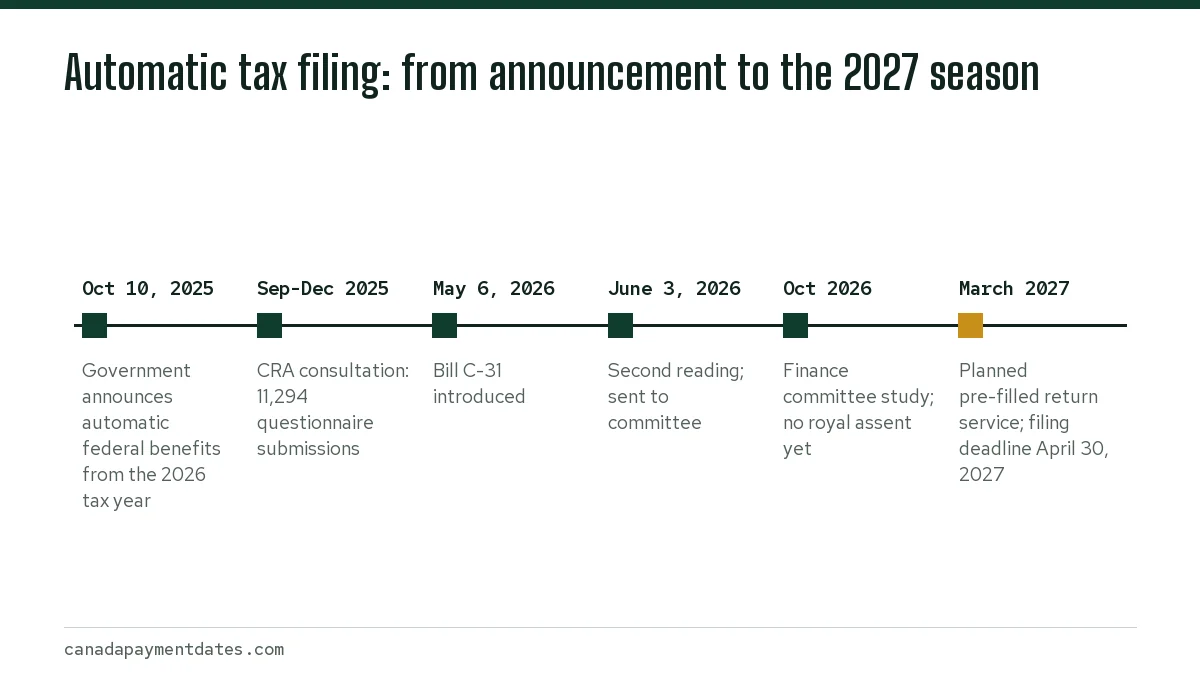
Until the law passes, the CRA has no power to file a return on your behalf. The CRA's own consultation report describes even its first, small deemed-filing pilot as pending royal assent. So for the 2027 filing season, plan as if you must file yourself.
Who would qualify for automatic tax filing?
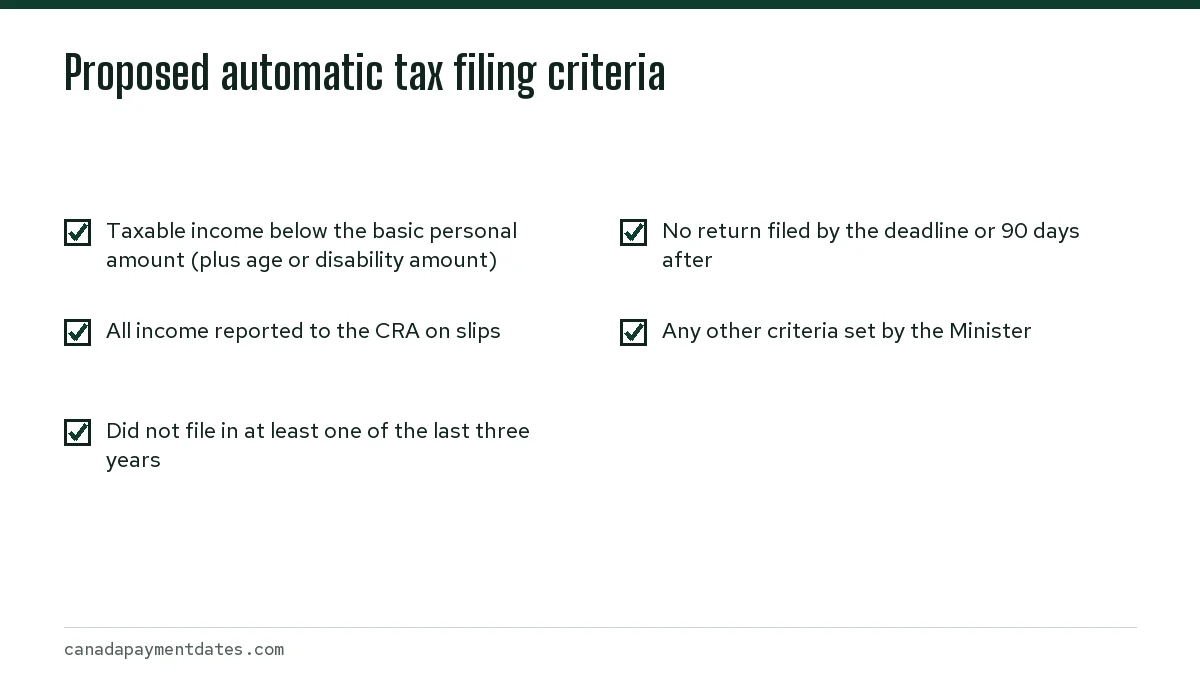
Budget 2025 proposes a discretionary power for the CRA to file a return for an individual, other than a trust, who meets every one of these conditions:
- Taxable income for the year is below the lower of the federal basic personal amount or its provincial equivalent, plus the age or disability amount where it applies.
- All of the person's income comes from sources reported to the CRA on information returns, such as T4 or T4A slips.
- The person did not file a return in at least one of the three previous tax years.
- No return for the year has been filed by the deadline or within 90 days after it.
- Any other criteria set by the Minister of National Revenue are met.
In plain terms, it is aimed at people who would owe nothing and usually miss out on benefits because they do not file. The CRA has said it does not plan to deem file returns where taxes are owed. Anyone with self-employment income, rental income or other amounts that no slip reports would still have to file a return themselves.
How would automatic tax filing work?
The proposal gives you two chances to act before anything is filed for you. Here is the sequence the Budget 2025 measure and the CRA's consultation report describe.
- The filing deadline passes and you have not filed; another 90 days pass with no return.
- The CRA sends a notice to your CRA account and shares the information it holds about your income.
- You have 90 days from the notice to review that information, submit changes or opt out.
- If you need to change something, you opt out before the CRA files and send your own return.
- If you do nothing, the CRA can file the return, and it is treated as filed by you, so benefits can be calculated from it.
The budget document says the measure would apply to the 2025 and later tax years. The government's own rollout, as set out by the Department of Finance and the CRA, starts automatic federal benefits with the 2026 tax year and aims to reach up to 5.5 million low-income Canadians by the 2028 tax year.
What is the pre-filled return service planned for March 2027?
Separately from deemed filing, the CRA says that in March 2027 it will offer a pre-filled return service for eligible individuals with low incomes. People offered it will have until the April 30, 2027 filing deadline, a minimum of six weeks, to review the return and either consent to the CRA filing it or decline.
| Service | What it does | Status on October 20, 2026 |
|---|---|---|
| Auto-fill my return | Fills in parts of your return with information the CRA already has when you file online with certified software | Available now |
| SimpleFile | Simplified filing offered by invitation to lower-income people with simple tax situations | Available by invitation |
| Pre-filled return service | A prepared return you review and consent to before it is filed | Planned for March 2027 |
| Deemed (automatic) filing | The CRA files for you if you do nothing after a 90-day notice | Proposed in Bill C-31; not law |
Consultation shaped these plans: from September to December 2025, the CRA ran an online questionnaire that drew 11,294 completed submissions, plus virtual roundtables with 20 participants.
Why does filing matter for your benefit payments?
The CRA uses your return to work out most income-tested payments, and it says people have to update their information each year by doing their taxes to keep receiving benefit and credit payments. That is the whole point of automatic tax filing for benefits: people who never file are missing payments they qualify for.
| Payment | Payments it sets | If you do not file |
|---|---|---|
| Canada Child Benefit | July 2027 to June 2028 | Payments stop until you file |
| Canada Groceries and Essentials Benefit | July 2027 to June 2028 | No payments for that year until you file |
| Provincial credits paid with them, such as the OTB | July 2027 to June 2028 | Not paid until you file |
| Canada Workers Benefit | Claimed on the return itself | Not paid |
If payments have already stopped because a return is missing, the fix is the same today as before the proposal: file. The CCB payments stopped page covers what happens next, and the CRA benefits hub lists every payment that depends on your return.
What should you do before the 2027 filing season?
Nothing in the proposal changes your deadline. The 2026 return is due April 30, 2027, which is a Friday. These steps keep benefit payments on schedule whether or not Bill C-31 passes in time.
- File any missing return for an earlier year; late returns can still restore benefits for that year.
- Watch your CRA account from March 2027 for a SimpleFile invitation or a pre-filled return offer.
- Check that your address, marital status and direct deposit are current in CRA My Account.
- If you have income that no slip reports, plan to file a full return yourself.
- Be wary of texts or emails offering an automatic refund in exchange for banking details; under the proposal, the CRA's deemed-filing notice would appear in your CRA account.
Common questions
Will the CRA file my taxes automatically in 2027?
Only if Bill C-31 becomes law and you meet the criteria. As of October 20, 2026 the bill was still in committee, so plan to file your 2026 return yourself by April 30, 2027.
Can I opt out of automatic tax filing?
Yes, under the proposal. After the CRA's notice you would have 90 days to review the information, make changes or opt out and file your own return.
Does automatic tax filing apply if I owe tax?
No. The CRA has said it does not plan to deem file returns where taxes are owed, and the budget criteria require income below the basic personal amount.
Is automatic tax filing the same as SimpleFile?
No. SimpleFile is an existing simplified way to file that the CRA offers by invitation. Automatic or deemed filing would let the CRA file a return for you, and it is not yet law.
How many people would automatic tax filing reach?
The government's goal is to reach up to 5.5 million low-income Canadians by the 2028 tax year, starting with the 2026 tax year.
Sources
- Automatic tax filing consultation report (CRA) canada.ca
- Budget 2025: tax measures, supplementary information budget.canada.ca
- Minister Champagne introduces second piece of legislation to implement Budget 2025 (Department of Finance) canada.ca
- Bill C-31, Budget 2025 Implementation Act, No. 2 (LEGISinfo) parl.ca
- Offering and expanding automatic tax filing services (CRA) canada.ca
We check figures against these official pages. Rules change; confirm anything that affects a deadline or payment with the agency before you act.
Tell us what happened
Describe your situation and our editors will use it to improve this guide. If you leave your email, we may reply with a pointer to the right page or official contact. We never share your details.
Related guides
 CRA Benefits: Every Federal Benefit and When It Is Paid
CRA benefits are payments the Canada Revenue Agency works out from your tax return, mainly the Canada Child Benefit, the Canada G…
CRA My Account Benefits and Credits: Checking Your Payments
In CRA My Account, benefits and credits are on the Overview screen of your individual account: select Benefits and credits to see…
Why Did My CCB Go Down or Stop? Reasons and Fixes
CCB payments stopped or went down for most families for one of four reasons: you or your spouse did not file a tax return, your f…
GST Credit Eligibility: Who Qualifies for the CGEB Payment
GST credit eligibility, now for the Canada Groceries and Essentials Benefit (CGEB), requires you to be a Canadian resident for ta…
Canada Groceries and Essentials Benefit: What Has Changed
The Canada Groceries and Essentials Benefit (CGEB) is the new name for the GST/HST credit, in effect since July 2026. It pays abo…
CRA Payment Dates 2027: What Is Published and What Is Not
CRA payment dates for 2027 are not yet announced. As of October 20, 2026, Canada.ca's payment calendars list only 2026 dates for…