
Canadian Dental Care Plan eligibility: the four rules and the $90,000 income limit
Short answer
Canadian Dental Care Plan eligibility comes down to four rules: no access to private dental insurance, a filed tax return for you and any spouse or partner, adjusted family net income under $90,000, and Canadian residency for tax purposes. The plan pays dental providers, not you, and members must renew every year; the 2027-2028 renewal opens in spring 2027.
- 01Income limit
- Adjusted family net income under $90,000
- 02No co-payment
- Income under $70,000
- 03Co-payment $70,000 to $79,999
- You pay 40%
- 04Co-payment $80,000 to $89,999
- You pay 60%
- 05Benefit period ends
- June 30 each year
- 06Next renewal
- Opens spring 2027 for 2027-2028
Who qualifies for the Canadian Dental Care Plan?
The Canadian Dental Care Plan (CDCP) is a federal program that covers part or all of the cost of dental care for residents who have no dental insurance and moderate income. Canadian Dental Care Plan eligibility rests on four rules, and you must meet all four (Canada.ca, Do you qualify, updated July 15, 2026).
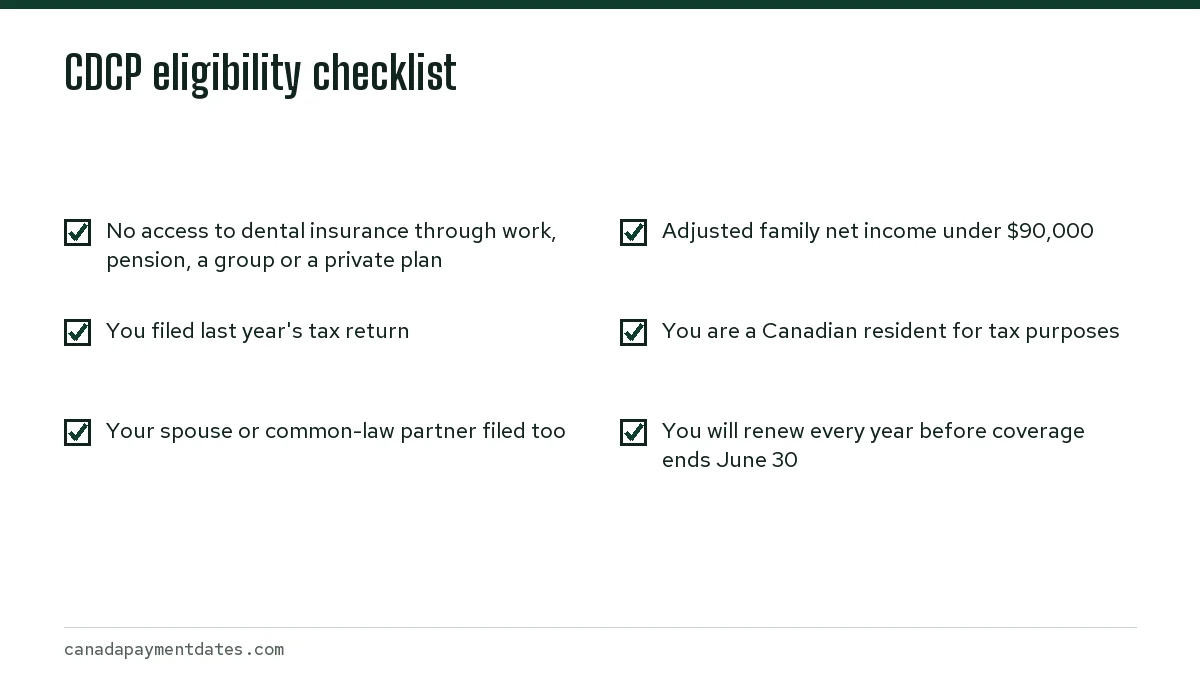
- No access to dental insurance. This includes coverage through your own or a family member's job or pension, a professional or student organization, a plan you or a family member buy, and health spending accounts that pay dental costs.
- Taxes filed. You, and your spouse or common-law partner if you have one, must have filed a return for the previous year so income can be assessed.
- Adjusted family net income under $90,000.
- Canadian resident for tax purposes, and the same for your spouse or partner.
Having access counts even if you chose not to use it. If your employer offers dental benefits and you declined them, you do not qualify. The only exception Service Canada lists is for retirees who opted out of dental coverage through their pension plan before December 11, 2023 and cannot opt back in. Opting out after that date does not make you eligible.
How do I tell if I have access to dental insurance?
Check your tax slips. Employers report dental access in box 45 of the T4 slip, and pension payers use box 015 of the T4A slip. Code 1 means no access to dental coverage; codes 2, 3, 4 or 5 mean some coverage is available to you or your family.
Seniors often lose workplace coverage when they retire but keep it through a pension plan, so the T4A code matters. If you are 60 to 64 and have left work, read can I get OAS before 65 as well, because the same retirement date affects when public pensions begin.
Read the video transcript
Canadian Dental Care Plan eligibility: the four rules and the $90,000 income limit
Canadian Dental Care Plan eligibility comes down to four rules: no access to private dental insurance, a filed tax return for you and any spouse or partner, adjusted family net income under $90,000, and Canadian residency for tax purposes.
Income limit: Adjusted family net income under $90,000.
No co-payment: Income under $70,000.
Co-payment $70,000 to $79,999: You pay 40%.
Check your tax slips. Employers report dental access in box 45 of the T4 slip, and pension payers use box 015 of the T4A slip.
Yes. Canada dental care plan renewal is required every year to confirm you still meet the rules, including that you still have no access to dental insurance.
As of September 2026, applications are open for the 2026-2027 benefit year.
What is the Canadian Dental Care Plan eligibility income limit?
The limit is adjusted family net income under $90,000. It is based on your net income (line 23600) plus your spouse's or partner's, with a few adjustments, taken from the previous year's returns.
| Step | Tax return lines |
|---|---|
| Start with family net income | Line 23600 for you and your spouse or partner |
| Subtract universal child care benefit income | Line 11700 |
| Subtract registered disability savings plan income | Line 12500 |
| Add back UCCB and RDSP amounts repaid | Lines 21300 and 23200 |
Worked example: a couple has net incomes of $52,000 and $36,500, a family total of $88,500. One partner received $1,200 of RDSP income on line 12500, so adjusted family net income is $87,300. They qualify, but in the top co-payment band.
How much do I pay at each income level?
Your share of each covered service depends on the same income figure (Canada.ca, CDCP coverage, updated August 27, 2026):
| Adjusted family net income | CDCP pays | You pay |
|---|---|---|
| Under $70,000 | 100% | 0% |
| $70,000 to $79,999 | 60% | 40% |
| $80,000 to $89,999 | 40% | 60% |
| $90,000 or more | Not eligible | Not eligible |
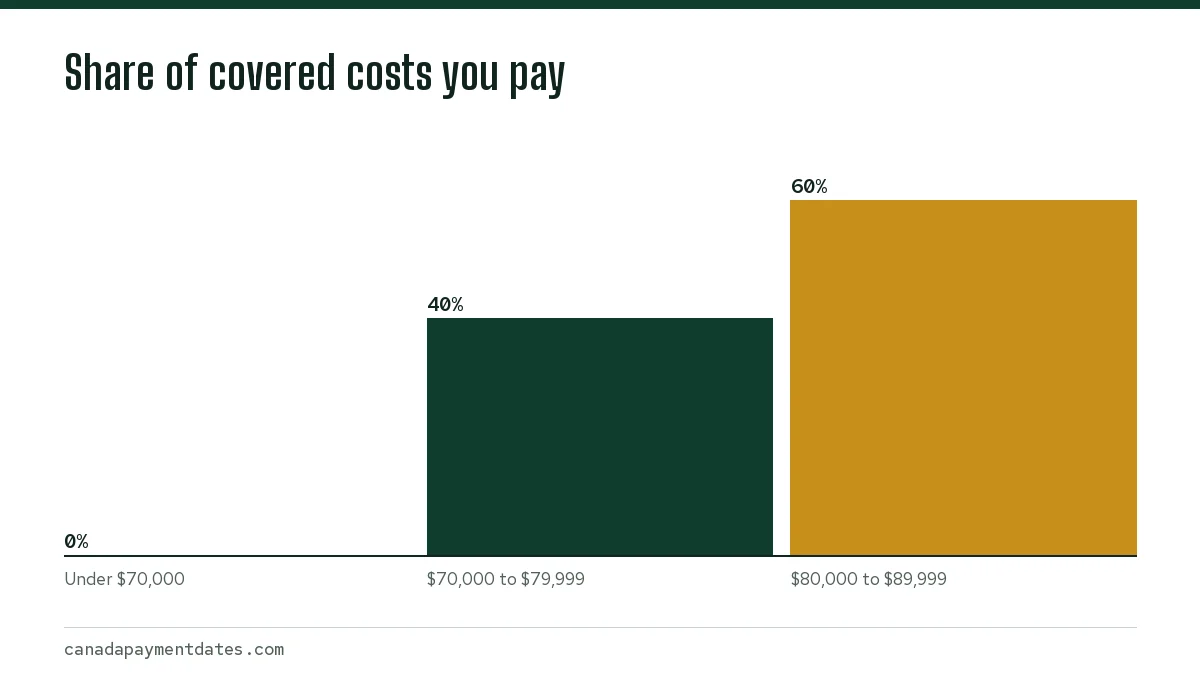
Because the bands have hard edges, $1 of income can change your share. At $69,999 you pay nothing on covered services; at $70,000 you pay 40%. Ask the dental office before treatment whether it will bill anything beyond what the plan pays.
Do I need to renew the Canada Dental Care Plan every year?
Yes. Canada dental care plan renewal is required every year to confirm you still meet the rules, including that you still have no access to dental insurance. Each benefit period ends on June 30.
- 2026 renewal: closed June 1, 2026.
- 2027-2028 renewal: opens in spring 2027, according to Service Canada. The exact opening date and deadline are not yet announced.
- How to renew: through My Service Canada Account or by phone with Service Canada.
- Missed the window: you can apply again, but care received during the gap before approval is not covered or reimbursed later.
Is the dental care plan a payment?
No. The CDCP is coverage, not a cash benefit, so it will never appear as a deposit or on a benefit payment calendar. Service Canada confirms eligibility, then shares your details with Sun Life, which mails a welcome package with a member card. Dental providers bill the plan directly.
You can book care only on or after the coverage start date in your Government of Canada letter. Some services, including crowns, partial dentures, immediate complete dentures and root canal re-treatment, need preauthorization before treatment. Most diagnostic, preventive and basic services do not.
That also means the CDCP is not listed in CRA My Account; it lives in My Service Canada Account. Our CRA My Account guide shows what the CRA side does hold, and the CRA benefits list covers every cash payment.
How do I apply if I qualify?
As of September 2026, applications are open for the 2026-2027 benefit year. You can apply online through My Service Canada Account, online through the Canada.ca application, or by phone with Service Canada. After applying you get a letter or email confirming whether you are enrolled.
- Confirm that you, and your spouse or partner, filed last year's tax return.
- Check T4 box 45 and T4A box 015 to confirm you have no dental coverage.
- Work out adjusted family net income and your co-payment band.
- Apply online or by phone, and wait for the enrolment letter.
- Wait for the Sun Life member card, then book care after your coverage start date.
Seniors weighing the CDCP alongside pension income should see benefits for seniors in Canada. And if you are catching up on unfiled returns to qualify, the same returns can release unpaid amounts from the Canada Carbon Rebate for 2021 to 2024.
Step by step
Confirm tax returns are filed
You and your spouse or partner need an assessed return for the previous year.
Check your tax slips
T4 box 45 or T4A box 015 code 1 means no dental access.
Work out your income band
Adjusted family net income under $70,000, $70,000 to $79,999 or $80,000 to $89,999.
Apply
Apply through My Service Canada Account, Canada.ca or by phone.
Renew each year
Renew when the window opens; the 2027-2028 renewal opens in spring 2027.
Common questions
What is the income limit for the Canadian Dental Care Plan?
Adjusted family net income must be under $90,000. Below $70,000 there is no co-payment; between $70,000 and $89,999 you pay 40% or 60% of covered costs.
Can I get the dental care plan if my spouse has dental insurance?
Not if that insurance is available to you. Access through a spouse's or partner's workplace, pension or private plan counts as access to dental coverage, even if you have not used it.
What happens if I miss the CDCP renewal?
Your coverage ends when the benefit period closes on June 30. You can apply again, but any dental care between the end of coverage and your new approval is not covered and is not reimbursed retroactively.
Does the Canada Dental Care Plan pay me money?
No. It pays dental providers directly for covered services. You receive a member card from Sun Life, not a deposit, and you may owe a co-payment depending on income.
Do I qualify if I declined my employer's dental plan?
No. Having access to employer dental coverage makes you ineligible even if you opted out. The only exception listed by Service Canada is for retirees who opted out of pension dental coverage before December 11, 2023 and cannot re-enrol.
Sources
- CDCP: Do you qualify canada.ca
- CDCP: What is covered canada.ca
- CDCP: Renew your coverage canada.ca
- CDCP: How to apply canada.ca
- CDCP: After you apply canada.ca
We check figures against these official pages. Rules change; confirm anything that affects a deadline or payment with the agency before you act.
Tell us what happened
Describe your situation and our editors will use it to improve this guide. If you leave your email, we may reply with a pointer to the right page or official contact. We never share your details.
Related guides
 CRA Benefits: Every Federal Benefit and When It Is Paid
CRA benefits are payments the Canada Revenue Agency works out from your tax return, mainly the Canada Child Benefit, the Canada G…
Canada Carbon Rebate: Ended in 2025, What Late Filers Get
The Canada Carbon Rebate is no longer paid: the federal government ended it for individuals on March 15, 2025, and the April 2025…
CRA My Account Benefits and Credits: Checking Your Payments
In CRA My Account, benefits and credits are on the Overview screen of your individual account: select Benefits and credits to see…
Can You Get OAS Before 65? Age Rules and Alternatives
Can I get OAS before 65? No. The Old Age Security pension cannot start before age 65, and there is no reduced early option like C…
Benefits for Seniors in Canada: Payments to Check at 65
The main benefits for seniors in Canada are the Canada Pension Plan (up to $1,507.65 a month at 65 in 2026), Old Age Security (up…