
Why is my OAS lower this month? Six reasons and how to confirm yours
Short answer
If you are asking why is my OAS lower this month, the answer is almost always a deduction, not a cut to the pension itself: Old Age Security (OAS) rates are indexed each quarter and never fall when prices drop. The usual causes are OAS recovery tax withholding that resets every July, a voluntary tax deduction, a smaller Guaranteed Income Supplement (GIS) or an overpayment being recovered.
- 01OAS maximum, October to December 2026 (ages 65 to 74)
- $762.50 per month
- 02OAS maximum, October to December 2026 (75 and over)
- $838.75 per month
- 03Recovery tax threshold, 2025 income
- $93,454 (15% of net income above it)
- 04Withholding period based on 2025 income
- July 2026 to June 2027
- 05Form to ask for less recovery tax withheld
- T1213(OAS)
- 06Can OAS rates go down with inflation?
- No, rates never fall when prices drop
Why is my OAS lower this month? The short answer
A lower Old Age Security deposit means something is being taken off your gross pension, or a benefit paid alongside it has shrunk. Service Canada adjusts OAS in January, April, July and October for the cost of living, and the rate does not go down if prices fall (Service Canada, OAS benefit amount). So a quarterly rate change can explain a small rise, never a drop.
The gross pension is the amount before deductions. The net payment is what reaches your bank account. When the net falls, compare the two figures before assuming a mistake. Most drops fall into one of the six causes below.
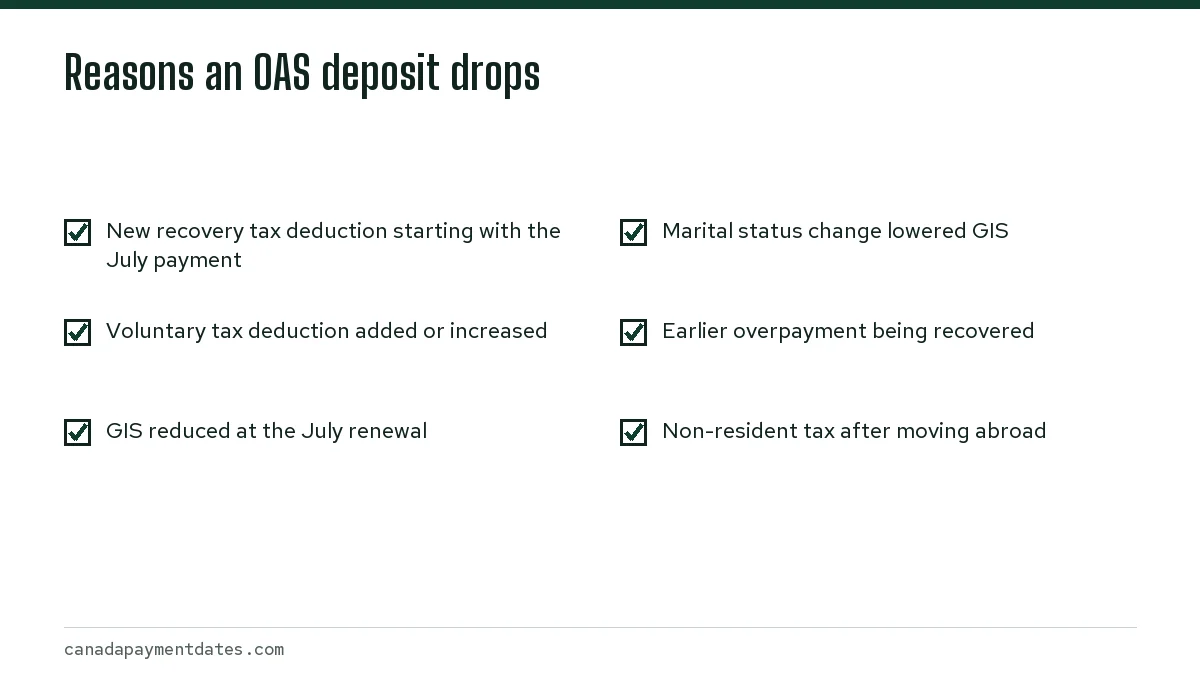
| Reason | When it usually shows up | Where to confirm it |
|---|---|---|
| OAS recovery tax withholding starts or grows | July payment | Advisory letter; payment details in My Service Canada Account |
| New or larger voluntary tax deduction | The month after you asked for it | Tax deductions screen in My Service Canada Account |
| GIS recalculated from last year's income | July payment, or after an income report | GIS renewal letter sent after the July review |
| Overpayment being recovered | Any month after an overpayment notice | Overpayment letter from Service Canada |
| Marital status change affecting GIS | Month after the change is processed | Service Canada decision letter |
| Partial pension based on residence | From the first payment | OAS approval letter (years counted out of 40) |
Why is my OAS reduced in July? Recovery tax withholding resets
July is the month most people ask why is my OAS reduced, because the OAS pension recovery tax (often called the clawback) is recalculated then. The recovery tax is 15% of your net world income above the annual threshold, and Service Canada spreads it over the 12 payments from July to the following June (Service Canada, OAS recovery tax).
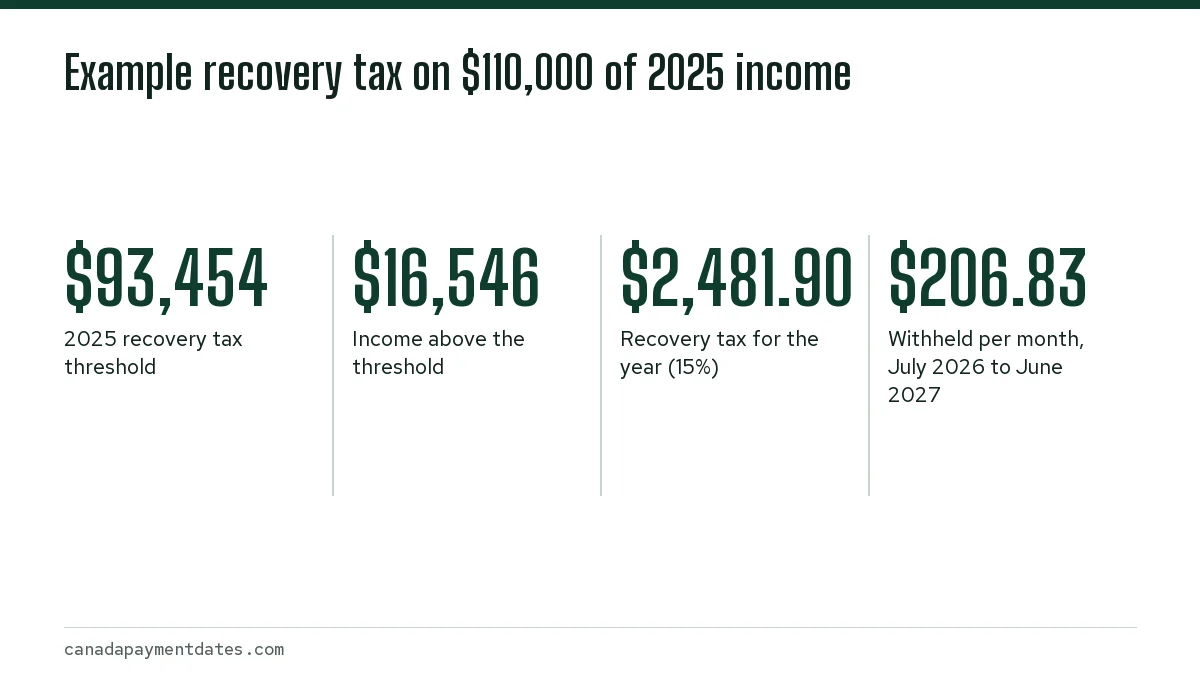
The withholding period and the income year are one year apart. Payments from July 2026 to June 2027 are based on your 2025 income, measured against the 2025 threshold of $93,454. If your 2025 income was higher than your 2024 income, the July 2026 deposit drops even though nothing else changed.
Worked example: how much the July withholding takes
Take a 70-year-old whose 2025 net income was $110,000. The amount over the threshold is $110,000 minus $93,454, or $16,546. Fifteen per cent of that is $2,481.90 for the year, which works out to about $206.83 withheld from each payment from July 2026 to June 2027. This is an illustration using the published threshold; your advisory letter shows the actual figure.
If your income has fallen sharply this year, for example because you stopped working, you can ask the Canada Revenue Agency (CRA) to cut the withholding with Form T1213(OAS), Request to Reduce Old Age Security Recovery Tax at Source (CRA, Form T1213(OAS)). The rules on thresholds and repayment ranges are covered in our OAS clawback guide.
Did a tax deduction change? Check your voluntary withholding
Income tax is not taken off OAS automatically. If you or someone helping you asked for monthly tax deductions, or raised the amount, the net deposit falls by that amount from the month the change takes effect (Service Canada, managing your taxes).
Voluntary deductions can be started, changed or stopped in My Service Canada Account, or on paper with the Request for Voluntary Federal Income Tax Deductions CPP/OAS (ISP-3520CPP). The same form covers the Canada Pension Plan (CPP) and OAS, so check which benefit the deduction was set up on if you filled it in recently.
Why is my OAS less this month when my GIS changed?
The Guaranteed Income Supplement is a separate benefit, but it is paid on the same dates as OAS, so many people see one combined deposit and read any GIS change as an OAS change. Service Canada reviews GIS every July using the income on your latest tax return and sends a letter saying whether payments continue, change or stop (Service Canada, GIS while receiving).
A higher income on your 2025 return, including CPP, private pensions or registered retirement income fund withdrawals, lowers GIS from July 2026. If you did not file your 2025 return, GIS may stop or be reduced. The current maximums are in our GIS amount page.
A change in marital status also changes GIS, because the benefit is based on combined income once you have a spouse or common-law partner. The single maximum for October to December 2026 is $1,138.90 a month, while the maximum for someone whose partner receives OAS is $685.56. See our guide to reporting a marital status change for how the two agencies handle it.
Is an overpayment being taken back from my OAS?
If Service Canada paid you more than you were entitled to in an earlier period, it can recover the excess by deducting it from future payments. This happens most often after a late report of a death, a move abroad or a change in income that affected GIS. Service Canada tells you about the overpayment by letter, and the amount recovered from your gross pension appears in your payment details.
If you think the overpayment decision is wrong, you can ask for a reconsideration within 90 days of the letter. Our benefit overpayment guide sets out both routes.
Why is my OAS so low compared with the maximum?
If your OAS has always been low, rather than lower this month, you are probably receiving a partial pension. A full pension needs 40 years of residence in Canada after age 18. With fewer years, you receive one-fortieth of the full pension for each year, provided you have at least 10 years (Service Canada, OAS eligibility).
Someone aged 65 to 74 with 25 qualifying years gets 25/40 of $762.50, or $476.56 a month for October to December 2026. That amount rises with indexation each quarter but the fraction does not change later. Our OAS residency requirements page explains how years are counted.
The reverse also happens: the pension rises by 10% automatically the month after your 75th birthday, which is why the 75-and-over maximum is $838.75 rather than $762.50. If you turned 75 recently and saw no increase, contact Service Canada.
How to check your OAS statement line by line
- Sign in to My Service Canada Account and open the Old Age Security section.
- Open the payment details for the lower month and the month before it.
- Compare the gross OAS amount. If it is unchanged, the drop is a deduction or a GIS change.
- Look for a recovery tax line, a federal income tax line and any overpayment recovery line.
- Check the GIS amount separately from the OAS amount.
- Match each new deduction to a letter you received: an advisory letter, a GIS renewal letter or an overpayment notice.
- If no deduction explains the drop, wait for the next payment date and then contact Service Canada, using the steps in our missing payment guide.
Compare against the published rates in our OAS payment amounts table. The October to December 2026 rates are 1.4% higher than in July to September and are first paid on October 28, so a lower October deposit comes from a deduction or a GIS change, not from the rate.
Common questions
Why did my OAS go down when inflation went up?
The OAS rate itself cannot go down. A lower deposit comes from a deduction such as recovery tax, income tax withholding or overpayment recovery, or from a smaller GIS paid on the same day.
Is OAS recovery tax taken from every payment?
Yes. When recovery tax applies, the yearly amount is split across the 12 payments from July to June. It only changes when a new income year is used each July or when the CRA approves a reduction.
How do I stop tax being taken off my OAS?
Voluntary income tax deductions can be stopped in My Service Canada Account or with form ISP-3520CPP. Recovery tax cannot be switched off, but you can ask the CRA to reduce it with Form T1213(OAS) if your income has dropped.
Why is my OAS different from my spouse's?
Each person's OAS depends on their own years of residence, age and income. One spouse may have a partial pension, be over 75, or have recovery tax withheld because their own net income is above the threshold.
Will a lower OAS payment be fixed automatically?
If the drop is recovery tax based on last year's income, it is corrected when you file your return and the CRA reassesses the withholding. If you think Service Canada made an error, you have 90 days from the decision letter to ask for a reconsideration.
Sources
- Old Age Security pension recovery tax canada.ca
- Old Age Security: How much you could receive canada.ca
- Old Age Security payment amounts canada.ca
- Form T1213(OAS), Request to Reduce Old Age Security Recovery Tax at Source canada.ca
- CPP and OAS: Managing your taxes canada.ca
- Guaranteed Income Supplement: Receive your benefits canada.ca
We check figures against these official pages. Rules change; confirm anything that affects a deadline or payment with the agency before you act.
Tell us what happened
Describe your situation and our editors will use it to improve this guide. If you leave your email, we may reply with a pointer to the right page or official contact. We never share your details.
Related guides
 Benefit Payment Not Received: What to Check and When to Call
If a benefit payment was not received, first wait out the official grace period: 5 working days for the Canada Child Benefit (CCB…