
GIS clawback: which income reduces the Guaranteed Income Supplement
Short answer
The GIS clawback is the way the Guaranteed Income Supplement shrinks as your other income rises. The basic GIS drops by $1 for every $2 of countable income, and a top-up portion shrinks faster at the bottom. CPP, workplace pensions, RRIF withdrawals and investment income count. OAS does not, and the first $5,000 of employment income is exempt.
- 01Basic GIS reduction
- $1 for every $2 of countable income
- 02Does OAS count?
- No
- 03Employment income exemption
- First $5,000, then 50% of the next $10,000
- 04GIS ends, single (Oct to Dec 2026)
- Annual income of $23,112 or more
- 05Income year used
- Previous calendar year, reassessed each July
How the GIS clawback works
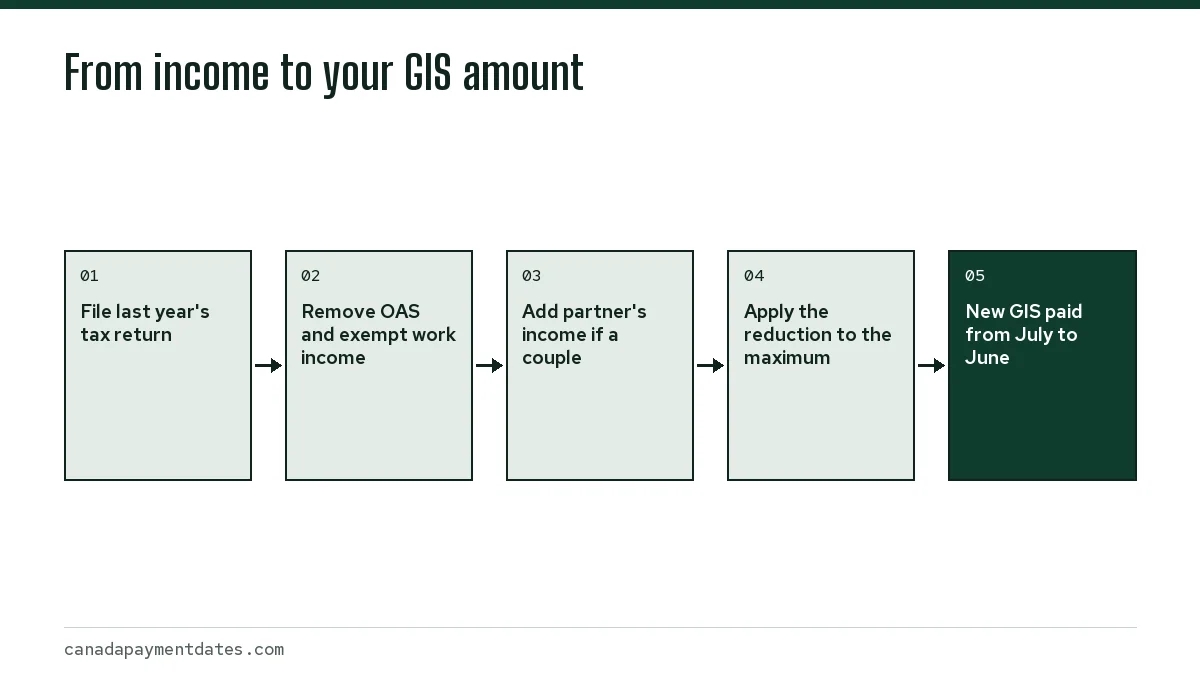
Unlike the OAS recovery tax, the GIS clawback is not a repayment on your tax return. It is built into the benefit itself: Service Canada takes your income from the previous year, applies the reduction, and sets your monthly GIS for July to June.
Federal program notes describe the gis clawback rate for the basic benefit as a reduction of $1 for every $2 of other income, a 50% rate. A separate top-up portion, added for the lowest-income seniors, is reduced faster over the first few thousand dollars. That is why the first dollars of CPP or pension income can cut GIS by more than half their value.
What counts as income for GIS
| Type of income | Counts toward the GIS income test? |
|---|---|
| OAS pension | No |
| GIS itself | No |
| CPP or QPP pensions | Yes |
| Workplace or private pensions | Yes |
| RRSP and RRIF withdrawals | Yes |
| Interest, dividends, rental income, capital gains | Yes |
| Employment and self-employment income | Yes, after the $5,000 and 50% exemptions |
| TFSA withdrawals | No |
For couples, the income of both partners is combined. The GIS clawback threshold, the income at which GIS stops, depends on your situation. For October to December 2026 it is $23,112 for a single, widowed or divorced pensioner and $30,528 of combined income when both partners receive the full OAS.
Does OAS affect GIS?
Receiving OAS does not reduce GIS. The pension is excluded from the income count, so a single pensioner can collect the full $762.50 OAS and still get up to $1,138.90 of GIS in the same month, if other income is low enough.
Delaying OAS is a different matter. GIS is not paid at all while OAS is deferred, so a low-income senior who postpones OAS to 70 gives up five years of GIS. For most people who expect to qualify for GIS, taking OAS at 65 is the better choice. Our OAS before 65 page explains the start-age rules.
CPP and GIS
CPP is the income that most often trims GIS. Every CPP dollar counts, and because CPP arrives every month, it reduces GIS every year for life.
The 2026 average CPP retirement pension at 65 was $877.01 a month, or $10,524.12 a year. For a single pensioner with no other income, that amount alone uses up almost half of the $23,112 income limit. The GIS left over is still worth claiming, but it will be well below the $1,138.90 maximum.
Working while on GIS
Employment and self-employment income get special treatment. The first $5,000 of earnings is ignored completely. On earnings between $5,000 and $15,000, only half is counted. Anything above $15,000 counts in full.
In practice, a pensioner earning $9,000 from part-time work has $5,000 excluded and half of the remaining $4,000 excluded, so only $2,000 is counted toward the GIS test.
Worked example: a single pensioner
Take a single 70-year-old whose 2025 income was made up of the following:
- CPP retirement pension: $10,524
- RRIF withdrawal: $4,000
- Part-time job: $9,000
- OAS pension: excluded, whatever the amount
Countable income is $10,524 + $4,000 + $2,000 from the job, or $16,524. That is under the $23,112 limit, so this person keeps some GIS from July 2026 to June 2027. For the exact monthly figure, enter the same numbers in Service Canada's benefits estimator, which applies the full rate tables including the top-up.
Now suppose the same person had withdrawn $12,000 from the RRIF instead of $4,000. Countable income would reach $24,524, above the limit, and GIS would stop for the whole July to June period. Spreading withdrawals over several years usually costs far less GIS than one large withdrawal.
What to do if your income drops
Because GIS uses last year's income, a pensioner who stopped working or lost a pension can be stuck with a low GIS for months. You can ask Service Canada to use an estimate of your current-year income instead.
- Get form ISP3026, the Statement of Income for the Renewal of the Guaranteed Income Supplement, the Allowance or the Allowance for the Survivor.
- Report the income you expect for this year and note the reason for the drop, such as retirement or the end of a pension.
- Send it to Service Canada, and keep proof of the change, such as a record of employment or a letter ending the pension, in case it is requested.
- File your tax return by April 30 each year so the next July reassessment uses accurate figures.
Payments continue on the regular OAS payment dates. For the current maximums by household type, see GIS amount, and for survivors aged 60 to 64, see the Allowance for the Survivor. New to the program? Start with what GIS is.
Common questions
Does CPP reduce GIS?
Yes. CPP counts in full as income for GIS, so every CPP dollar lowers the supplement. The basic GIS falls by $1 for every $2 of income, and the top-up portion falls faster.
Does OAS count as income for GIS?
No. The OAS pension is excluded from the GIS income test, so receiving OAS does not reduce your GIS.
Does working reduce GIS?
Only above $5,000 of earnings. Half of earnings between $5,000 and $15,000 is counted, and earnings above $15,000 count in full.
What is the GIS clawback threshold for a single person?
For October to December 2026, GIS stops when a single, widowed or divorced pensioner's annual income, not counting OAS, is $23,112 or more.
Do TFSA withdrawals affect GIS?
No. TFSA withdrawals are not taxable income and are not counted for GIS, which makes a TFSA a useful place for savings if you expect to receive GIS.
Sources
- Guaranteed Income Supplement overview canada.ca
- Old Age Security payment amounts canada.ca
- The Old Age Security program toolkit canada.ca
- Question Period Note: Guaranteed Income Supplement search.open.canada.ca
- Allowance: Apply (forms ISP3008 and ISP3026) canada.ca
We check figures against these official pages. Rules change; confirm anything that affects a deadline or payment with the agency before you act.
Tell us what happened
Describe your situation and our editors will use it to improve this guide. If you leave your email, we may reply with a pointer to the right page or official contact. We never share your details.
Related guides
 OAS Payment Dates: 2026 Schedule, GIS and Current Amounts
The next OAS payment date is Wednesday, October 28, 2026, the first at the higher October to December rates, followed by November…
Allowance for the Survivor: 2026 Amounts and Who Qualifies
The Allowance for the Survivor is a tax-free monthly payment for people aged 60 to 64 whose spouse or common-law partner has died…
CPP at 60: How Much Less You Get Than Waiting Until 65
Yes, you can start CPP at 60, but the pension is permanently 36% smaller than at 65, because it drops 0.6% for every month you st…