
CPP at 60: how much smaller the pension is, and when it pays off
Short answer
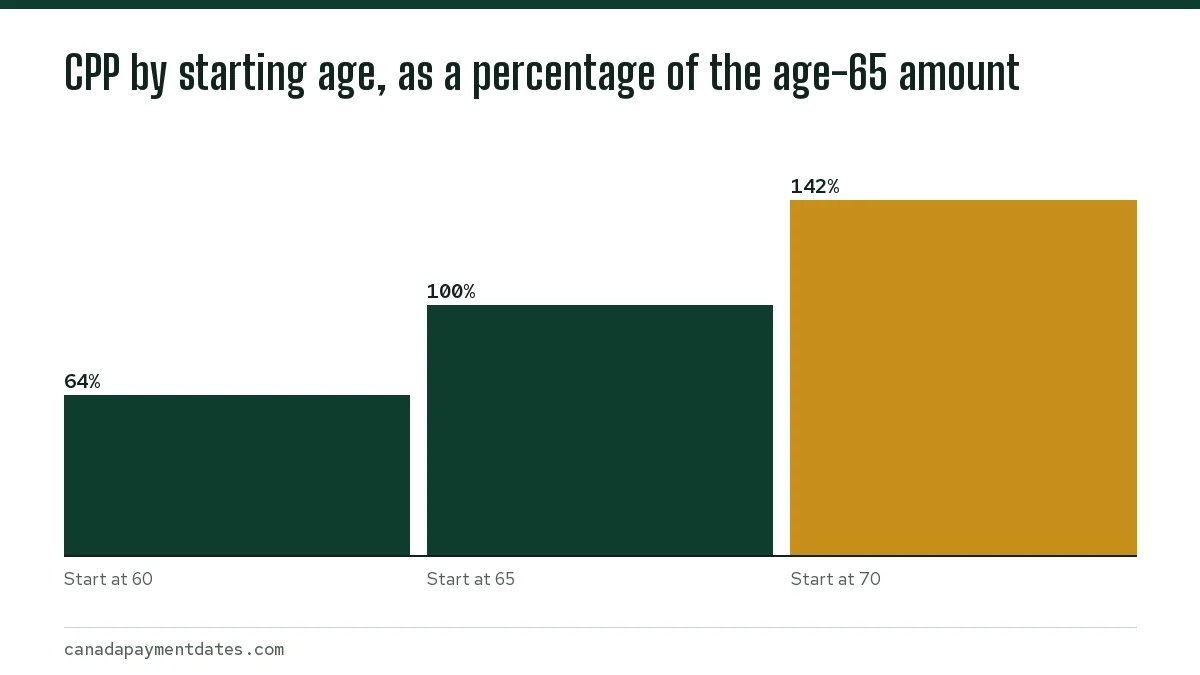
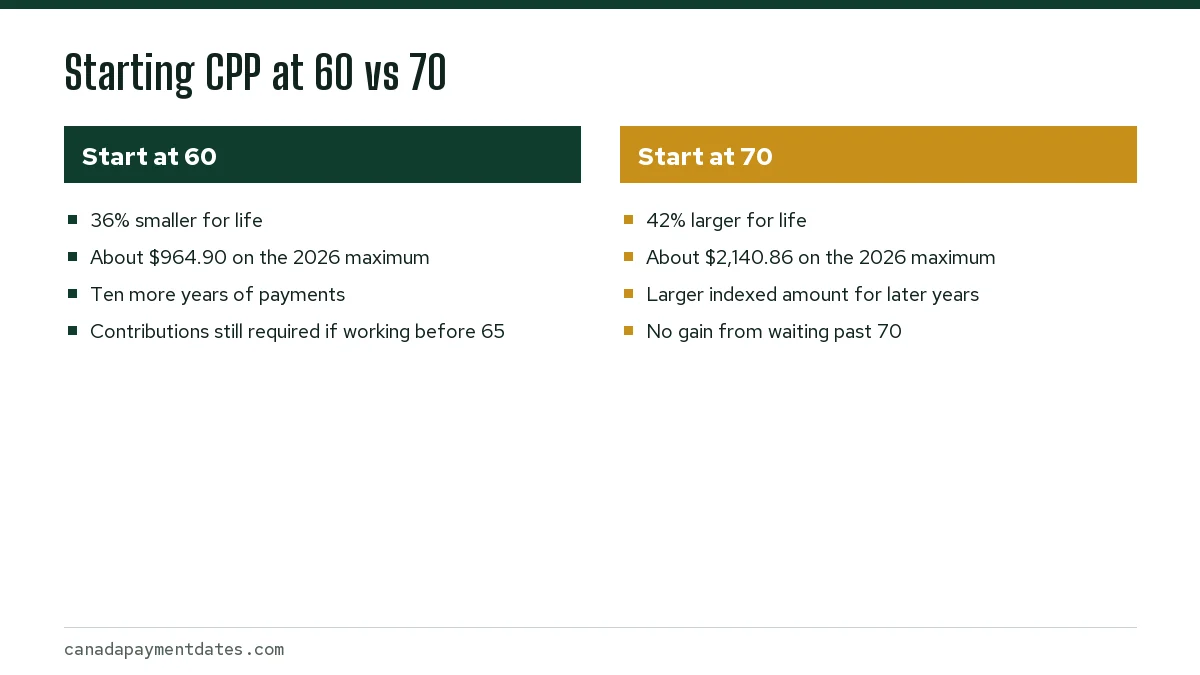
Yes, you can start CPP at 60, but the pension is permanently 36% smaller than at 65, because it drops 0.6% for every month you start early. Using the 2026 maximum, that is about $964.90 a month instead of $1,507.65. Waiting past 65 raises it by 0.7% a month, up to 42% more at 70. You can apply up to 12 months before your chosen start date.
- 01Reduction for starting at 60
- 36% (0.6% per month before 65)
- 02Increase for starting at 70
- 42% (0.7% per month after 65)
- 032026 maximum at 65, reduced to age 60
- About $964.90 a month
- 04Earliest and latest start
- Age 60 to age 70
- 05Apply up to
- 12 months before your start date
- 06Cancel up to
- 12 months after the first payment
Can I get CPP at 60?
Yes. The CPP retirement pension can start any month from age 60 to age 70, as long as you have made at least one valid contribution. Starting at 60 is a permanent choice: the reduction stays in place for life and does not disappear when you turn 65, unless you cancel the pension within 12 months of the first payment.
The rule is simple. For every month before your 65th birthday that the pension starts, it is cut by 0.6%, or 7.2% a year. Starting on the month after you turn 60 means the full 36% reduction.
How much is CPP at 60? A worked example
The table applies the official percentages to two 2026 reference points: the maximum pension at 65 of $1,507.65 and the average new pension at 65 in July 2026 of $858.34. Your own figure will differ, but the percentages are the same for everyone. Service Canada had not posted 2027 amounts as of October 22, 2026; when it does, the percentages below stay the same.
| Start age | Adjustment | On the $1,507.65 maximum | On the $858.34 average |
|---|---|---|---|
| 60 | -36% | $964.90 | $549.34 |
| 61 | -28.8% | $1,073.45 | $611.14 |
| 63 | -14.4% | $1,290.55 | $734.74 |
| 65 | none | $1,507.65 | $858.34 |
| 68 | +25.2% | $1,887.58 | $1,074.64 |
| 70 | +42% | $2,140.86 | $1,218.84 |
One caution about this table: it holds contributions constant. In real life, someone who stops working at 60 contributes nothing more, and someone who keeps working adds to their record. Your My Service Canada Account estimate shows the amount for each starting age based on your actual history.
Delaying CPP to 70: 0.7% a month
Each month you wait after 65 raises the pension by 0.7%, or 8.4% a year, to a maximum increase of 42% at 70. After 70 there is no further increase, so there is no reason to wait longer.
If you apply after 65 and did not mean to delay, you can ask for up to 11 months of retroactive payments, but never for a month before the one after your 65th birthday. There is no retroactive option for starting early: a pension meant to start at 60 has to be applied for in time. Details are on our CPP retroactive payments page.
Break-even ages: when waiting catches up
A break-even age is the point where the larger, later pension has paid out as much in total as the smaller, earlier one. The simple arithmetic below ignores inflation indexing, tax and investment returns, so treat it as a rough guide rather than advice.
| Comparison | Payments given up by waiting | Extra per month after | Approximate break-even age |
|---|---|---|---|
| 60 vs 65 | 60 months at 64% | 36% of the age-65 amount | About 74 |
| 65 vs 70 | 60 months at 100% | 42% of the age-65 amount | About 82 |
| 60 vs 70 | 120 months at 64% | 78% of the age-65 amount | About 78 |
Here is the first row worked out. Starting at 60 pays 0.64 of the age-65 amount for 60 months, a head start worth 38.4 months of full pension. Waiting gives 0.36 more each month from 65, so it takes about 107 months, just under nine years, to catch up.
Break-even is only one lens. Health, other savings, a spouse who may need a survivor's pension, and whether you still have earned income all matter. This page gives general information, not personal financial advice.
Taking your CPP retirement pension at 60 and still working
You can take CPP at 60 and keep working. Your pension is not reduced because of employment income.
- Under 65, you must keep making CPP contributions on your earnings.
- Between 65 and 70, contributions are optional. An employee who wants to stop gives the employer form CPT30, Election to Stop Contributing to the Canada Pension Plan, or Revocation of a Prior Election.
- Each year you contribute while receiving a pension earns a post-retirement benefit that is added to your payments the following year. In 2026 the maximum post-retirement benefit at 65 is $54.69 a month.
- Contributions stop for everyone at 70.
The CPP pension counts as taxable income, which matters if you are still earning a salary. Our is CPP taxable guide explains the T4A(P) slip and how to have tax withheld.
Who tends to consider CPP at 60
There is no single right answer, but some situations point one way or the other. These are common considerations, not rules.
- Starting early is more common when you have stopped working and need income, have serious health concerns, or have no other savings to bridge the years to 65.
- Waiting is more common when you are still earning, have savings to draw on, expect a long retirement, or want a larger inflation-indexed pension for a surviving spouse.
- Whenever you start, your spouse or common-law partner and children may later qualify for survivor and children's benefits, and your estate for the one-time CPP death benefit.
Whatever you choose, the pension arrives on the regular CPP payment dates near the end of each month.
How do I apply for CPP at 60?
- Pick the month you want payments to start. The earliest is the month after you turn 60, and there are no retroactive payments for a start before 65, so a late application means a later start.
- Apply up to 12 months before that month. Service Canada advises applying early so the pension starts on the date you chose.
- Apply online in My Service Canada Account, in the Canada Pension Plan section. Service Canada says to expect a decision by mail within 28 days.
- Or mail form ISP1000, Application for a Canada Pension Plan Retirement Pension. A paper application can take up to 120 days, and people applying from outside Canada must use paper.
Changing your mind after you start
Service Canada says you can cancel your CPP retirement pension up to 12 months after your first payment. The request is made by letter sent by mail, with your full name, Social Insurance Number, date of birth, mailing address and phone number, a clear statement that you want to cancel, the date payments began if you know it, and your signature and the date. Ask Service Canada what you would need to repay before you send it.
Common questions
How much is CPP reduced at 60?
By 36%. The pension drops 0.6% for each month before age 65, and starting at 60 means 60 months early.
Is the CPP reduction at 60 permanent?
Yes. The reduced amount is locked in for life, although it still rises each January with inflation indexing. Service Canada does let you cancel the pension up to 12 months after your first payment.
Is it better to take CPP at 60 or 70?
It depends on your health, other income and how long you expect to draw the pension. By simple arithmetic, starting at 70 overtakes starting at 60 in total payments at around age 78.
Can I take CPP at 62?
Yes. You can start in any month from 60 to 70. At 62, the reduction is 36 months times 0.6%, or 21.6%.
Do I have to stop working to take CPP at 60?
No. You can keep working, but you must continue paying CPP contributions until 65, and those contributions build a post-retirement benefit.
How far ahead should I apply for CPP at 60?
You can apply up to 12 months before your chosen start date. An online application through My Service Canada Account gets a decision by mail within 28 days; a paper application can take up to 120 days.
Can I cancel CPP after starting it at 60?
Yes, up to 12 months after your first payment, by sending Service Canada a letter by mail. After that window, the early start and its 36% reduction stay in place.
What happens to my CPP if I die before I start it?
If you die on or before your 70th birthday without having started your retirement pension, it cannot be paid to anyone else. If you die after 70 without applying, your estate can apply within one year of the death. Survivors may still qualify for survivor's, children's and death benefits.
Sources
- CPP retirement pension: when to start canada.ca
- CPP retirement pension: eligibility canada.ca
- CPP pensions and benefits monthly amounts canada.ca
- Form CPT30, Election to Stop Contributing to the CPP canada.ca
- CPP retirement pension: Apply canada.ca
- CPP: Receive your benefits (cancelling your pension) canada.ca
We check figures against these official pages. Rules change; confirm anything that affects a deadline or payment with the agency before you act.
Tell us what happened
Describe your situation and our editors will use it to improve this guide. If you leave your email, we may reply with a pointer to the right page or official contact. We never share your details.
Related guides
 CPP Payment Dates: Schedule, Amounts and Missing Payments
CPP payment dates in 2026 fall near the end of each month: January 28, February 25, March 27, April 28, May 27, June 26, July 29,…
Can I Get CPP Retroactively? How the 11-Month Rule Works
You can get the CPP retirement pension retroactively only if you apply after age 65. Service Canada can backdate the retirement p…
CPP Death Benefit: $2,500 Lump Sum, or $5,000 With Top-Up
The CPP death benefit, often called the $2,500 funeral benefit, is a one-time payment of $2,500 made after a Canada Pension Plan…
Is CPP Taxable? How CPP Is Taxed and When Tax Is Withheld
Yes, every Canada Pension Plan (CPP) benefit is taxable income in Canada, including the retirement pension and the disability, su…
CPP Survivor Benefit Amount in 2026 and How It Is Paid
The CPP survivor benefit amount in 2026 is up to $803.54 a month if you are under 65 and up to $904.59 if you are 65 or older. Av…