
CPP enhancement explained: what it adds to your pension and what CPP2 costs in 2026
Short answer
The CPP enhancement gradually raises the Canada Pension Plan retirement pension from one quarter to one third of your covered average work earnings, but only for work and contributions from 2019 on. It was phased in from 2019 to 2025 and includes CPP2, a 4% contribution on 2026 earnings between $74,600 and $85,000. If you stopped contributing before 2019, it does not change your pension.
- 01Replacement rate
- 25% rising to 33.33% of covered average earnings
- 02Counts work from
- January 1, 2019 onward
- 032026 earnings ceilings
- $74,600 (YMPE) and $85,000 (YAMPE)
- 04CPP2 rate, 2026
- 4% each for employees and employers; 8% self-employed
- 05Maximum CPP2, 2026
- $416 employee; $832 self-employed
What is the CPP enhancement?
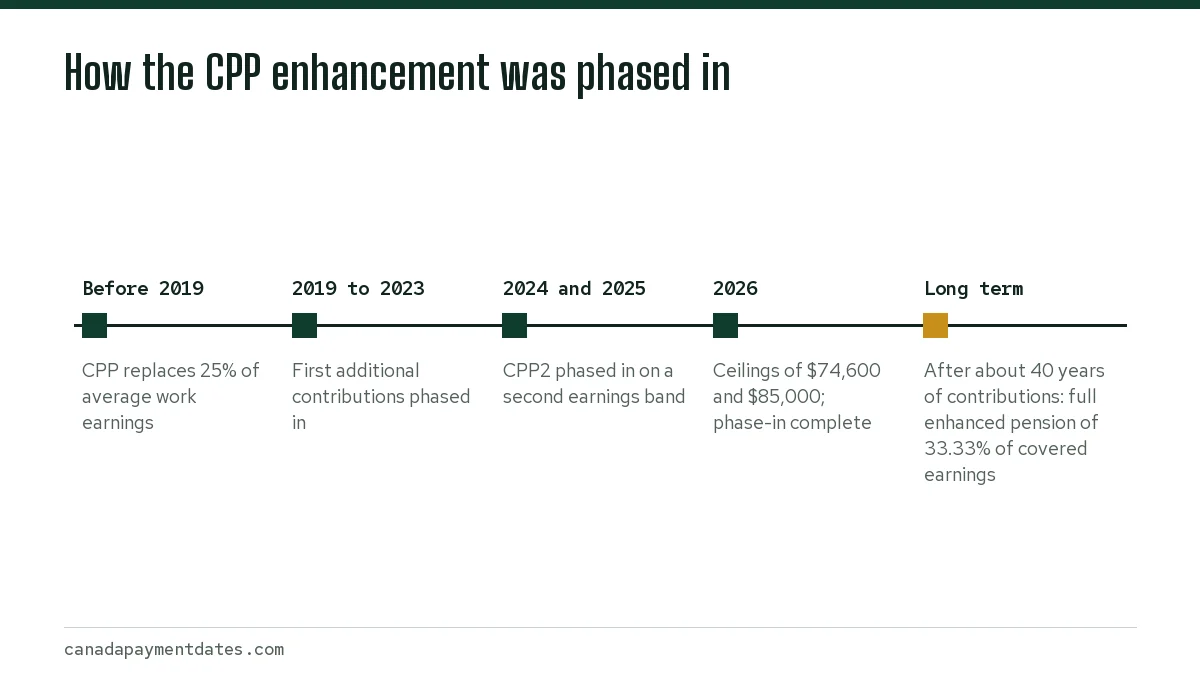
The CPP enhancement is the gradual expansion of the Canada Pension Plan that began on January 1, 2019. Before it, the CPP retirement pension replaced one quarter (25%) of your average work earnings. Under the enhancement it grows to replace one third (33.33%) of your covered average work earnings, and the maximum earnings the plan covers rose by 14% over 2024 and 2025.
It came in two parts. The first additional component was phased in between 2019 and 2023 on earnings up to the regular ceiling. The second additional component, known as CPP2, was phased in over 2024 and 2025 on a new band of earnings above that ceiling. Together, the contribution changes were phased in over seven years.
How much does the CPP enhancement add to your pension?
It depends on how much you earn and for how long you contribute to the enhanced CPP. The Government of Canada says the maximum pension rises by more than 50% for someone who makes enhanced contributions for 40 years. Most people retiring today have only a few years of enhanced contributions, so the extra amount in their pension is still small; the full effect arrives for people who start their careers under the enhanced plan.
This is also why the CPP maximum is no longer a simple figure. For a pension starting in 2026, the maximum at 65 is $1,507.65 a month, but Service Canada notes that maximum amounts change month by month as the enhancement matures. Your own estimate, which includes your enhanced contributions, is in My Service Canada Account; current averages are on the how much is CPP per month page.
| Your situation | Effect of the enhancement |
|---|---|
| Stopped working and contributing before 2019 | No change to your pension |
| Worked and contributed in 2019 or later, pension started after January 1, 2019 | Enhanced amount is included in your monthly pension |
| Receiving CPP and still working and contributing since 2019 | Post-retirement benefit is higher |
| CPP disability pension that started before 2019 | Not affected |
| CPP disability pension, contributions in 2019 or later | Higher, from 2019 |
| CPP survivor's pension | Higher only if the person who died contributed in 2019 or later |
What is CPP2 and when does it kick in?
Second additional CPP contributions, or CPP2, began on January 1, 2024. They apply only to earnings above the first ceiling, the Year's Maximum Pensionable Earnings (YMPE), up to the second ceiling, the Year's Additional Maximum Pensionable Earnings (YAMPE). In 2026 that band runs from $74,600 to $85,000, so CPP2 kicks in only once your pensionable earnings for the year pass $74,600. If you earn less than that, you pay no CPP2 at all.
| Contribution | Earnings it applies to | Employee and employer rate (each) | Employee maximum | Self-employed rate and maximum |
|---|---|---|---|---|
| Base and first additional | $3,500 to $74,600 | 5.95% | $4,230.45 | 11.90%, $8,460.90 |
| Second additional (CPP2) | $74,600 to $85,000 | 4.00% | $416.00 | 8.00%, $832.00 |
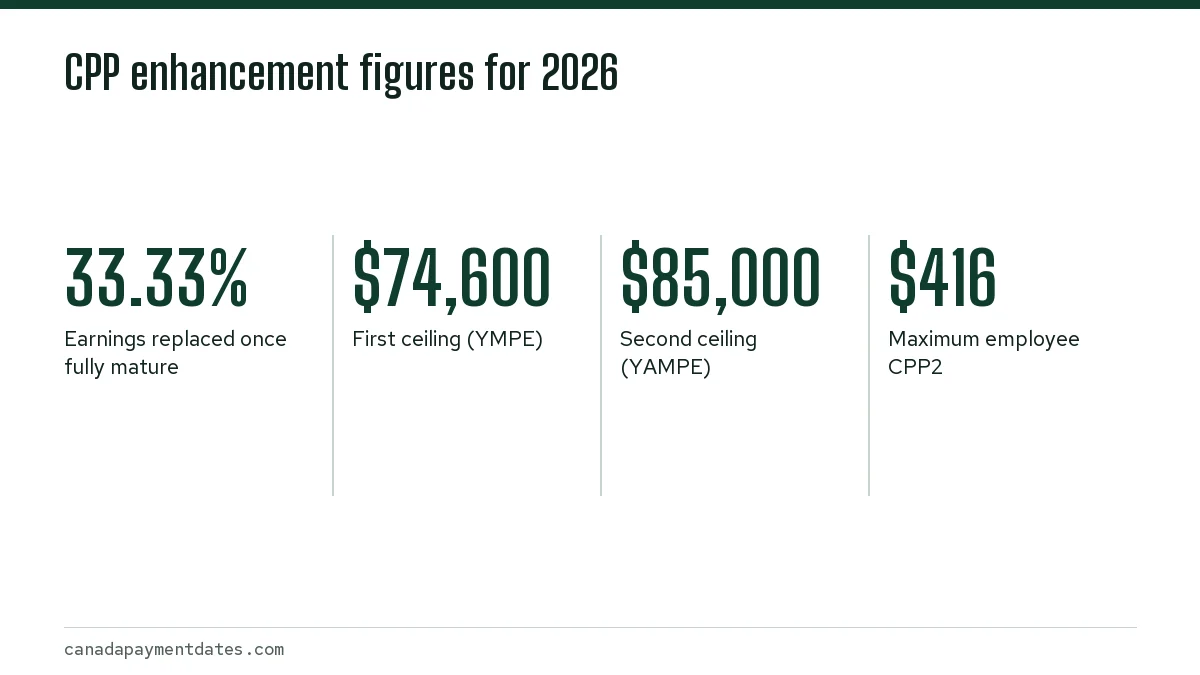
CPP2 maxes out when your 2026 earnings reach $85,000; earnings above that are not pensionable and no CPP2 is taken from them. Employers deduct it from pay automatically, and if you had two employers and paid too much in total, the excess is worked out when you file your return.
How are enhanced CPP contributions treated at tax time?
The CRA splits your contributions in two. You claim a non-refundable tax credit for the base portion, and a tax deduction for the enhanced portions, the first additional contribution and all CPP2. A deduction lowers your net income, which can also matter for income-tested benefits that use net income.
- Base contributions: a non-refundable tax credit; for employees it is claimed on line 30800.
- Enhanced contributions, including CPP2: a tax deduction; for employees it is entered on line 22215.
- Employer contributions: fully tax deductible for the employer.
- Self-employed people pay both halves; Schedule 8 splits their contributions into the credit part and the deduction part.
Quebec workers contribute to the Québec Pension Plan instead, which has its own additional plan: in 2026, combined employer and worker rates of 2% on earnings from $3,500 to $74,600 and 8% from $74,600 to $85,000. QPP pensions are paid by Retraite Québec on different days, listed on the QPP payment dates page.
What will the CPP enhancement look like in 2027?
The phase-in finished in 2025, so no further step-up in contribution rates is scheduled for 2027. What changes each year is the pair of ceilings. The 2027 YMPE and YAMPE had not been published as of October 20, 2026; they are usually announced in November. Since 2025 the second ceiling has been set about 14% above the first, which is how $74,600 became $85,000 for 2026.
Pensions already being paid are a separate question. The January 2027 indexation rate for every CPP benefit, enhanced or not, is still to be announced and is covered on the CPP increase 2027 page. Indexation moves the whole pension; the enhancement only adds to the part you earned through contributions from 2019 on.
Do you need to do anything to get the enhanced CPP?
No. There is no separate application. Contributions are taken from your pay or calculated on your return, and when you apply for your CPP retirement pension, Service Canada includes the enhanced amount automatically if you contributed in 2019 or later.
- Check your Statement of Contributions in My Service Canada Account to confirm your earnings for 2019 onward are recorded.
- If you are deciding when to start, remember that every year of work under the enhanced plan adds to the enhanced part of your pension; the CPP at 60 page compares starting ages.
- Payments follow the normal CPP payment dates; the enhancement does not change when you are paid.
Common questions
When did the CPP enhancement start?
On January 1, 2019. The first additional contributions were phased in from 2019 to 2023, and second additional contributions (CPP2) were phased in over 2024 and 2025.
How much is CPP2 in 2026?
CPP2 is 4% of earnings between $74,600 and $85,000 for employees, matched by employers, up to $416. Self-employed people pay 8%, up to $832.
When does CPP2 kick in?
Only once your pensionable earnings for the year pass the first ceiling, which is $74,600 in 2026. Earnings below that attract no CPP2.
Does the CPP enhancement help people who are already retired?
Only if they keep working and contributing in 2019 or later, through a higher post-retirement benefit. A pension based only on contributions made before 2019 is not changed by it.
Is CPP2 tax deductible?
Yes. The CRA says all CPP2 contributions are tax deductible, and the first additional contributions are deducted too. Only base contributions are claimed as a tax credit.
Sources
- CPP enhancement (Government of Canada) canada.ca
- CPP enhancement for employers and payroll (CRA) canada.ca
- Maximum benefit amounts and related figures, January to March 2026 canada.ca
- The CPP enhancement: what it means for you (CRA) canada.ca
We check figures against these official pages. Rules change; confirm anything that affects a deadline or payment with the agency before you act.
Tell us what happened
Describe your situation and our editors will use it to improve this guide. If you leave your email, we may reply with a pointer to the right page or official contact. We never share your details.
Related guides
 CPP Payment Dates: Schedule, Amounts and Missing Payments
CPP payment dates in 2026 fall near the end of each month: January 28, February 25, March 27, April 28, May 27, June 26, July 29,…
CPP at 60: How Much Less You Get Than Waiting Until 65
Yes, you can start CPP at 60, but the pension is permanently 36% smaller than at 65, because it drops 0.6% for every month you st…
Is CPP Taxable? How CPP Is Taxed and When Tax Is Withheld
Yes, every Canada Pension Plan (CPP) benefit is taxable income in Canada, including the retirement pension and the disability, su…
How Much Is CPP Disability per Month? 2026 Amounts
The Canada Pension Plan (CPP) disability benefit pays up to $1,741.20 a month in 2026, and new recipients receive $1,234.68 on av…