
CPP death benefit: how much it pays and who gets it
Short answer
The CPP death benefit, often called the $2,500 funeral benefit, is a one-time payment of $2,500 made after a Canada Pension Plan contributor dies. For deaths on or after January 1, 2025, an extra $2,500 top-up is paid when the person never received a CPP retirement pension or disability benefit and leaves no spouse or partner eligible for a survivor's pension, for a maximum of $5,000. The executor applies first, and the payment is taxable.
- 01Basic amount
- $2,500, paid once
- 02Top-up (deaths from Jan 1, 2025)
- $2,500 more, maximum $5,000
- 03Quebec (QPP) death benefit
- Up to $2,500, from Retraite Québec
- 04Paper form
- ISP1200, Application for a CPP Death Benefit
- 05Executor should apply within
- 60 days of the death
- 06Typical processing time
- 6 to 12 weeks
How much is the CPP death benefit?
The CPP death benefit is a single lump-sum payment of $2,500, not a monthly pension. Service Canada pays it once per deceased contributor, to one applicant.
For deaths on or after January 1, 2025, a $2,500 top-up can be added, which brings the maximum to $5,000. Service Canada's payment amounts table shows an average of $2,620.72 for new death benefits in July 2026, above the $2,500 basic amount, which reflects the top-up being paid on some claims.
| Situation of the deceased | Basic | Top-up | Total |
|---|---|---|---|
| Had received a CPP retirement pension, disability benefit or post-retirement disability benefit | $2,500 | None | $2,500 |
| Never received any of those, but a spouse or partner is eligible for a survivor's pension | $2,500 | None | $2,500 |
| Never received any of those, and no spouse or partner is eligible for a survivor's pension | $2,500 | $2,500 | $5,000 |
Who qualifies for the CPP death benefit amount
The person who died must have contributed enough to the CPP. Service Canada requires contributions in at least one-third of the calendar years in their contributory period (and never fewer than three years), or in 10 calendar years. Contributions to the CPP and the Quebec Pension Plan are counted together, and the amount can be lower if a social security agreement with another country was needed to meet this rule.
Extra conditions for the $2,500 top-up
- The death happened on or after January 1, 2025.
- The deceased qualified for the basic death benefit.
- The deceased never received a CPP disability benefit, post-retirement disability benefit or retirement pension.
- No surviving spouse or common-law partner is eligible for a CPP survivor's pension.
In practice, the top-up is aimed at people who died before drawing any CPP income and left nobody to collect a survivor's pension, such as a single worker in their fifties. Someone who was already collecting CPP at 60 or later does not trigger it.
Who can apply, and in what order
Only one person or organization receives the benefit. Service Canada follows a fixed order of priority.
- The executor or administrator named for the estate. Service Canada asks the executor to apply within 60 days of the date of death.
- If there is no estate, the person or institution that paid, or is responsible for paying, the funeral expenses.
- Next, the surviving spouse or common-law partner.
- Finally, the next of kin of the deceased.
What if the person contributed to the Quebec Pension Plan?
Service Canada refers Quebec cases to Retraite Québec, which pays the Quebec Pension Plan (QPP) death benefit. It follows different rules from the CPP benefit:
- It is a maximum of $2,500 and reimburses eligible funeral expenses on proof of payment, rather than paying a flat amount.
- For the first 60 days after the death, the person or charitable organization that paid the funeral has priority if it applies with proof of payment.
- If the funeral cost less than $2,500, the difference can go to heirs who have not renounced the estate and have applied.
- Flowers, the reception after the funeral and prearranged funeral contracts paid by the deceased are not reimbursed.
- Retraite Québec lists no top-up like the CPP's extra $2,500, and the amount is taxable in the income of the estate, whoever the cheque is made out to.
CPP death benefit application: how and when it is paid
You can apply online through My Service Canada Account using the CPP death benefit form, or on paper with form ISP1200, Application for a Canada Pension Plan Death Benefit, mailed to Service Canada. Apply as soon as you can after the death rather than waiting for the estate to settle.
Service Canada says payment usually arrives six to 12 weeks after it receives a complete application. It is paid as a one-time deposit or cheque, not on the regular monthly CPP payment dates. If more than 12 weeks have passed, contact the CPP to check the status of the application.
What to gather before you apply
- The deceased's Social Insurance Number and date of death
- Proof of death, such as the funeral director's statement or a death certificate
- Your own identification and your relationship to the deceased
- Proof that you are the executor, or receipts showing you paid the funeral, if applicable
- Your banking details for direct deposit
Service Canada says supporting documents are optional unless it asks for them, and copies are generally accepted. On a paper application, write both the deceased's and your own Social Insurance Number on every document. A trustee, guardian or other legal representative can apply in person, by mail or by phone, but not online.
If a spouse, partner or child may also qualify for survivor's or children's benefits, the same visit to Service Canada is a good time to ask about them. Those are separate applications.
Is the CPP death benefit taxable
Yes. The death benefit is taxable, but it is not reported on the deceased person's final return. Who reports it depends on who received it.
- If the estate received it and files a T3 Trust Income Tax and Information Return, the amount is reported on the T3.
- If a beneficiary such as a spouse received it and no T3 is filed, that person reports it on line 13000 of their own return.
- The amount appears in box 18 of the T4A(P) slip issued for the benefit.
If no tax is taken off the payment, a spouse who is already in a higher bracket should set aside part of it for filing time. For wider rules on CPP income and withholding, see is CPP taxable.
Other benefits to check after a death
The death benefit is only one of the payments that can follow a CPP contributor's death. The checklist below covers the steps families most often miss.
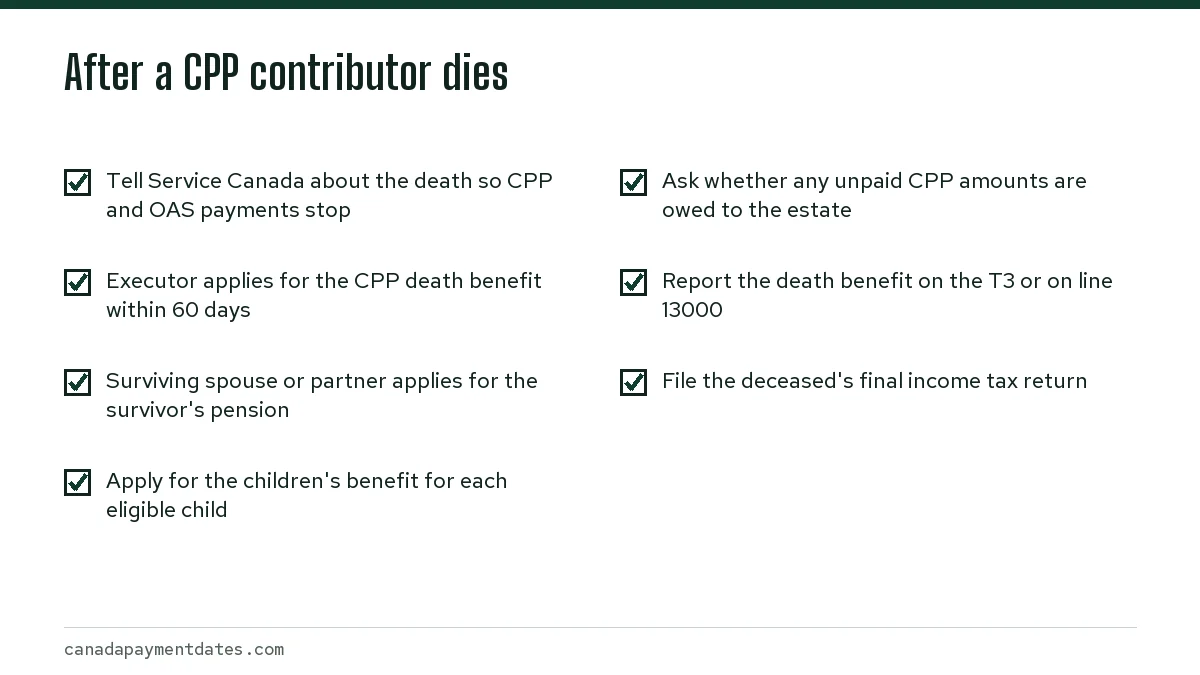
A surviving spouse or partner may qualify for a monthly survivor's pension of up to $803.54 (under 65) or $904.59 (65 and over) in 2026. Read CPP survivor benefit for how that amount is worked out. A survivor aged 60 to 64 with low income may also qualify for the Allowance for the Survivor.
If the deceased had not yet applied for a CPP pension they were entitled to, ask Service Canada whether any unpaid amounts are owed to the estate. Our page on CPP retroactive payments explains the back-pay limits that apply.
Common questions
How much is the CPP death benefit in 2026?
The basic CPP death benefit is $2,500. If the death happened on or after January 1, 2025, the deceased never received a CPP retirement pension or disability benefit, and no spouse or partner qualifies for a survivor's pension, a $2,500 top-up brings it to $5,000.
Does everyone get the $2,500 death benefit?
No. The person who died must have paid into the CPP in at least one-third of the calendar years in their contributory period (minimum three years) or in 10 calendar years, and someone must apply. Only one payment is made per death, and the amount can be lower when a social security agreement was needed to qualify.
Is the $2,500 funeral benefit the same as the CPP death benefit?
Most people who search for a $2,500 funeral benefit mean the CPP death benefit. It is a flat amount that does not depend on what the funeral cost. In Quebec, the QPP death benefit from Retraite Québec works differently: it reimburses funeral expenses up to $2,500 on proof of payment.
Is the CPP death benefit automatic?
No. Someone must apply, either online in My Service Canada Account or with form ISP1200. Service Canada does not pay it on its own after being told about the death.
Who gets the CPP death benefit if there is no will?
If there is no estate, it goes first to whoever paid or is responsible for the funeral, then to the surviving spouse or common-law partner, then to the next of kin.
Is the CPP death benefit reported on the final tax return?
No. It is reported on the estate's T3 return, or on line 13000 of the beneficiary's own return if no T3 is filed.
How long does the CPP death benefit take to arrive?
Service Canada says to expect it about six to 12 weeks after it receives a complete application.
Does the CPP death benefit cover funeral costs?
It is not tied to actual funeral costs and is paid the same flat amount regardless of what the funeral cost. Many families use it toward funeral bills, but it can be spent on anything.
How much is a widow's pension in Canada?
The CPP survivor's pension for a surviving spouse or common-law partner pays up to $803.54 a month under age 65 and up to $904.59 at 65 and over in 2026. New survivors in July 2026 received an average of $555.70 (under 65) and $336.91 (65 and over) a month. Service Canada had not posted 2027 amounts as of October 22, 2026.
Sources
- CPP death benefit canada.ca
- CPP: Pensions and benefits monthly amounts canada.ca
- CRA: Line 11400, CPP or QPP benefits canada.ca
- CRA: T4A(P) Statement of Canada Pension Plan Benefits canada.ca
We check figures against these official pages. Rules change; confirm anything that affects a deadline or payment with the agency before you act.
Tell us what happened
Describe your situation and our editors will use it to improve this guide. If you leave your email, we may reply with a pointer to the right page or official contact. We never share your details.
Related guides
 CPP Payment Dates: Schedule, Amounts and Missing Payments
CPP payment dates in 2026 fall near the end of each month: January 28, February 25, March 27, April 28, May 27, June 26, July 29,…
CPP at 60: How Much Less You Get Than Waiting Until 65
Yes, you can start CPP at 60, but the pension is permanently 36% smaller than at 65, because it drops 0.6% for every month you st…
Can I Get CPP Retroactively? How the 11-Month Rule Works
You can get the CPP retirement pension retroactively only if you apply after age 65. Service Canada can backdate the retirement p…
Is CPP Taxable? How CPP Is Taxed and When Tax Is Withheld
Yes, every Canada Pension Plan (CPP) benefit is taxable income in Canada, including the retirement pension and the disability, su…