
EI payment dates in 2026: how your biweekly report sets the day you are paid
Short answer
EI payment dates are not fixed. Employment Insurance is paid only after Service Canada processes your biweekly report, and with direct deposit the money arrives 2 business days later. Your first payment usually comes about 28 days after you apply, if you are eligible, and the first week of a claim is an unpaid waiting period. Service Canada tells you when each next report is due.
- 01Fixed EI payment calendar
- None; payments follow your reports
- 02Deposit after a processed report
- 2 business days (direct deposit)
- 03First payment
- About 28 days after you apply, if eligible
- 04Waiting period
- 1 unpaid week
- 05Maximum weekly benefit, 2026
- $729
Does EI have fixed payment dates in 2026?
No. Unlike CPP, OAS or the Canada Child Benefit, Employment Insurance (EI) has no published list of payment dates for 2026. Service Canada issues EI payments only after your reports have been processed, so the day money reaches you depends on when you report and when that report is processed. Two people on EI can be paid on different days of the same week.
That is why EI does not appear on the Government of Canada benefits calendar, and why the Service Canada payment dates for pensions and the Canada Disability Benefit do not apply to it. What you can predict is the rhythm: one report every 2 weeks, and a deposit shortly after each report clears.
| Step | What Service Canada says | Effect on your payment date |
|---|---|---|
| Application | First payment about 28 days after you apply, if eligible and all information is provided | Sets when payments can start |
| Waiting period | 1 week of the claim is not paid | Your first week of benefits is never deposited |
| Biweekly report | Due every 2 weeks; you are told when the next one is due | No report, no payment for those weeks |
| Processing | Payments are issued only after reports are processed | The 2-business-day count starts when processing is done |
| Direct deposit | Paid into your account 2 business days after the report is processed | Weekends and holidays are not business days |
When will I get my first EI payment?
Service Canada says you will receive your first payment about 28 days after you apply, if you are eligible and have provided all the required information. Its service standard is a decision within 28 days of filing, a standard it aims to meet 80% of the time, so some claims take longer.
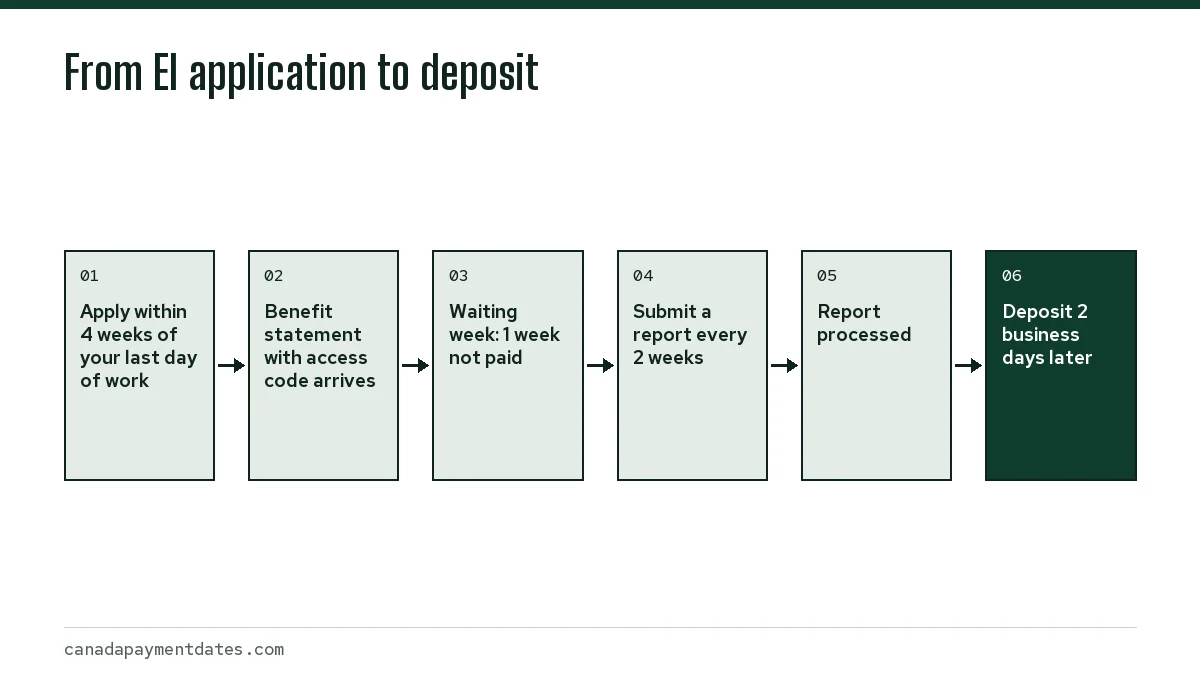
Two rules shape that first deposit. There is a 1-week waiting period at the start of every claim, which works like a deductible and is never paid. And timing matters before you apply: Service Canada warns that if you apply more than 4 weeks after your last day of work, you may lose benefits. Service Canada asks you to submit your online application right away; it needs a record of employment from each employer, but required documents can be sent after you apply.
Shortly after you apply, a benefit statement arrives by mail with a four-digit access code. You need that code and your social insurance number for every report, so keep it somewhere safe and never share it.
How do biweekly reports control your EI payment dates?
Regular, sickness and fishing claimants must submit reports every 2 weeks for as long as they receive benefits. Each report covers a two-week period, and once you submit it, Service Canada tells you when the next one is due. You have 3 weeks from that date to send it, but a late report means a late payment.
- Online: the Internet Reporting Service at canada.ca/EI-internet-reporting.
- By phone: the Telephone Reporting Service at 1 800 531-7555.
- Report dates: sign in to My Service Canada Account to see when your reports are due.
- Earnings: report any work or money you earned in the period; not reporting it can create an overpayment you must repay.
If you report on the first day a report is due and it is processed without questions, your payment follows a steady two-week cycle. People who report a few days late see their EI payment dates drift by the same number of days, or more.
How long after my report is EI deposited?
With direct deposit, Service Canada says your payment goes into your bank account 2 business days after it processes your EI report. Business days exclude Saturdays, Sundays and statutory holidays, so a report processed just before a weekend or a long weekend takes longer to appear.
| Report processed on | 2 business days later | Why |
|---|---|---|
| Monday | Wednesday | Ordinary week |
| Thursday | Monday | Saturday and Sunday are skipped |
| Friday, December 18, 2026 | Tuesday, December 22, 2026 | Weekend skipped |
| Friday, October 9, 2026 | Wednesday, October 14, 2026 | The weekend and Thanksgiving Monday, October 12, are skipped |
The dated examples assume the report is processed on that day; the processing date itself is not something you control. The 2-business-day timing applies to direct deposit only, and Service Canada does not publish a timing for payments by mail, so sign up for direct deposit through My Service Canada Account if you have not already. How banks post government deposits in general is covered on the CRA direct deposit time page.
Why didn't I get my EI payment?
When an expected EI deposit does not show up, the cause is almost always one of the steps above rather than a lost payment. Check these in order.
- Did you submit the report? Payments for a period are issued only after its report is submitted and processed.
- Has it been 2 business days since the report was processed? Count weekends and holidays out.
- Is this the waiting week? The first week of every claim is unpaid.
- Is your first payment still within about 28 days of your application?
- Did you change banks? Update your direct deposit information in My Service Canada Account.
If none of these explains it, sign in to My Service Canada Account to check your claim information and report dates, then contact Service Canada. For other federal payments that have not arrived, the benefit payment not received checklist lists each program's waiting period.
How much is EI in 2026, and what changes in 2027?
For most people the basic EI rate is 55% of average insurable weekly earnings. As of January 1, 2026, the maximum yearly insurable earnings are $68,900, which means a maximum of $729 a week. EI benefits are taxable, and federal and provincial or territorial tax is deducted from payments where it applies.
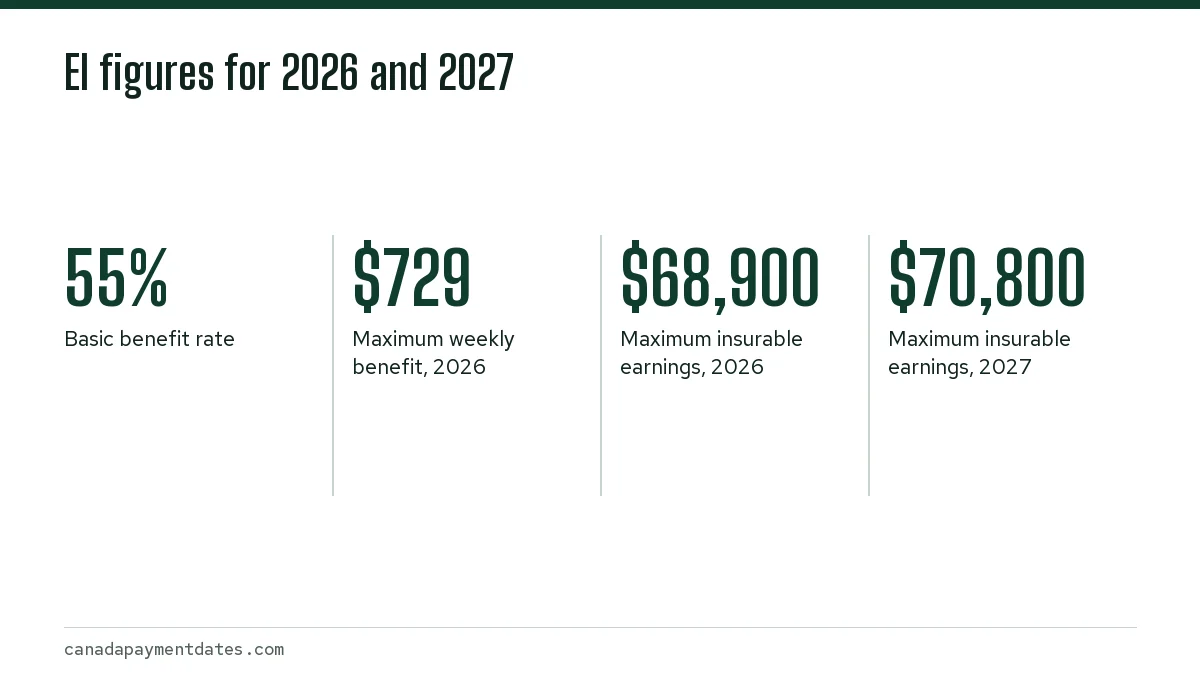
On September 14, 2026, the Canada Employment Insurance Commission confirmed that maximum insurable earnings rise to $70,800 in 2027, and that the 2027 premium rate is $1.64 per $100 of insurable earnings for employees, or $1.29 for employees in Quebec. Service Canada had not yet posted the 2027 maximum weekly benefit as of October 20, 2026. None of this changes how EI payment dates work: in 2027 you will still be paid after each processed report.
Common questions
Is EI paid every two weeks?
Yes, in practice. You report every 2 weeks and Service Canada pays the weeks you reported once the report is processed, so payments usually arrive every two weeks.
Does EI pay on statutory holidays?
Payments are timed in business days, and statutory holidays are not business days. A report processed just before a holiday or a weekend is deposited later than one processed mid-week.
What day of the week is EI deposited?
There is no fixed day. With direct deposit, the money arrives 2 business days after Service Canada processes your report, so your deposit day depends on when you report.
Why is my first EI payment taking so long?
The first payment usually comes about 28 days after you apply, and the first week of the claim is an unpaid waiting period. A claim that is missing required information can take longer.
Where can I see my EI report and payment dates?
Sign in to My Service Canada Account. It shows when your reports are due, and you can also find report dates through the Internet Reporting Service.
Sources
- EI regular benefits: after you apply (Government of Canada) canada.ca
- EI regular benefits: apply (Government of Canada) canada.ca
- Employment Insurance benefit statement (Government of Canada) canada.ca
- EI regular benefits: how much you could receive (Government of Canada) canada.ca
- Canada Employment Insurance Commission confirms 2027 EI premium rate canada.ca
We check figures against these official pages. Rules change; confirm anything that affects a deadline or payment with the agency before you act.
Tell us what happened
Describe your situation and our editors will use it to improve this guide. If you leave your email, we may reply with a pointer to the right page or official contact. We never share your details.
Related guides
 Benefit Payment Not Received: What to Check and When to Call
If a benefit payment was not received, first wait out the official grace period: 5 working days for the Canada Child Benefit (CCB…
Benefit Payments on Long Weekends and Holidays in Canada
When a benefit payment date lands on a weekend or statutory holiday, the payment goes out on the last business day before it, so…
CRA Payment Dates: Every Benefit Payment Date in One Place
CRA payment dates in 2026: the Canada Child Benefit arrives around the 20th of each month (December 11), the Ontario Trillium Ben…
CRA Payment Dates 2027: What Is Published and What Is Not
CRA payment dates for 2027 are not yet announced. As of October 20, 2026, Canada.ca's payment calendars list only 2026 dates for…